Why the world's leading neuroscientist thinks "deep learning is rubbish," what Gary Marcus is really allergic to, and why Yann...
The future of Web 3.0 that we all envision, essentially the Economy of Everything, must be on a common network. Websites will evolve to include web worlds networked with nested entities of people, places, and things, both real and virtual. All of this will be searchable and accessible through AI. Our daily lives will be augmented with shared data between these two realms, physical and digital.
Anything that wants to be recognized will have to be included in this network.
VERSES AI is building the foundation technology to enable this network.
In 1990, Sir Tim Berners-Lee combined the coding language HTML with an innovative new protocol, HTTP to connect “hyperlinked” pages for the foundation of the World Wide Web, which became a global, accessible digital library of information.
Throughout 2021, VC’s invested $33 Billion in Crypto and Blockchain startups. Currently, 2022 is on pace to nearly double that. Cointelegraph research recently reported Web3 as the most sought-after investment sector of 2022, including Cryptography, Web3, NFTs, Wallets, Metaverses, Gaming, deFi, Media, Communities, and DAOs.
These technologies along with humans, machines, content, data, assets, locations, buildings, factories, workflows, imagination, and the context of real-time interaction across every one of them, THIS is the Web 3.0 of the future.
Every protocol, platform, interaction, messaging, data distribution, 1st Layer, 2nd Layer, developer API and Language aspect of Web3 that is in development today needs to be thinking about this transition to the Spatial Web.
As Dan Mapes of VERSES and The Spatial Web Foundation points out, in regard to today’s Web 2.0, “The internet is one network of 50 billion computers and 10 billion webpages — you are either on this or you are not.”
Just as critical as the searchability of websites, information, and content has been to the World Wide Web of these past 32 years, the same will be true of the Spatial Web.
If you, as a company, project, individual, are not included in this all-inclusive new Network of Everything, you will be invisible in Web 3.0 and unknowable to the world.
Special thanks to Dan Mapes, President and Co-Founder, VERSES AI, and Director of The Spatial Web Foundation. If you’d like to know more about The Spatial Web, I highly recommend a helpful introductory book written by Dan and his VERSES Co-Founder, Gabriel Rene, titled, “The Spatial Web,” with a dedication “to all future generations.”
++ This is Part 4 of a four part series titled, “The Spatial Web is Coming… Is Web 3.0 Ready?”
Missed the beginning… Read Part 1 here.
All content on this site is independently created by Denise Holt. If you enjoy this content, please consider supporting my efforts at patreon.com/SpatialWebAI

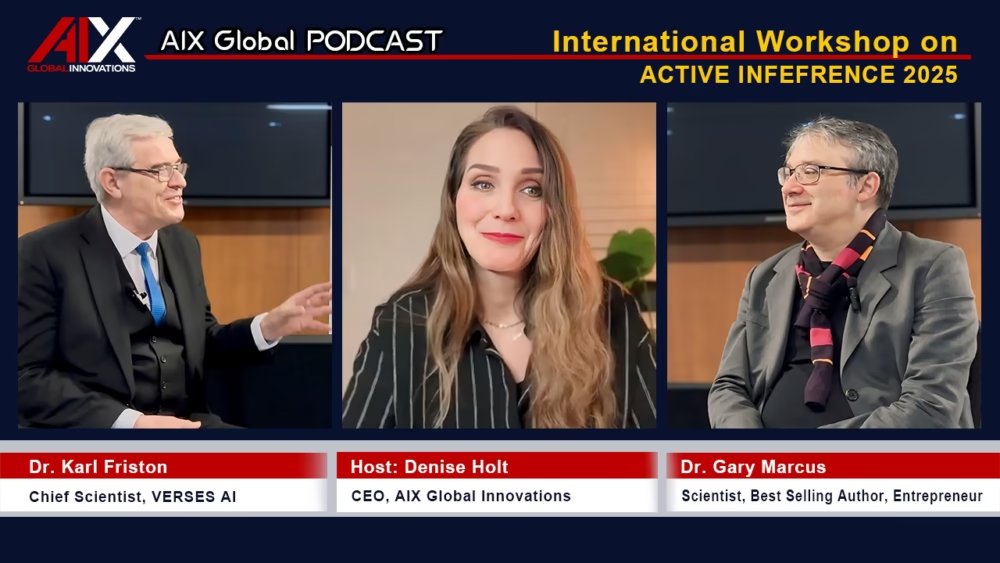
Why the world's leading neuroscientist thinks "deep learning is rubbish," what Gary Marcus is really allergic to, and why Yann...

Seed IQ™ enables coherence across distributed agents through shared operational belief propagation maintaining system-level viability, constraints, and objectives while adapting...
Preliminary results with Seed IQ™ suggest that barren plateaus can be treated as an operational state that is detectable, actionable,...
Operations are control problems, not prediction problems, and we're applying the wrong kind of intelligence. The missing layer: Adaptive Autonomous...
We have been entrusted with something extraordinary. ΑΩ FoB HMC is the first and only adaptive multi-agent architecture based on...
AI is entering a new paradigm, and the rules are changing. AXIOM + VBGS: Seeing and Thinking Together - When...

Blueprint for new robotics control stack that achieves an inner-reasoning architecture of mult-agents within a single robot body to adapt...

The convergence of two groundbreaking technologies is reshaping how we think about AI, automation, and intelligent systems, affecting every industry...

On 29 May 2025, the IEEE Standards Board cast the final vote that transformed P2874 into the official IEEE 2874–2025...