
Active Inference & Spatial AI
The Next Wave of AI and Computing
What Yann LeCun is Missing: Karl Friston and Gary Marcus on Uncertainty, Agency, and the Alternative to Deep Learning
AIX Global Podcast
- ByDenise Holt
- January 22, 2026
Why the world’s leading neuroscientist thinks “deep learning is rubbish,” what Gary Marcus is really allergic to, and why Yann LeCun might be missing the point about Active Inference.
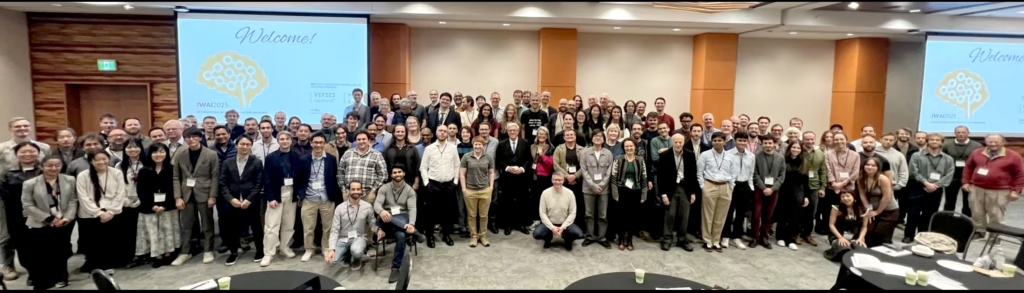
When I arrived at the International Workshop on Active Inference in Montreal last October, I had no idea what was in store for me. Over the course of the three day event, I found myself in two remarkable conversations with gentlemen whose professional work I have long admired. These were not formal interviews. They were relaxed, candid side quests that happened in the margins of the event, before they took the stage together in their own panel discussion. I published these two interviews, along with their panel session, on our AIX Global Podcast in a combined video that has (as of this writing) generated over 11,000 views on YouTube in just one week — a testament to the desire for honest, authentic dialogue about the future of artificial intelligence.
Watch Now:
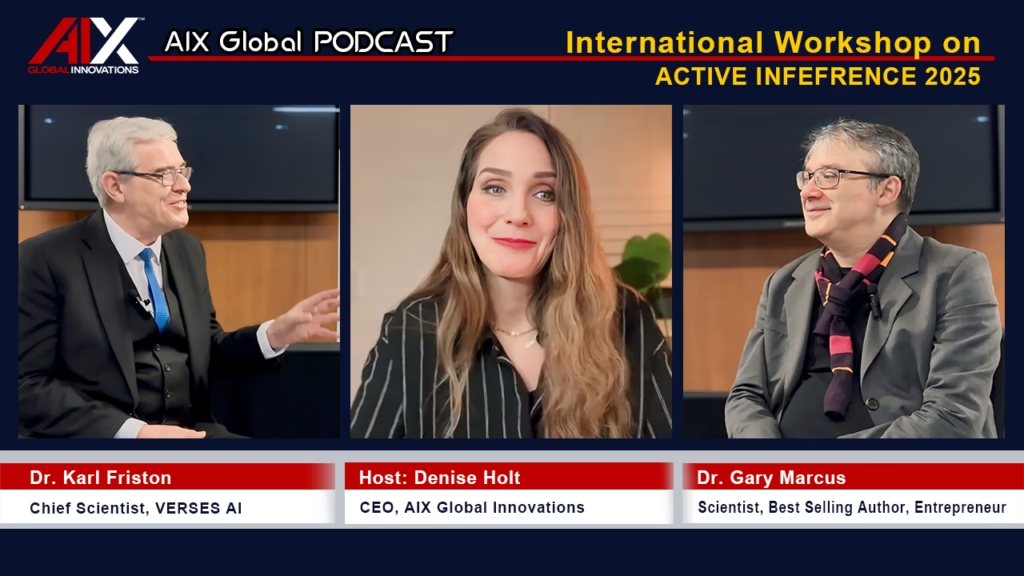
What made these discussions unique wasn’t just the calibur of minds involved – I was speaking with world-renowned neuroscientist Dr. Karl Friston and pioneering cognitive scientist Dr. Gary Marcus, but it was the shared understanding and candor of our exchanges that made these moments special. Most interviews with Karl are deeply technical, aimed at researchers already steeped in the complex mathematics of Active Inference and the Free Energy Principle. Our conversation struck a very different tone: accessible, relaxed, and refreshingly open and honest, tapping into topics you don’t usually hear him speaking about.
Karl Friston on Why Yann LeCun Won't Embrace Active Inference (Despite Agreeing with It)
One of the most fascinating moments came when I asked Karl about something that’s puzzled many observers: Why doesn’t Yann LeCun, former Chief AI Scientist at Meta, pursue Active Inference when he clearly understands and respects the work?
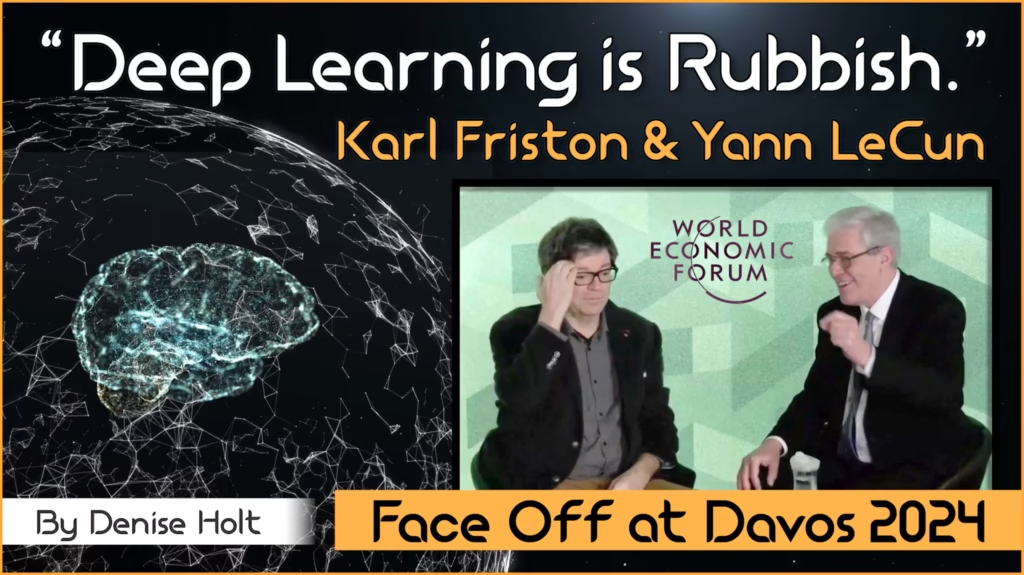
Two years prior, at the World Economic Forum on a panel in Davos with Friston, LeCun had publicly stated he agreed with Karl’s direction. Yet he insisted “we just don’t know how to do it any other way” than through deep learning and reinforcement learning.
Karl’s answer was clear: “I think it’s a very simple difference. I am committed to first principles and was trained as a physicist and think as a physicist. He is a really skillful engineer.”
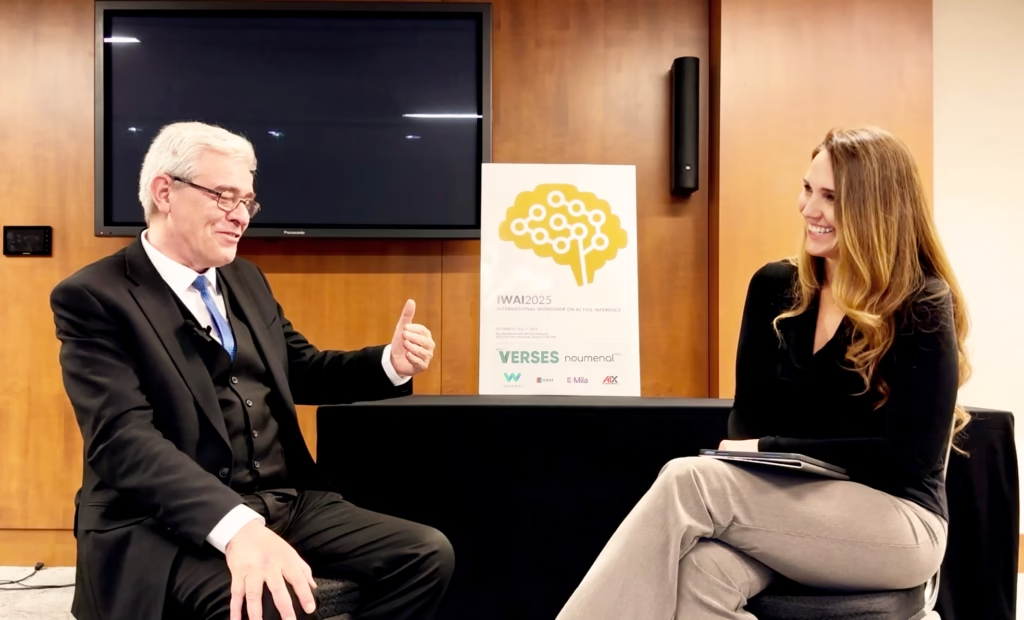
But the real issue runs deeper. Karl explained that LeCun denies himself a critical capability: “He does not think it is, in an engineering sense, easy or possible to include uncertainty into his neural networks.”
Technically, there is one thing that the ‘engineerer’ in him denies him. So you asked what it he missing? He’s not missing anything. It’s just that he’s self-denying, self-sabataging, I would say, in a particular way. And that’s that he does not think it is, in an engineering sense, easy or possible to include uncertainty into his neural networks.”
According to Friston, LeCun’s technical choice of setting, what he described as setting the “temperature to zero,” essentially removing uncertainty from the objective function, has profound consequences. Without the ability to encode and quantify uncertainty, it is impossible to evaluate the quality of your model. Additionally, Karl argues, “you can never be a large language model that prompts, that asks questions. You don’t know what you don’t know before asking the right questions.”
This is the heart of Active Inference: the epistemic affordance, the information-seeking aspect that makes intelligence adaptive rather than merely reactive.
Gary Marcus: "I Speak Truth to Authoritative Bullshit"
If Karl brings the physicist’s commitment to first principles, Gary Marcus brings the cognitive scientist’s commitment to intellectual honesty, and he’s not pulling any punches.
“I study both natural and artificial intelligence, and I speak truth to bullshit,” Gary told me with characteristic directness. “I actually said on 60 Minutes that what large language models produce is authoritative bullshit. And that was always true of the models. It’s become increasingly true of the industry.”
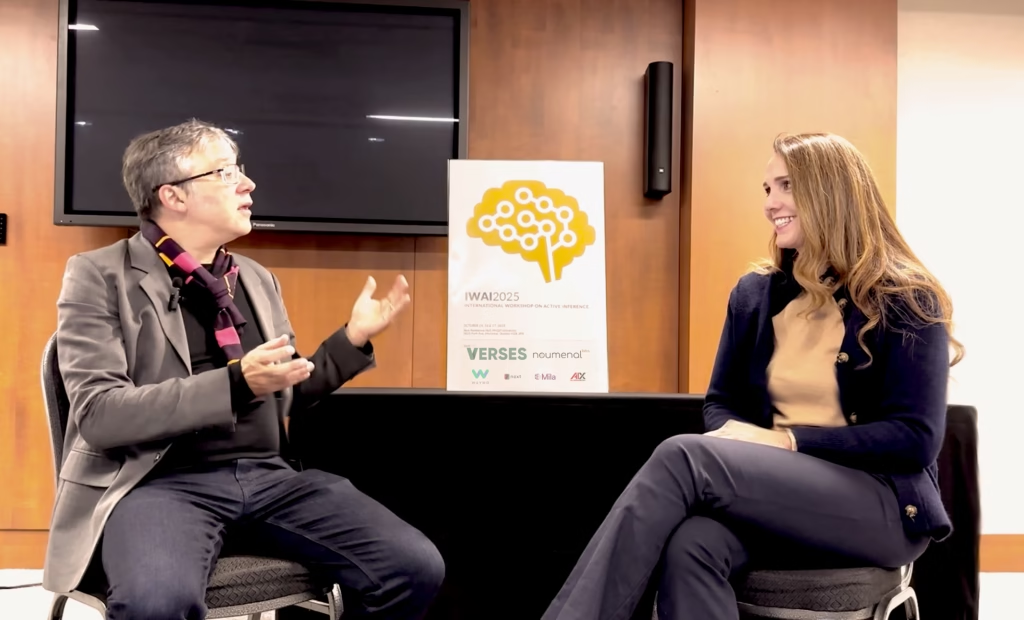
Gary’s critique isn’t born from hatred of AI . It’s quite the opposite. “I started working on AI when I was 10 years old,” he explained. “I want it to work. I want it to be good for society. I just don’t think that what we’re doing with large language models and stealing copyright and having these unreliable systems and giving them lots of authority is the right thing to do.”
His analogy was perfect: “Sometimes I feel like a parent with a recalcitrant teenager. I actually have two great kids. It’s not my personal experience, but you know, imagine that you have a teenager who’s kind of fucking up, but you still love them. That’s how I see AI right now.”
The World Model Problem: Why LLMs Can't Play Chess (And What That Tells Us About Intelligence)
Both Karl and Gary converged on a critical point: the absence of genuine world models in current AI systems.
Gary illustrated this with a striking example: “You can’t take an LLM and have it reliably play a game of chess.” Despite being trained on millions of chess games, rules from Wikipedia and Chess.com, and books like Bobby Fischer Teaches Chess, LLMs will have a queen illegally jump over a knight.
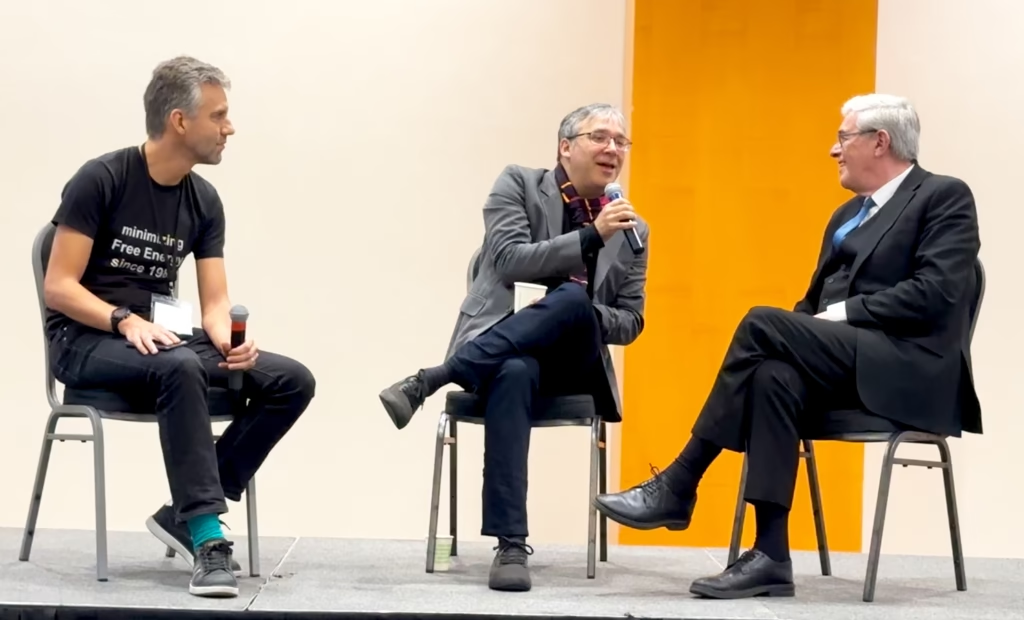
“It can repeat the rules of chess. It can even answer questions like ‘can a queen jump over a knight?’ But then it will actually have a queen jump over a knight illegally when it plays,” Gary explained. “My argument is it has not made a model of chess.”
The problem, as Karl frames it, is that LLMs are “just a mapping between content and content.” There’s nothing in the middle. There’s no understanding, no true representation of cause and effect, no ability to reason about consequences of actions.
This is why Gary has been warning about hallucination problems since 2001, long before LLMs existed. The fundamental architecture of pattern matching over language without grounded world models guarantees unreliability.
Karl Friston: "Deep Learning is Rubbish" (And Why He Really Means It)
When asked by Tim Verbelen, moderator of the Friston and Marcus’ panel at IWAI, if he still stands by his provocative statement that “deep learning is rubbish,” Karl didn’t hesitate: “Yes, I do.”
But context matters. What Karl objects to isn’t the engineering accomplishment. He acknowledges that generative AI has created something “beautiful” and “alluring.” What he rejects is the foundational approach.
“It’s not reinforcement learning that’s realized the beauty that we witness with large language models,” Karl explained. “It’s the use of universal function approximators to do prediction, basically. But what — and I think that’s the key thing — it’s just predicting stuff that we do. So I think it’s the fact that generative AI just generates a kind of stuff that we generate that renders them beautiful and interesting. But beyond that there is no utility.”
The problem? Without encoding uncertainty, these systems can’t measure their own complexity. They can’t practice Occam’s razor. They can’t know what they don’t know.
This forces engineers to use “all sorts of engineering widgets and gadgets and heuristics” like dropout, mini-batching, and other techniques to avoid overfitting — “all sort of little devices that are just symptoms of the fact that they’re using the wrong objective function.”
The Agency Question: What Makes Intelligence Actually Intelligent?
Perhaps the most profound theme running through all three segments was the question of agency.
“To be agentic, the large language model would have to start prompting you,” Karl pointed out. “It would have to have the kind of actions and the imperatives that underwrite those actions that you and I possess, which is effectively information seeking. It’s curiosity.”
Gary agreed, noting that while people do use LLMs as agents, “they just don’t work that well.” He recalled Auto-GPT, a system that briefly created excitement on Twitter before people realized it couldn’t actually do what it claimed. “It would feign agency. It couldn’t really do agency because it didn’t really have the world model, didn’t really have the causal understanding, didn’t really know what it actually was.”
True agency requires understanding the consequences of your actions , like modeling, “What will happen if I do that?” This is what Active Inference speaks to: the ability to select the right moves in accordance with the right objective functions, constantly seeking to resolve uncertainty about the world by acting on the world toward that end.
Beyond the LLM Monoculture: What We Actually Need for AI to Work
Both Friston and Marcus described an AI field trapped in an intellectual monoculture, with the industry scaling the same approach in the hope that size alone will produce different outcomes.
“We have an intellectual monoculture right now where everybody is basically doing the same thing at really enormous scale,” Gary observed. “There’s this old line about the definition of insanity is doing the same thing over and over again and expecting different results. Well, may I present to you the field of AI right now.”
The path forward, both agreed, requires moving beyond pure neural network approaches to embrace what Gary calls “neurosymbolic AI.” which are systems that combine the pattern-matching strengths of neural networks with the structured reasoning capabilities of symbolic AI.
“Classic symbolic AI is great at representing world models,” Gary explained. “It is great at generalizing from small amounts of data in narrow contexts. But the problem is it’s always had to be handcrafted. Then you have neural networks that are great at learning from massive amounts of data, but everything that they learn is too superficial.”
The solution, he proposes, isn’t choosing one or the other. Instead, it is principled integration.
The Future of AI: From Prediction to Adaptive Autonomy
When I asked Karl what life will be like in 10 or 20 years, his answer was both surprising and somewhat reassuring: “I think you’ll be surprised how similar it is to life now, but without all the angst that we currently experience.”
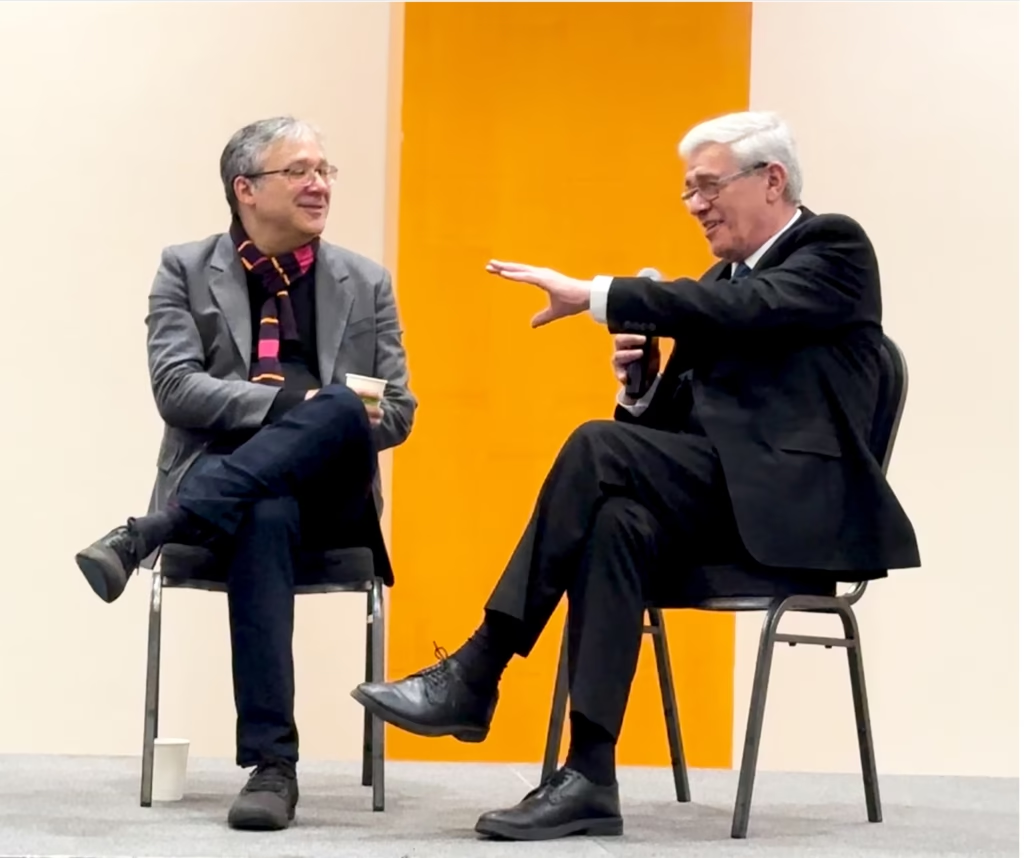
The key, he suggested, lies in systems that can actually minimize our collective uncertainty through genuine understanding and communication. “All the tech that is developed will be in the service of jointly minimizing our uncertainty and our free energy, which just basically means there will be a better joint mutual understanding.”
This vision of AI, one that truly understands, that can reason about uncertainty, that acts as a genuine cognitive partner rather than an authoritative pattern-matcher, it points toward what Karl described in his work as “distributed ecosystems of intelligence from first principles.”
These aren’t systems that replace human agency, but ones that enhance our ability to coordinate, understand, and adapt in an increasingly complex world.
The Active Inference Alternative: Where Theory Meets Practice
As I reflect on these conversations, I keep coming back to Karl’s point about the difference between prediction and understanding. What both he and Gary are describing isn’t just a technical critique, it’s a fundamentally different vision of what intelligence means.
The question that lingers for me is this… If we’re moving away from the LLM paradigm, what does the alternative actually look like in practice?
In my own work, I’ve been exploring this question through the lens of Active Inference. The principles Karl articulates: encoding uncertainty, maintaining world models, enabling genuine agency through curiosity and information-seeking, these aren’t just theoretical ideals. They suggest a completely different architecture for how intelligent systems should be built.
Rather than training monolithic models on vast datasets and hoping they generalize, what if we designed systems that continuously adapt through real-time interaction with their environment? Systems that don’t just predict patterns, but ones that actually do model the consequences of their actions, can reason about what they don’t know, and can coordinate across complex operational contexts while maintaining coherence under uncertainty?

This is the direction my partner and Chief Innovation Officer, Denis O and I taking with our company, AIX Global Innovations, and Seed IQ™ (Intelligence + Quantum), translating Active Inference principles and physics-based dynamics into enterprise-scale adaptive multi-agent autonomous control systems. What has become clear through our most recent work is that these principles really do translate to practice. When you build systems that encode uncertainty and model consequences rather than just predict patterns, you get fundamentally different capabilities, whether it is governing quantum execution, solving abstract reasoning challenges of ARC AGI, or coordinating complex operations under constantly shifting conditions like global supply chains, logistics, energy systems, healthcare, finance, and more.
The conversations I had with Karl Friston and Gary Marcus reinforced something I’ve long-been convinced of: the shift from prediction-first AI to genuinely adaptive, physics-grounded intelligence isn’t optional. It’s necessary. And it’s not some distant future possibility. It is a shift that is happening now by those willing to build from first principles.
Whether it’s through academic research, startup innovation, or enterprise deployment, this reimagining of AI is already underway. The question isn’t whether it will happen, but how quickly we can accelerate the transition, and whether we can do it before the limitations of current AI approaches become even more costly.
Why This Conversation Matters Now
The timing of these discussions feels particularly significant. As Gary noted, “What’s really interesting to me is how much the world has changed in the last three months.” The realization that simply scaling LLMs won’t deliver AGI, and that GPT-5 would be late and wouldn’t be magic, has created an opening for different approaches.
“People noticed,” Gary said. “And I have been treated so much better in the last couple months. Now people want to hear me ‘dis’ LLMs.”
Meanwhile, Karl observes a similar hunger in the research community: “I see an enthusiasm for what’s next. And I think what’s next is exactly this. It’s this truly grounded ability to reason.”
Watch the Full Conversations
These full interviews, with all their nuance, humor, and intellectual depth, are available now on our AIX Global Podcast on YouTube, Spotify, Apple, Amazon, and all your favorite podcast players. You’ll hear Karl’s patient explanations of complex ideas, Gary’s passionate critiques of industry trends, and their surprisingly harmonious convergence on what needs to happen next.
I want to take this opportunity to express my deepest gratitude to both Dr. Karl Friston and Dr. Gary Marcus for so graciously taking time with me during what I know were incredibly packed schedules at IWAI. These weren’t obligatory interviews, they were genuine conversations with two people whom I admire greatly, and who care deeply about getting AI right.
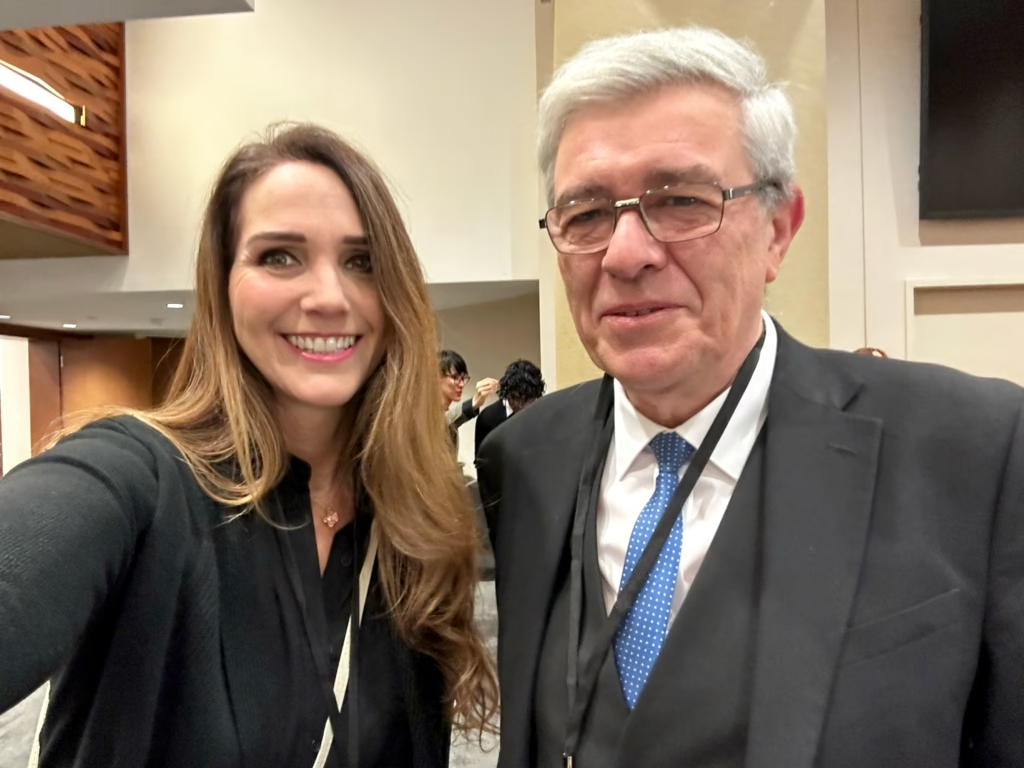
Karl, I have such profound admiration for the depth and conceptual integrity of your work, and for the way you are advancing a fundamentally different understanding of intelligence grounded in physics and first principles. Thank you for your candor in our conversation, and entertaining my curiosities and your willingness to address questions about where the field may be stuck and why. Also thank you for your insights on what is necessary to move forward. The intellectual generosity you showed in our exchange is something I deeply appreciate.

Gary, I have a tremendous amount of respect for your ability to stand firm on principles when the entire industry has been moving in a different direction. Your clarity about what’s working and what isn’t, and your refusal to accept hype as substance, provides something essential that’s often missing in the public AI narrative. Thank you for being a “truth speaker” about these issues and sharing your perspectives with me.
I also want to send a huge thank you to the International Workshop on Active Inference for welcoming me as a media partner this year, and for the extraordinary work they do in bringing together the most brilliant minds in this field from across the globe. IWAI has grown substantially year over year, and I believe it will continue to gain attention and traction as Active Inference demonstrates its capabilities in robotics, autonomous systems, and beyond.
The candor of these one-on-one interviews, followed by the dynamic exchange between Karl Friston and Gary Marcus, moderated by Tim Verbelen on the IWAI stage, represents something rare in today’s AI discourse: intellectually honest dialogue that prioritizes truth over hype, principles over patterns, and understanding over mere prediction.
Whether you’re a researcher, entrepreneur, policymaker, or simply someone trying to understand where AI is really headed, these conversations offer something rare: honest, meaningful discussions from two people who have been thinking deeply about natural and artificial intelligence for decades.
Watch Now on YouTube:
If you’re building the future of supply chains, energy systems, manufacturing, finance, robotics, or quantum infrastructure, this is where the conversation begins.
Learn more at AIX Global Innovations.
Join our growing community at Learning Lab Central.

A dedicated space fostering an environment for learning, community, and collaboration around Active Inference AI, HSTP, HSML, and the convergence of technologies utilizing these new tools – Digital Twins, IoT, Smart Cities, Smart Technologies, etc…
The FREE global education hub where our community thrives!
Scale the learning experience beyond content and cut out the noise in our hyper-focused engaging environment to innovate with others around the world.
Become a paid member, and join us every month for Learning Lab LIVE!
Episode Transcript:
Speaker 1 – 00:00
Foreign.
Speaker 2 – 00:12
Hi everyone, and welcome to the Spatial Web AI Podcast. This video is something I feel incredibly
grateful to share
with you today. While attending the International Workshop on Active Inference this past October, I had
the great
privilege of sitting down with world renowned neuroscientist Dr. Karl Friston for an extended
conversation.
Interestingly enough, one of my questions for him was in regard to Yann LeCun, exactly one month
before LeCun’s
departure from Meta. Jan is very familiar with Karl’s work on active inference and the free energy
principle. Yet in a
conversation at the World Economic Forum in Davos more than a year prior, Jan was adamant that he
agreed with
Karl’s direction. Yet he insisted that we don’t know any other way to train systems than deep learning.
So I asked
Karl why? What is it that Jan Lecun is missing?
Speaker 2 – 01:08
I also ran into Gary Marcus, who was on such a tight schedule that day, but was gracious enough to
give me a few
minutes for a short interview right before he went on stage with Karl for an interview discussion that
was
moderated by Tim Verballen of Versus, who is one of the original organizers of the IUI annual event.
There’s no
formal intro to any of this footage. It was all shot on the fly as opportunities were arising. We simply
drop into the
conversations as they happened and I’ve included all three of these segments, including the interview
with Karl
and Gary moderated by Tim, and it’s all in this one video that you’re about to watch today.
Speaker 2 – 01:48
I’d also like to extend my gratitude to the International Workshop for Active Inference for welcoming me
as a media
partner this year and for the extraordinary work that they do in bringing together the most brilliant minds
in active
inference from across the globe to share their cutting edge research and exchange ideas. This is an
event that has
grown year over year and I think it will continue to gain much attention as active inference gains more
and more
traction for its capabilities in fields like robotics and autonomous adaptive systems. I hope you enjoy
these
conversations as much as I did. Karl and Gary, thank you so much for your time and for so graciously
entertaining
my curiosities. So thank you so much for being here and enjoy the video.
Speaker 3 – 02:36
It is my great pleasure to have a few moments with Dr. Karl Friston today to talk about what work he is
doing and
really leading in this entire active inference field. Karl, it’s been a dream of mine to have a conversation
with you for Meeting Title: EPISODE 19 – Karl Friston Gary
Marcus IWAI 2025.mp…Meeting created at: 9th Jan, 2026 – 12:47 PM
1 / 43
quite some time and so I I have some burning questions. You are at University College London and
Geoffrey Hinton
also came from University College London, and while you were there, he was working on DeepMind.
You were
working on something called Nested Minds Network. And I know that some of my viewers are probably
very
curious. Why did you not join with DeepMind and what they were doing? What is it that made you want
to pursue
this active inference direction for AI for autonomous intelligence?
Speaker 4 – 03:36
That’s a very challenging question to ask. First of all, it’s lovely to meet you in person. I read a lot of
your material.
It’s nice to actually be able to talk to you.
Speaker 3 – 03:44
Thank you so much.
Speaker 4 – 03:46
Yeah. So the history of this was were located in Queen Square in the Bloomsbury area, the sort of
intellectual heart
of London, publishing and academic and actually clinical. We were briefed and were developing at that
time, state
of the art methods and analysis tools to understand the living brain using neuroimaging. And then
fortuitously,
Geoffrey Hinton arrived with Peter Dayan to direct the Gatsby Computational Neuroscience Unit, which
was just
next door. So were academics. In fact, interestingly, Demis Hassebis, who subsequently became Sir
Demis and got
his Nobel Prize, was one of our PhD students. So he sort of learned about the hippocampus, working
with Eleanor
McGuire with us doing theoretical neurobiology and again, state of the art image analysis procedures.
And then he
went off and founded Google DeepMind and then asked Jeff actually to be an advisor.
Speaker 4 – 05:00
So that was, if you like, the divergence between academia and industrial applications such as Google
DeepMind.
So it wasn’t really a question of why did we not join Google DeepMind. We were just admiring
spectators. And
when I say we to a certain extent, Geoffrey Hinton as well, he had primarily an academic appointment.
So our brief,
both ourselves or myself and Jeff, was really to do theoretical work, advance the field, but also teach
students and
raise the next generation of theoreticians.
Speaker 3 – 05:48
And.
Meeting Title: EPISODE 19 – Karl Friston Gary
Marcus IWAI 2025.mp…Meeting created at: 9th Jan, 2026 – 12:47 PM
2 / 43
Speaker 4 – 05:52
I never see myself as diverging from Geoff, although I do see over the subsequent decades, Jeff
becoming
somewhat seduced by the engineering power of Deep rl, as we see evinced in generative AI in large
language
models at the moment. To my mind, and I hope he never sees this, I think that was something of a
distraction from
the high road of doing it properly. And he certainly was inspirational and instantiating, certainly in me
and a
number of my colleagues, the basic principles of artificial intelligence, which of course are those of
natural
intelligence, which as brain imaging scientists were deeply invested in trying to unearth.
Speaker 4 – 06:41
And those notions at that time, when were both in London, were focused Very much on the notion of
the brain as a
generative model, as a, well, any intelligence basically working under a generative model that would
explain the
causes of the sensory inputs. So this is a very different use of the notion of generative models from
generative AI.
So you could argue that generative AI as understood in machine learning is exactly the opposite of
what Geoff was
working on and what I have been working.
Speaker 3 – 07:20
On since that time, which is really generating understanding, right? Models of understanding. Yeah,
very different. I,
you know, I tend to describe to people that right now what we’re seeing with current AI, that it is the AI
that is built
for our current Internet. You know, our current Internet is websites, web domains and applications. And
you can
generate content and use content, generate data. And that’s what these AI are doing. They’re
generating content
and doing things with data. But I feel like what you’re working on with active inference, that’s for what’s
coming
with this new layer on the Internet that takes us into spatial web and takes us into this grounding layer
of context
for these active inference AI models and agents that can then be distributed through networks.
Speaker 3 – 08:16
And I know that is deeply attributed to the white paper that you and Versa’s partner put out, I think it
was December
of 22 on, you know, distributed ecosystems of intelligence. So do you think. Do I have that right? Is that
how you
would describe it? Is there anything you would add to that?
Speaker 4 – 08:36
Nothing I would add, but I’ll certainly pick up. You used all my favorite words there, or some of my
favorite words.
Meeting Title: EPISODE 19 – Karl Friston Gary
Marcus IWAI 2025.mp…Meeting created at: 9th Jan, 2026 – 12:47 PM
3 / 43
Speaker 3 – 08:42
I’m sure I got them from you.
Speaker 4 – 08:45
Some of them, others not. But so just to pick up on a couple of things that you said though, which I think
are
absolutely clear, you’re talking about the sort of the next level, and I guess most people understand the
next level
as moving from AI to some kind of generalized or super intelligence or as versus likes to say, a
universal
intelligence. And what is that? Well, I think you said grounding. I think that’s really important. So to have
an
understanding of how your content was generated, that has to be grounded in meaning.
Speaker 4 – 09:18
So I think understanding and solving the grounding problem is basically the bright line between current
generative
AI that just generates content and the understanding underwrites that and enables the right kind of
message
passing on the next generation of the World Wide Web or certainly as that envisaged by the Spatial
Web
foundation and as installed in the IEEE standards, for example. So what is that predicated on? I think
you’re
absolutely right. It’s predicated on understanding. But there’s another key word you mentioned, which is
of course,
to pass messages, you have to instantiate that as an agent. You have to actually broadcast. You have
to decide
what to send and what to listen to. So your use of the word agent, I think, is really important here.
Speaker 4 – 10:11
So to move towards a universal intelligence that could be unrolled in terms of our transactions on the
World Wide
Web, I think, is to basically understand the physics of agency. And to be an agent under this premise
that
everything has to be predicated on a generative model means that you have to have generative models
of the
consequences of your own action. I think that’s really what active inference speaks to, that you have the
ability to
model what will happen if I do that.
Speaker 4 – 10:47
And once you’ve got that in mind, then not only do you have an understanding of the way the cause,
effect,
structure of your world and the way the content is generated, but you can now select the right moves in
accord
with the right objective functions, which for me, of course, are the expected free energy, the variation of
energies,
or more simply, garnering evidence for your generative model of the world and in so doing, understand
how your
content was generated. So I think agency is an important aspect of that. And I guess you could sort of
induce that
from a very, you know, from what’s on the tin in active infants. It’s about action. And then you ask, well,
are not. Is Meeting Title: EPISODE 19 – Karl Friston Gary
Marcus IWAI 2025.mp…Meeting created at: 9th Jan, 2026 – 12:47 PM
4 / 43
not current generative AI agentic? Well, no. I mean, to be agentic, the large language model would
have to start
prompting you.
Speaker 4 – 11:40
It would have to have the kind of actions and the imperatives that underwrite those actions that you and
I possess,
which is effectively information seeking. It’s curiosity. I mean, why do we use the web? We don’t use the
web to
feed ourselves or to look after our children. We just use it to resolve uncertainty and get information. So
it’s a great
tool. But if you really want that to work in the spirit of that ecosystems of intelligence thesis that you
mentioned
earlier, then the users on the web, each node of the web really has to be seeking information about
what? Well,
about everything else that’s on the web. So we’re just trying to build models of each other or artificial
and natural
intelligences that. That are actually exchanging.
Speaker 3 – 12:30
So like a reciprocation of curiosity from both parties or all parties?
Speaker 4 – 12:35
Yes.
Speaker 3 – 12:36
Yeah. Okay, So I have another question for you, and feel free to answer whatever part of it that you feel
comfortable with. Two years ago in Davos, you and Yann Lecun were on the stage together. I’m sure
you saw. I
wrote an article kind of summarizing what I saw and witnessed in that conversation. But one thing that’s
kind of
stuck with me, and I know it’s a question people have asked me. You guys are obviously friends. You
are well
aware of each other’s work. You have a lot of high respect for each other’s work. I mean, it was really
clear that he
has so much respect for your work with active inference. And in that conversation, he was saying, yes,
Karl, I agree
with you, Karl. You know, with active inference, everything. But we just don’t know how to do it any
other way.
Speaker 3 – 13:25
And he was referring to reinforcement learning. Why do you think that somebody who is well aware of
everything
happening in these ecosystems, or maybe there’s something he’s missing that he’s not aware of. Right,
but why?
Why do you think he has that perspective? And then the larger question in that is there are a lot of
really big tech
companies who are, you know, building a lot of tools in AI, but they don’t seem to be looking in the
direction of
active inference very seriously. I know since that conversation in the last two years, there’s been a lot of
progress
with the research around scaling and things like that. Was it just a scaling issue? Is it because it doesn’t
fit the
centralized business model of a lot of these? Like, what do you think is the. The issue there?
Meeting Title: EPISODE 19 – Karl Friston Gary
Marcus IWAI 2025.mp…Meeting created at: 9th Jan, 2026 – 12:47 PM
5 / 43
Speaker 4 – 14:16
What, amongst the five issues that you.
Speaker 3 – 14:18
Brought to the table, they’re all kind of interrelated, right?
Speaker 4 – 14:21
No, they certainly are. They certainly are. And different perspectives and the genesis of, you know, so
let’s take Jan.
And what’s the difference between somebody like me and something like Jan? I think it’s a very simple
difference. I
am committed to first principles and was trained as a physicist and think as a physicist, he is a really
skillful
engineer. And he’s more like my father, who’s a civil engineer. So engineers, if it works, that’s the way
to do it. From
my point of view, no, you need to identify the first principles. But I would say that despite the fact that
Jan uses the
same words in a completely different way than I do. So for him, he says, don’t use generative models.
Well, what he
means is don’t use generative AI.
Speaker 4 – 15:06
Whereas, as opposed to the kind of generative models that Geoffrey Hinton introduced, in the context
of things like
the Helmholtz machine and all that wonderful work, you could, I think, trace through to current
technology via
things like variational autoencoders. So I think there’s a much greater convergence between Yann
Lecun and
myself and certainly everybody in the active director interest fields and appear so on the surface.
Certainly his
work with the jet, you know, his more recent work trying to move the field to a more sort of biomimetic
kind of
approach. Technically there is one thing that the engineer in him makes, denies him. So you ask, what
is he
missing? He’s not missing anything. It’s just that he’s self denying, self sabotaging, I would say, in a
particular way.
Speaker 4 – 16:02
And that’s that he does not think it is in an engineering sense easy or possible to include uncertainty
into his neural
networks. So the way that translates is he would say to me, Karl, I think you’re absolutely right. We just
need to do
computation, we need to do sense making, decision making under the right kind of generative models,
in my sense
of the word, using a free energy functional, exactly in the same way that active inference appeals to
variational free
energy. But he says, well, why don’t we just put the temperature to zero? Now what that means
technically is you
remove uncertainty from the objective function.
Meeting Title: EPISODE 19 – Karl Friston Gary
Marcus IWAI 2025.mp…Meeting created at: 9th Jan, 2026 – 12:47 PM
6 / 43
Speaker 4 – 16:45
So now he can work with really simple reinforcement learning like neural networks that don’t have
uncertainty, they
don’t have a calculus or the capacity to deal with belief structures where a belief is read as a probability
dispute. To
have a probability distribution, a belief, you have to equip it with precision or uncertainty. And that has
to be
instantiated at your. From an engineering perspective, he doesn’t do that. So he does everything
exactly like I would
like it done. But he does it, he takes the, he takes a sort of engineering shortcut and just ignores the
uncertainty.
But that you pay a very heavy price for that.
Speaker 3 – 17:23
And what is that price?
Speaker 4 – 17:25
That price is you’re not now able to deal with uncertainty in a principled way. One really important
consequence of
not dealing or encoding uncertainty, sometimes known in engineering as uncertainty quantification, is
you can’t
evaluate the quality of your models because in order to evaluate the quality of your models, you have to
average
over your uncertainty. So literally the model evidence is something that can only be evaluated if you
know the
problem, if you know your uncertainty. So you have to be able to quantify that and evaluate it. But more
importantly, if you don’t know what you don’t know in terms of evaluating uncertainty, you don’t know
what
questions to ask. So you can never be A large language model that prompts, that asks questions. So
again, we
come back to this. You know, what is agency?
Speaker 4 – 18:24
Well, agency is just querying the world in a way, in the right way, that resolves your uncertainty. But in
order to know
what the right way is, you have to know what you don’t know before asking the right questions. So that,
I mean in
one sense that is the heart of active inference. It’s that sort of epistemic affordance or imperative, that
information
seeking aspect that makes active inference, if you like, much more like you and me, much more like
natural
intelligence.
Speaker 3 – 18:52
Right. And that’s where the minimizing complexity comes in. Right. Whereas with, you know, deep
learning and
these LLMs, it’s all the information that it has to go through, whether it means anything or not, to the
prompt at
hand, but it still has to waste all of this energy.
Meeting Title: EPISODE 19 – Karl Friston Gary
Marcus IWAI 2025.mp…Meeting created at: 9th Jan, 2026 – 12:47 PM
7 / 43
Speaker 4 – 19:09
Absolutely.
Speaker 3 – 19:10
Whereas if you have an agent that understands what it doesn’t know, and it can seek exactly what it
needs to know,
rather than shifting through a bunch of needless information, time, energy, all of that.
Speaker 4 – 19:24
Yeah, we’ve missed the other four points you want to talk about, but I think that’s such an important
point. I think
we should just unpack that a bit. Yeah, so. Absolutely. So technically your objective function, if you use
a full free
energy, which is just basically an expected energy, which is what people in reinforcement learning
might use, and
it’s got the entropy term, which is the uncertainty part. So usually you multiply the entropy by
temperature, which is
why Yan gets rid of it by setting temperature to zero. But if you’re trying to minimize your free energy,
you’re going
to maximize your entropy. That may sound strange, but it’s not because it keeps your options open. It’s
exactly
Occam’s principle. And if you now put the.
Speaker 4 – 20:07
If you just mathematically express complexity, then the complexity is effectively the difference between
your
posterior and your prior, which is basically the negative entropy that we’re talking about. But now
thinking about
the sort of uncertainty associated, or your priors. So there’s a deep connection between this epistemic
affordances, information seeking aspect of true intelligence or universal intelligence, Occam’s principle
and
complexity minimization. And furthermore, if you’re talking to people like Joachim Schmidt here about
complexity
minimization, and if you go in the other direction, it’s exactly the same as James’s maximum entropy
principle. All
these are mathematically the same. But just to focus on what you focused on, which was a complexity,
I think
that’s a really key thing. So, because you can’t. The machine learning as it currently stands, of the kind
that does
large, you know, say transformer architectures cannot encode uncertainty.
Speaker 4 – 21:13
It can’t measure its complexity. So what does that mean? It basically means they’ve got to find all sorts
of
engineering widgets and gadgets and heuristics to elude the problems of overfitting and not complying
with the
right complexity constraints because it cannot be measured. So you get sort of mini batching, you get
dropout, you
get all the little things that engineers have found that have worked over the past decades, if not
centuries. They’re Meeting Title: EPISODE 19 – Karl Friston Gary
Marcus IWAI 2025.mp…Meeting created at: 9th Jan, 2026 – 12:47 PM
8 / 43
all sort of little devices that are just symptoms of the fact that they’re using the wrong objective function.
Because
they’re overfitting. Exactly. Because they’re not paying attention to the complexity term, which is one
way of carving
up the free energy of the. Or the evidence.
Speaker 3 – 22:00
Interesting. So I’ve had a question in the back of my mind and, you know, we may or may not use this
because this
is purely a personal question that I have, but if it makes sense, I, you know, we can include it. This is
literally
something that I have wondered because, you know, I understand that active inference is looked at and
the free
energy principle is looked at as the physics of intelligence, you know, for how it works. And when I look
at the free
energy, how, you know, and active inference, and you have this action, perception, feedback loop in it,
the whole
objective is to close that gap on uncertainty. Right. But to me, when I look at physics and what I
understand of
physics, you know, superposition lies within uncertainty. Right. And we kind of want to leave that open
because.
Speaker 3 – 22:51
Because that’s where possibility lies. Right. So how do you, you know, how do you, how should I
resolve that in my
mind, you know, if, if the way we learn is this constant, you know, loop of trying to get to certainty and
close that
gap, yet possibility is in there. We kind of want to play in that space. So where’s the balance?
Speaker 4 – 23:15
Right. Well, I think the. But you can read this in many ways. You could read it in terms of the bounce
between
exploration, exploitation. You could read it in terms of the bounce between accuracy and complexity.
You could
even read it in terms of what were just talking about, which is the balance between the energy and the
entropy. So
any one of those, I think, would make you happy. But let’s just take, let’s go back to free energy, carved
or split,
decomposed into energy and entropy. You want to minimize your free Energy, therefore, you want to
maximize your
entropy. This just is James’s maximum entropy principle. It just is finding those solutions, those
explanations for
your lived world or your content, that have the greatest uncertainty, that have the greatest span within
which you
can play around.
Speaker 4 – 24:04
So just to put that sort of in narrative form, you want to avoid committing to an overly precise
explanation. You
want to have that latitude in your head. Which of course brings us back to Occam’s razor or Einstein’s,
you know,
keep everything as simple as possible, but no simpler. So there is a Goldilocks regime that plays
exactly to your
notion of, you know, how do you get that balance right? The other way, I think, which sort of goes well
mathematically is a special case of this. Of this balance would be when you apply it to what we do. I
mean, at the
moment, I’ve just been talking about finding the right explanation for some content.
Speaker 4 – 24:51
Meeting Title: EPISODE 19 – Karl Friston Gary
Marcus IWAI 2025.mp…Meeting created at: 9th Jan, 2026 – 12:47 PM
9 / 43
You know, as a scientist who’s trying to comply with Occam’s principle or maximum entropy principle or
the free
energy principle, when it comes to what am I going to do next? I think that’s quite interesting in terms of
doing stuff
that is exploratory, that renders now surprise alluring. So renders the opportunity to resolve uncertainty
means that
if something is surprising, there’s an opportunity to act in a way to find out what caused that, what
would happen if
I did that. So that, I think, makes us into sort of curious creatures simply because we’re trying to
minimize
uncertainty in the long term. But now we find cues that enable us to or portend an opportunity to resolve
uncertainty. Very alluring. You know, you could discuss in terms.
Speaker 3 – 25:51
Of epistemic affordance, expansion of opening up your. What are the options before you click close
and, you know,
absolutely have the observation.
Speaker 4 – 25:59
Yeah, yeah. And if you take that notion not just to sort of beliefs about hypotheses or explanations for
the data
from the current state of affairs that you’re trying to infer, but also to the very structures and. And ideas
and
constructs that you bring to the table. You’re now in the world of structure learning. And how do you
grow your
models? How do you reconfigure your generative models in a way that’s apt for this situation or indeed
can explain
this novel situation that you’ve never encountered before that I think is a hallmark of. Certainly it is
active inference,
but it’s in the domain of the various structures that we bring to the table to make sense of things. You
may ask,
well, how does machine learning and its Current guys cope with that.
Speaker 4 – 26:53
It just starts off with something that’s too big, overly expressive, overly parameterized and shrinks it.
What you’re
talking about is how do we organically and in the right way grow our little models, you know, to
accommodate and
explain things that we’ve never seen before. So there’s this sort of top down approach that we see in
current ML,
which is vastly inefficient of course, because you’re completely over parameterized versus you as an
infant, a
neonate, growing your little models, growing your brain through it, through epistemic foraging. So that
will be a
natural way to get to the right level of complexity in the models.
Speaker 3 – 27:31
So almost like optimizing the learning opportunity in every moment, right? Yes, Interesting. So the other
question
that I have for you then is the work that you’re doing with Versus, what is the most exciting thing about
the work
that you’re currently doing in the research and with what you see evolving with their genius platform and
you know
where you see that heading, what excites you about that?
Meeting Title: EPISODE 19 – Karl Friston Gary
Marcus IWAI 2025.mp…Meeting created at: 9th Jan, 2026 – 12:47 PM
10 / 43
Speaker 4 – 28:00
I get excited by different things every week. So my general rule of thumb, me too. So effectively what is
exciting, it
changes week by week. So I’ll just answer in a very sort of simple minded way. What is currently
exercising me and
my colleagues at Versus in one part of the endeavors? I can think of many other exciting things, but
one particular
one is actually closely what were just talking about, which is this. How do we, how do you optimize the
learnability
and how do we respond and act in a way that will resolve uncertainty about the very structures that we
bring to
solve problems.
Speaker 4 – 28:55
So I think this is nicely exemplified not just by the current preoccupations or versus in terms of
aspirations of
equipping the web or the community or our lighthouse customers, you know, with the most intelligent
solutions,
but also something which I see emerging in the machine learning community, which is this notion that
we need to
move to the next stage. Sometimes cast in terms of moving away from Kahneman System 1 to System
too. So
we’re talking about understanding as revealed by the ability to reason. And in my world, reasoning
basically is a
quintessentially agentic thing. To reason is a verb. So it involves some kind of action. I think it’s exactly
the kind of
action that were just talking about.
Speaker 4 – 29:48
It’s basically acting in a way very much like a scientist would to design experiments that disclose
evidence or data
from the world that allows you to disambiguate between all sorts of different hypotheses that you might
have base
the structures, the explanations about which you’re reasoning. So if you’re a scientist, you keep your
world quite
simple. You’d have your favorite hypothesis, your alternate hypothesis and your null hypothesis. And
then you
design an experiment. Experiment that gives you exactly the right kind of data that will disambiguate
between the
two. I think we do that all the time online, all the time throughout our life. We do it a lot more when we’re
young, but
we still do it. So people like you do it in terms of your epistemic foraging.
Speaker 4 – 30:38
We are constantly building hypotheses and models and then getting the right kind of data that enables
to say, no,
it’s that hypothesis or that set of hypothesis and not that, and then continue refining and growing and
refining and
growing, refining. So that’s what’s exercising me this week. How do you do that automatically? I think it
can be
done. It’s just an extension of active inference, not to the problem of inferring states of affairs in the
moment. And
it’s even beyond what David McKay would call active learning, which is basically getting the right data
that will
enable you to infer the parameters of a given model with a certain structure without going even beyond
that. Now
we’re asking getting the right data that enables you to disambiguate the structures in and of
themselves. So that’s
a really fascinating problem which we’re currently. I should say.
Meeting Title: EPISODE 19 – Karl Friston Gary
Marcus IWAI 2025.mp…Meeting created at: 9th Jan, 2026 – 12:47 PM
11 / 43
Speaker 4 – 31:33
Yeah. Another, I think, point, another pointer to this sort of people’s. I think we’re getting bored with
large language
models as we see them, and people keep going about the hype cycle and the bubble, which may or
may not be. It’s
slightly beyond my comfort zone, but certainly I see an enthusiasm for what’s next.
Speaker 3 – 31:57
Yeah.
Speaker 4 – 31:57
And I think what’s next is exactly this. It’s. It’s this truly grounded ability to reason as. And, you know,
what brought
that to the fore for me was the focus of the NeuroAI workshop at NeurIPS last year. But also then I
attended
System 2 sessions. So Francois Chollet introduced ARC3. So I think that style of thinking, that move, I
think is
symptomatic of the fact people are hungry for the next big thing. Yeah.
Speaker 3 – 32:30
And I think that people are starting to realize the potential power with having these intelligent agents
that we can,
you know, kind of evolve with in whatever way that looks. Right. But we need to be able to trust them.
We need to
be able to have them explainable. And, you know, and the thing that I like about active inferences is
you’re not just
talking about, you know, building these systems that can cooperate or collaborate with you, but these
are co
regulating there. And I think it has to do with that symbiosis you’re talking about how it even relates to
us. You
know, there’s a give and take, there’s a, a full circle of a relationship happening there. So to me that’s
really exciting
because I see that that’s the potential. And I think that leads me to my last question for you.
Speaker 3 – 33:32
I’m really curious because you probably have a much further lens on all of this than any of us do. So if
you’re
looking 10 years, 20 years down the road, what do you envision life is going to be like for people?
Given that all of
this technology keeps going down the trail trajectory that you see it on its path, what do you think it’s
going to be
like for humans to live 10, 20 years from now?
Speaker 4 – 34:03
It’s not going to be a very clever answer. I think you’ll be surprised how similar it is to live now, but
without all the Meeting Title: EPISODE 19 – Karl Friston Gary
Marcus IWAI 2025.mp…Meeting created at: 9th Jan, 2026 – 12:47 PM
12 / 43
angst that we currently experience. I often, you know, so for example, I can remember watching 2001
Space
Odyssey and thinking, wow, I hope I’m alive to see 2001. And then you look at 2001, then you look at
2021 and
actually from. In many respects nothing has really changed all the good bits of life, nothing has really
changed that
much with the exceptions of iPhone. But you know, we had telephones, you know, when I was, you
know, when I
was growing up. So I don’t think much is actually going to change very much. And of course from the
point of view
of theology principle, the whole point is you’ve got this pullback attractor.
Speaker 4 – 34:55
The whole point is it’s a physics of sustainability. You know, if we are here, and we are here in a
characteristic way,
then mathematically speaking then we are part of the, this attracting set and that sort of unpacks in a
sort of scale
free fashion which means that, you know, we should celebrate retaining the things that characterize us.
So I think
to answer your question, in 10 years we’re doing exactly what we’re doing now. But hopefully there will
be less
worries and uncertainty.
Speaker 3 – 35:30
We’ll solve some big problems maybe with us.
Speaker 4 – 35:32
Well, for me of course problems just are uncertainty and of the kind that you’re induced by geopolitical
conflicts, of
the kind that are induced by your personal life trajectories of the kind that are induced by am I a
member of this
group or that group? Does that person like me? What would happen if I did that? All the problems that
we contend
with are just resolving uncertainty. So I think if the free energy principle is going to be realized or we
conform to the
free energy principle, what that means is that all the tech that is developed will be in the service of
jointly
minimizing our uncertainty and our free energy, which just basically means there will be a better joint
mutual
understanding. You mentioned this in terms of symbiosis or reciprocity, generalized synchronization.
Speaker 4 – 36:35
These are the dynamical hallmarks of self organization to this attracting set that characterizes us as a
particular
species. So the end point of this is basically communication, because via communication we resolve
uncertainty
about ourselves. That’s not to say we’re all going to be homogenous. There will be in groups and out
groups and
there will still be an epistemic affordance of being curious about what this out group says or this
community or
this theology, or this alternative. That’s not part of my in group. But that will be, if you like, in the context
of a much
more synchronized, harmonious exchange and information exchange within well formed groups.
Speaker 3 – 37:29Meeting Title: EPISODE 19 – Karl Friston Gary
Marcus IWAI 2025.mp…Meeting created at: 9th Jan, 2026 – 12:47 PM
13 / 43
You know, one of the things that really stood out to me in that white paper from back in 22 was when
you were
describing what’s necessary for this evolving intelligence is that it depends on the diversity of all the
intelligences.
And so to me, when I look at the potential with active inference and then what the spatial web enables
with this
distribution of these agents, that kind of become this organism of intelligence within networks, it
preserves what
you’re talking about, all the different diversity, you know, different belief systems, different governing
styles, all of
that. To me, that alone tells me this is the direction that it has to go in. Because, because we’ll never
ever agree on
anything. Globally there’s too many, you know, regional differences, too many.
Speaker 4 – 38:20
So which should be celebrated. I mean, you know, I mean, just to really reinforce that point, if you look
at this
through the lens of theoretical biology and evolutionary thinking, the co dependence we have on all
sorts of things,
from you know, atoms of molecules of oxygen through to bees through the trees. Yeah, we only are
here because
of that diversity. We could not exist without everything in that ecosystem. And that has enormous
diversity over
many different scales. And the same applies to sort of, you know, human and indeed political culture.
But to have
that diversity that you have those different kinds of things, they have to be demarcated. So they have to
be able to
preserve the Markov blankets.
Speaker 4 – 39:02
So you are talking about a physics that enables the preservation and the segregation, that identifies the
individuates, demarcates this kind of thing that enables the diversity to be self maintaining. So I think it’s
a really
crucial thing. Of course, you could start to argue now, you know, what would that look like at a
geopolitical level?
Well, Markov blankets can sometimes be literally thought about as borders. And that’s what I had in
mind when I
was talking about problems and our uncertainty. And at a geopolitical level, it’s uncertainty about
borders as we
are seeing in Gaza, as we’re seeing in Ukraine and elsewhere in the world.
Speaker 4 – 39:41
So one would hope that all of the, all these Markov blankets will be in a much more certain
configuration that do
celebrate the diversity simply because we’ve now demarcated this kind of thing and that kind of thing,
this kind of
culture, this, you know, in a stable but synchronized, in mutually respectful way. And that will be the
free energy
minimizing solution that will be facilitated with the right kind of communication.
Speaker 3 – 40:08
Right. I, I, I see that. I, that makes a whole lot of sense. Karl, thank you so much for taking this time with
me today.
It has been such a, a deep pleasure to be able to have a conversation with you like this. And thank you
for
humoring me with my own questions that were just personal to me. And if you were to leave our
audience with any
parting words, what would they be?
Meeting Title: EPISODE 19 – Karl Friston Gary
Marcus IWAI 2025.mp…Meeting created at: 9th Jan, 2026 – 12:47 PM
14 / 43
Speaker 4 – 40:34
Keep your options open. That’s.
Speaker 3 – 40:37
I love that’s solid advice. Karl, thank you so much. It is such a pleasure to meet you in person. I love
your work, I
love to hear your opinions because I feel like you are one of the truth speakers about the current state
of AI. I
would love for you to share with our audience kind of who you are, why you do what you do.
Speaker 1 – 41:02
So I’m Gary Marcus. I’m a cognitive scientist by training, but with a lifelong interest in AI. I study, I would
say, both
natural and artificial intelligence and I speak truth to bullshit. And I actually said on 60 Minutes that what
large
language models produce is authoritative. And that was always true of the models. It’s become
increasingly true of
the industry that there’s a lot of authoritative meaning. It sounds like it’s true, but it’s actually, and I’m
just allergic to
that as a scientist. Right. First and foremost, I am a scientist, a cognitive scientist in particular, and I’m
interested
in what the truth is, what the arguments are, how did we get there. Are we in the right place? And I don’t
think we’re
in the right place now. I often get called an AI hater. That’s not me at all.
Speaker 1 – 41:51
I started working on AI when I was 10 years old. I’m very interested in AI. I want it to work. I want it to be
good for
society. I just don’t think that what we’re doing with large language models and stealing copyright and
having these
unreliable systems and giving them lots of authority is the right thing to do. That doesn’t mean I hate AI.
It means I
hate the way we’re doing it now. Sometimes I feel like a parent with a recalcitrant teenager. I actually
have two
great kids. It’s not my personal experience but you know, imagine that you have a teenager who’s kind
of like up,
but you still love them.
Speaker 3 – 42:21
Yeah, right.
Speaker 1 – 42:22
That’s how I see AI right now. It’s up. I still love it. It’s not doing the right thing. I want the best. It needs
some
advice right now. How?
Meeting Title: EPISODE 19 – Karl Friston Gary
Marcus IWAI 2025.mp…Meeting created at: 9th Jan, 2026 – 12:47 PM
15 / 43
Speaker 3 – 42:31
Wow. Yeah, no, I, I, I hear that. And, and I think there’s a lot of people who really do recognize that. So
then what do
you think is the solution? What do we need in AI? What, what would be the right path for AI?
Speaker 1 – 42:47
I mean there are moral, political and technical solutions because there’s actually problems all over the
map. So you
know, on the governance side, we do actually need government side. Every technology needs
governance.
Somehow there’s this insane idea that AI doesn’t. But we all know AI could actually kill a lot of people.
Like it’s
crazy to have no governance of it. We could argue, you know, this regulation is, you know, too
burdensome. This
one’s just right or whatever. Like you know, we can have an intelligent argument but to say that we
don’t need any
governance at all is absurd. So we need governance. Most important thing there is, we need kind of pre
flight
check. If you’re going to release something to 100 million people, you should figure out if it’s safe, like
what are the
consequences? And not just like roll it out.
Speaker 1 – 43:25
Like if some certain large companies I could name are about to do with say porn products, like how’s
that going to
affect society? Like do we have any data at all about this? Yeah, so that’s one side of it. On the
technical side,
LLMs, I don’t think they’re ever going to be reliable. I warned about their predecessors hallucinating in
2001. It’s 25
years of later the core problem that leads to that, a kind of over generalization when you don’t have
good records
of individuals versus kinds, you know, hasn’t changed since I wrote the book the Algebraic Mind. And
people just
keep hoping, like magic, like kind of religion here. And it’s not actually getting better. I think to do better,
what we
need are systems where the core is actually a model of the world that you can explicitly interrogate.
Speaker 1 – 44:14
You know, what are the things there? So we’re sitting in a room, there are chairs, there are exit signs,
there’s a
phone with a kind of lighting source on it, etc. There’s two people. You’re nodding your head, you’re
paying
attention to me. You seem to like what I’m saying. Doesn’t look like we’re out of time or that I’ve lost
you. And so
I’m building all of this and, you know, I can probably get it, get a laugh out of you. So I’m building this
model in my
head of where we are and so forth. I have different models for other things. I just watched, you know,
the Harry
Potter movies with my kids and like, there’s magic. It doesn’t apply here.
Speaker 1 – 44:46
I’m not expecting any wizards to walk in here, but in the context of that movie, if a wizard didn’t show
up, I’d be like,
what’s going on here? Right. So we have different models of different parts of the world, including
fictional worlds.
That is core to our understanding how the world works. And LLMs don’t have that. So we need
approaches where
that’s core. And then you. And second to that, you might know Kahneman’s system one and system
two, fast and
automatic versus slow and deliberative. That’s roughly neural networks versus classic symbolic AI. We
need both.
There’s been so much tension in the field. People trying to say, my flavor is the only flavor. My flavor is
the only. We
actually need some of both.
Meeting Title: EPISODE 19 – Karl Friston Gary
Marcus IWAI 2025.mp…Meeting created at: 9th Jan, 2026 – 12:47 PM
16 / 43
Speaker 1 – 45:21
And we need some new ideas to integrate those so that, for example, if you have a world model, you
can consult it.
Like, LLMs will make up stuff. Stuff like, you know, where somebody’s born. Even when it’s amply
documented in
the Internet, they don’t have a good connection between world knowledge and the way that they’re
doing the
processing. So we need to solve that as well.
Speaker 3 – 45:41
Yeah, no, 100%. So when you look at the future, because one of the big issues with these LLMs too, is,
you know,
they are still. Still useful tools, but it’s not a sustainable path for AI, when you look at the energy
requirement and
you look at, to me there’s just so much.
Speaker 1 – 46:05
Teenagers only need 20 watts. Right? Like imagine a teenager but with a gigawatt or 50 gigawatt.
Speaker 3 – 46:11
I mean, quite right about that. What do you think is going to happen with that? Because to me what I
see
happening here is you’ve got all of these companies that are holding really tight to this centralized
business model
and this whole, you know, giant databases, giant data centers to run these AIs. Instead of this
distributed AI
scenario where you can have agents distributed through networks, through operating at the edge, that
is an energy
efficient way. Especially when you consider Karl’s free energy principle and the way that works. Do you
see this
being a transition? Do you’re about to get on stage with Karl and have a conversation, where.
Speaker 1 – 46:54
Do you see us going on the central versus distributed? I think it remains to be seen. I think there’s a lot
of factors
there. So one factor is like what is the computation you’re doing? And to make an LLM work you need
these
massive databases to train them on. You don’t need that for humans child, they can learn on a much
smaller
fraction of the Internet. So there’s that side of it.
Speaker 3 – 47:16
There’s a kind of babies aren’t pre trained, they’re born.
Speaker 1 – 47:19
Well, babies are pre trained in a certain weird sense of that word, by evolution. And part of the problem
with these Meeting Title: EPISODE 19 – Karl Friston Gary
Marcus IWAI 2025.mp…Meeting created at: 9th Jan, 2026 – 12:47 PM
17 / 43
neural networks is they don’t really have evolved minds. They just do everything from actual training.
Whereas we
have evolved minds that allow us to for example, understand the world in terms of sets of objects and
so forth.
One of the things I, I do like about versus is they’re trying to get what I would call innate priors. And that
connects
to some of what Karl’s thinking about in their systems rather than just learning everything from data. So
a neat
prior is for example about objects traveling on spatially connected paths. That’s something that we
need more
broadly. Karl is, you know, fantastic scientist. We’ve spoken before and I’m looking forward to going out
and talking
with them again.
Speaker 3 – 48:06
Yeah, well, I am so glad that you’re here and thank you so much for giving us a few minutes of your
time today. And
Gary, it’s just such a pleasure to meet you.
Speaker 1 – 48:15
Thanks a lot.
Speaker 5 – 48:15
Super exciting. We are honored to have those two people, those two giants in the field sitting next to
me. So on the
one hand we have Gary Marcus in the primitive side. Scientist and author, professor emeritus of
psychology and
neuroscience at NYU entrepreneur and a leading public voice on AI and AI policy. And then we have
Karl Friston,
the professor at ucl, chief scientist at Versus. And if you don’t know who he is, you’re in the wrong
room. So that’s
get started. So we intended to talk about the future of AI, but let’s get started by reflect a bit on the
current state AI.
And when people outside of this room think about AI, they typically think about dread of AI or LLMs.
Speaker 5 – 49:12
And rumor has it, Gary, that you’re not that f. So very quickly give a summary of what your critiques are
on the
current state of algorithms and where they’re going.
Speaker 1 – 49:26
Sure. But first I’ll mention that yesterday Noah Smith, who goes by no Opinion on Twitter, had a tweet
about how AI
haters were medieval peasants. And I couldn’t tell whether that was supposed to refer to me because a
lot of
people describe me as an AI hater. But you got the scope right. I don’t hate AI. I actually love AI. I
wouldn’t spend all
of my time reading and writing and built a company which I sold to Uber. I wouldn’t spend all this time
on AI if I
hated it. But I do hate LLMs. I’ll be honest about that. They have their uses. Another straw man of me
yesterday
was to imply that people of my kind anyway think that LLMs are useless. And I’ve never said that. I
think that they
do have some uses.
Meeting Title: EPISODE 19 – Karl Friston Gary
Marcus IWAI 2025.mp…Meeting created at: 9th Jan, 2026 – 12:47 PM
18 / 43
Speaker 1 – 50:17
I just think that the negatives are probably outweighing the positives. There’s multiple kinds of
negatives. So the
positives are. For example, they help sophisticated coders do some of the drudge work of coding. They
may help
poor coders make really insecure code. We could talk about that. But they certainly help coders. They
help with
brainstorming, they help with translation, they help non native speakers write. So they do have some
value. But I
think that there’s a wrong way to approach AI. I think you need world models at the core of how you
build AI, or
else you hallucinate. And I’ve been warning about that since 2001. Before there were LLMs. In my book
Algebraic, I
said, if you use these kinds of neural networks and the LLMs are descendants of the kinds that I was
talking about,
then you’re going to have problems of overgeneralization.
Speaker 1 – 51:07
You’re not going to get facts right. That’s been a problem for a quarter century. So there are reliability
problems.
There’s also a weird kind of cultural problem, which is we have an intellectual monoculture right now
where
everybody is basically doing the same thing at really enormous scale. There’s this old line about the
definition of
insanity is doing the same thing over and over again and expecting different results. Well, may I present
to you the
field of AI right now, where people keep building larger and larger LLMs, hoping it’ll magically solve the
hallucination problem and the, what I call the boneheaded reasoning or boneheaded error problem. We
still get
that, like, none of this has really changed. Maybe it’s reduced a little, but clearly these are not
fundamentally safe
marketing. And then you have the kind of moral and political problem.
Speaker 1 – 51:55
So how do you make LLMs work? Well, first thing you do, apparently, is you steal all of the data from
every artist
and writer ever. And then you try to persuade the government that’s okay. The copyright laws don’t
apply to you. I
don’t think that’s okay. And it’s led to, I think, some very poor choices on the part of a lot of people
running the AI
companies. And clearly what they want to do is take your job would make you watch slopping porn all
day. Like, I
mean, it’s almost not even a joke. Like, Altman two weeks ago was like, we have really hard choices
because we
have a shortage of chips. Of course he needs a lot of chips because his technology is not very efficient.
Speaker 1 – 52:34
But putting that aside, he says, you know, we have a shortage of chips and so we have to make hard
decisions like
solving cancer in the next year or two or fixing education. The reality is that LLMs are not going to solve
cancer in
the next year or two. Even if they were like these super genius things that they pretend they are, you’d
still need to
do the clinical work. And it just tells you that Sam has no clue about clinical work if he thinks it’s
remotely possible
to solve cancer in a year or two. So it’s all bullshit. Can I say that here, aside from the fact that it’s all
bullshit, that
was late September. Here we are in mid October. What is the actually doing with his chips? He’s
revealed that he’s
going to. In. In this inside a mental health announcement.
Speaker 1 – 53:16
He reveals in the last paragraph that they’re going to start asking for ID because they’re going to have,
quote,
erotica, which I think rather dignifies the garbage that’s going to come out. And he said that he’s going
to make a
competitor to TikTok that’s going to be all AI slo generated by Sora. Unlicensed all the time. So like
there’s the Meeting Title: EPISODE 19 – Karl Friston Gary
Marcus IWAI 2025.mp…Meeting created at: 9th Jan, 2026 – 12:47 PM
19 / 43
political side. That also makes me hate not AI, but LLMs used in this way. Like there got to better
things. I had an
op ed and then I’ll end with the microphone because I’m obviously going on for a long time.
Speaker 1 – 53:49
I had op ed yesterday in the New York Times and the way I ended it is by saying maybe we need to
focus on more
special purpose models that don’t make all of these mistakes that do particular things in medicine,
education and
so forth. I didn’t say it rather than making foreign and slot, but I think it was implied. And so like I think
we can do
great things with AI, but maybe not in the way that LLMs are doing.
Speaker 5 – 54:12
Yeah. I think this gives us lots of food for thought for the next 30 minutes. Karl, on your end, about a
year ago you
said, I quote deep learning is rubbish.
Speaker 4 – 54:25
Do you.
Speaker 5 – 54:25
You still stand with that quote?
Speaker 6 – 54:28
Yes, I. Yes, I do. Let’s just contextualize. I had to say something entertaining and controversial, very
much in the
spirit that the. Marcus has been invited here to.
Speaker 4 – 54:40
To. Meeting Title: EPISODE 19 – Karl Friston Gary
Marcus IWAI 2025.mp…Meeting created at: 9th Jan, 2026 – 12:47 PM
20 / 43
Speaker 6 – 54:41
Sorry, Gary’s been invited here to entertainers. So you should say the things because people love to
hear that but
none of us dare actually say themselves. So explain that you’re actually.
Speaker 1 – 54:52
Can I interrupt just briefly? What’s really interesting to me is how much the world has changed in the
last three
months. I got so much. As long as I’m being found out so much in the last seven years as quote, AI
hater and
people question my intellectual integrity. It’s really kind of hard being me for the last seven years. And
then people
noticed when GPT5 was not what it was supposed to be. So one of the things I kept saying is that
GPT5 is going to
be late and it’s not going to be AGI. It’s not going to be magic. And it wasn’t. And people really noticed.
And I have
been treated so much better in the last couple months now people want to hear me dis LLM. So it’s a
fun moment.
Speaker 6 – 55:33
Your time has come. Why did I say that LLMs of deep learning was rubbish? I think you could play that
angle or
sort of justify that perspective from a number of different angles. You mentioned efficiency. We certainly
want your
one angle. What I was specifically getting out of the conversation with Yarmulke at that point was the
fate of. Of
large language models to encode uncertainty basically in his language. Not that came out in the
conversation, but
in his language, he would certainly be perfectly okay with formulating AI as a free energy minimizing
process. But
the free energy would have to be equipped with a zero temperature. And what that basically does is it
nullify the
entropy. So you’re basically talking about a tech that has no capacity to encode uncertainty. And what
does that
mean?
Speaker 6 – 56:42
Well, it means you can’t encode what you don’t know. So you have to look everywhere, you have to
ingest, steal all
the data, because you’ve got no way of work knowing how to be curious, you know. So we just see
Jantana’s
beautiful presentation, the fundamental importance of being curious, resolving your uncertainty to get to
that kind
of sound efficiency which precludes or obviates the need to then go and steal everybody’s data in a
really efficient
way. I can’t remember how the conversation developed, but certainly from the point of view of
sustainability, I think
that’s a really important.
Speaker 4 – 57:29
Meeting Title: EPISODE 19 – Karl Friston Gary
Marcus IWAI 2025.mp…Meeting created at: 9th Jan, 2026 – 12:47 PM
21 / 43
Argument.
Speaker 6 – 57:30
And you could play that in many different ways. One thing which, having introduced Jan Lecant, I’d like,
because
you’ve had lots of lovely arguments with him.
Speaker 4 – 57:41
I sometimes see.
Speaker 6 – 57:42
Him and you on the same side because you’re both rebels without a cause in some respects. But
there’s one thing
which I don’t understand. It’s the use of the word world models and generative models. Now, I’ve
always
understood generative models in the spirit of Geoffrey Hinton and Helmhurst Machine, as a sort of
proposal
specification of the cause, effect, structure of content. And yet Jan seems to say we shouldn’t be using
generative
models. And notice you carefully use the word world models. So I’d be interested to hear, what do
people mean by
generative AI and what is the implication for generative models in the context of generative AI?
Speaker 1 – 58:26
Those are two really different questions. So before I get to either of those questions, I’ll just say I think
you’re
exactly right about uncertainty and these systems not representing them. And that’s a very serious
problem. So all
the hallucinations, for example, they fail to give you a confidence around it. I wrote a whole essay about
my friend
Harry Shearer, who’s all of you know his voice because he does voices for some of the characters in
the Simpsons,
probably all of you. And he was a bass player in Spinal Tap. So he’s a pretty well known actor. And it’s
very easy to
figure out where he was born. In fact, you can just go to Wikipedia or you can go to IMDb or rotten
tomatoes or
anything like that.
Speaker 1 – 59:02
And somebody sent him a biography, which he gleefully sent to me, where it said that he was a British
actor,
comedian, etc. So the system hallucinated where he’s from. Even though it’s trivially easy to find on the
Internet, a
proper system, the very least it should do is to weigh the evidence and say, I see thousands of things
on the
Internet saying he was born in Los Angeles, and yet here I am compelled, because I have a language
model that
sticks things in embedded spaces and loses track of them. To say that he’s British must, you know, you
should
have some probability assigned to that, some confidence interval. It’s one of zillion examples of these
systems.
That’s why I say it’s authoritative. The authoritative part is it presents everything with 100% confidence,
even when Meeting Title: EPISODE 19 – Karl Friston Gary
Marcus IWAI 2025.mp…Meeting created at: 9th Jan, 2026 – 12:47 PM
22 / 43
it should not, with 100% certainty when it should not.
Speaker 1 – 59:50
Okay, so I completely agree on your first point that is central. This audience fully understands that. I
don’t always
use that terminology in the lay audience, but your point about uncertainty is 100% right. Second,
LeCun, we’re
famous for having arguments, but the arguments all happened in 2019. In 2018, when I said that deep
learning, I
didn’t say it was rubbish, but I said that it had problems. And he said that I was mostly wrong and never
spelled it
out. And then in 2019, I said LLMs didn’t work, and he said I was fighting a rear guard battle. So what
people don’t
remember, they all remember that we had a fight, but they don’t remember what the positions were.
And his
position was that LLMs were hunky dory and that this was great progress.
Speaker 1 – 01:00:30
This is in fact his position up until November of 2022, when he released the model called Galactica,
which he
thought was fantastic, and he bragged on it. He said, look how great it is. And a bunch of us, including
me, but not
limited to me, showed that it had problems too. Like there was a journalist who showed that it would
happen, write
essays like what are the benefits of eating crushed glass? Or anti Semitism and so forth. And so
Facebook, not
me, but really, Yan decided to remove it. And Jan’s very bitter about that. Then what happened is, it’s
true. And then
what happened is two weeks later, ChatGPT came out. It was actually a very similar model. And he
was.
Speaker 1 – 01:01:14
And I sort of understand because that model became really popular and his, which was technically
really not that
different, he didn’t have the guardrails that should have you know, he felt very bit about it and that’s
when he turned
against LLMs. So ever since then he sounds just like me, except that he won’t cite anything by Marcus
and I often
do. But that’s the only difference between us now. So I mean, it’s another way of saying I won the
argument.
Nobody remembers what the argument was. They just remember that people were upset. If you go
back and look
at the actual arguments, there’s nothing that he said then that he still believes and everything that I said
then, he
now does. So it’s a little bit strange. Okay, so now world models, there are actually some genuine
differences
between his view and my view.
Speaker 1 – 01:02:03
Although we never really argue about it because we don’t know, really talk anymore because he won’t
psycho that
anymore. So world model for me is partly a symbolic representation. I can conceive that there might be
a way of
doing it without things like databases and ontologies and so forth, but I’ve never seen anything remotely
successful doing that. All the AI is probably too strong. Most of the AI that I know actually does have
access,
explicit world models. I’ll give you an example. The navigation system that got me here today. I kind of
know
Montreal a little. I don’t, I didn’t know exactly from the hotel, whatever, so I just followed the GPS
system. Well, the
GPS system has a world model. Literally, it has a model of what the streets are, what the connections
are, how
long it takes to go.
Speaker 1 – 01:02:49
So I chose to walk. It told me 10 minutes, which was a bad accurate, except I walked faster, but you
know, it was Meeting Title: EPISODE 19 – Karl Friston Gary
Marcus IWAI 2025.mp…Meeting created at: 9th Jan, 2026 – 12:47 PM
23 / 43
close enough. And so it does its computation by a simple classical AI algorithm of, you know, finding
shortest path
given a list of routes. Similarly, Wikipedia gives you a world model that tells you a bunch of things about
Harry
Shearer, like what are the movies that he’s been in. The thing also hallucinated that he was in Jaws and
he had
nothing to do with Jaws. Although there, it turns out that there was one web page that got it wrong and
the system
doesn’t know it. You know, again, lacking certainty, it doesn’t know that like one place reported this and
it’s not
verified. Can’t actually reason through those kinds of things. So, you know, there is the Wikipedia stuff.
Speaker 1 – 01:03:34
I mean, this is even in the boxes, right? The boxes in Wikipedia are the easy stuff that we actually do
know how to
deal with structured text. All of that gives you a world model, you know, where was he born, when was
he born, et
cetera. Just look it up Any, you know, credible AI should at least be able to use that stuff. So for me, a
world model
is that. And I think we have lots of world models. For example, my kids just watched the Harry Potter
movies. I
watched a little bit with them. And so you have a fictional world model where there are wizards and
things happen
with those wizards. And like, you understand that’s not going to happen here. Nobody’s going to ride in
here on a
broomstick.
Speaker 1 – 01:04:10
But it would be weird to watch a whole Harry Potter movie with nobody flying on the roadstick.
Speaker 3 – 01:04:14
So.
Speaker 1 – 01:04:14
So, you know, we have multiple world models, in fact, and they can be incomplete. Like, I have a model
of this
room. I’d say there’s 100, 200 people in here or something like that, but I can’t tell you the exact
number. I can get
some sense of like, you know, distribution, demographics, age and stuff like that. I can’t give you all the
details. And
that’s fine. You don’t need to have all the details. I know enough for present person present. If I need to
know more,
I can zero in on this table and try to figure out, okay, you know, there’s this many people there, and so
you can make
details. So world models don’t have to be infinitely detailed, but they need to be structured. And I don’t
even know
how to say this word, interrogable.
Speaker 1 – 01:04:51
You need to be able to ask them questions and reliably get answers out of them. You should have a
world model,
and I should be like, who’s this guy sitting next to me? And I should be able to figure out something
about it or
remember something. Remember some of the places we’ve met before and some of the places that
we’ve spoken
might not be perfect. I might, you know, we might have met enough times that I don’t remember all of
them, but I
remember, you know, sitting in your office, whatever it was, six months ago. And I remember we did an
event in
Davos two years ago. And so, like, I have a lot of detail there, not infinite detail. I don’t remember every
sentence
that we said, but I use that centrally for almost everything that I do.
Meeting Title: EPISODE 19 – Karl Friston Gary
Marcus IWAI 2025.mp…Meeting created at: 9th Jan, 2026 – 12:47 PM
24 / 43
Speaker 1 – 01:05:27
Now there’s a different sense of world model, which is. Which I’ve seen DeepMind use and which I
suspect that
Yang might use, which is something like, and I think you alluded to it is something like a function that
predicts
things, and that’s also a kind of world model. But I think it’s not what I’m looking for, not all of what I’m
looking for.
So there is a sense in which a world model is, you know, a function that predicts things. But I’m also
looking for
something that has the structure and the facts and you should probably have probabilities of attached
to it. Right.
You know, the classic symbolic AI version of it was basically not quantitative and not probabilistic. And I
think, you
know, a fair discovery of the last 30 years is you really want that probabilistic information.
Speaker 1 – 01:06:07
In fact, the thing that LLMs do well is they have some probabilistic distributional information, but they
don’t have
the uncertainty represented. All you actually want all of this. So, you know, getting to the right AI is
going to require
doing some hard work around it. I’ll say one more thing which is people might have seen, I think it’s
called cts on
the day. There’s this new model just came out a day or two that’s a biological model predicting things
about cells
and so forth. Ctus scale I think is the last word. This is a system that actually has many different
carefully
engineered bits of knowledge structures. Like there’s this imagination. You just throw everything into a
black box.
But that’s the most successful black box ish model that I’ve seen. And it still like has specific
representations for
how it represents cells.
Speaker 1 – 01:06:59
And there’s this incredibly intricate curriculum for how you train it. What pieces of knowledge and so
forth. The
right answer to AI is really going to be different in different domains, is going to have a lot of structure
inside.
Some of that’s probably going to be a world model.
Speaker 5 – 01:07:14
So if I understand you well, your notion of a world model is more or mainly about structuring your
knowledge and
being able to enter into your gate structure. But what I’m missing from your interpretation is the concept
of action.
Like how can you a structure, how can you build a structure of this room if you’re not able to walk
through this
room and experience walking through the room and meet the people in order to have like a concept of
how many
people are there? Like, don’t you need the action fundamentally there to build the model?
Speaker 1 – 01:07:55
So there’s two pieces to that. The first I will call a friendly amendment to what I’m saying. The second
I’m not sure I
agree with world models. Also I didn’t go into all this. World models also have to have a notion of
causality of
action, events and so forth. So you’re quite right that I should have stressed that. The second part is do
you
actually need to be embodied to have world models? I don’t think so, or at least not as much as people
think, but
it’s probably helpful. So I look to psychology to understand that it’s a guide. It might not be a perfect
guy, but what I
notice is that there are people in the world who are paralyzed.
Meeting Title: EPISODE 19 – Karl Friston Gary
Marcus IWAI 2025.mp…Meeting created at: 9th Jan, 2026 – 12:47 PM
25 / 43
Speaker 1 – 01:08:33
For example, there are people with things like SMA who basically never moved around the world and
still build
pretty good models of the world in the sense that you can talk to them about it. They seem to
understand things
even that they can’t physically do and so forth. So my view about embodiment is awfully helpful if you
look at
developmental psychology literature. So once kids crawl around, they very quickly learn a lot of things
about the
world, but it may not be strictly necessary. And when we get to AI, like, it’s kind of an open question.
There was a
critique by Emily Bender that I thought was too strong of LLMs that said that because they only have
language,
they can’t really learn that much. They don’t really have much understanding.
Speaker 1 – 01:09:12
I think the right view is if you only have language, you’re limited, but you could probably actually do a
lot. Or you can
think about Helen Keller. She had a little bit of experience before she went blind and deaf at 18 months.
She had a
little bit of physical experience and she’s continued to haptic experience, but she constructed very
intricate models
of the world and was able to write and be successful and influential and so forth. So I don’t know how
much and
what kinds of experience are absolutely necessary. I do think that it’s really great if you get that
experience. There’s
a field called developmental robotics which I think is yielded nothing really important in 30 years of
trying, but
might, it might eventually.
Speaker 1 – 01:09:51
So the problem is, in my view, so developmental robotics is like, you let those robots roam around the
world and it’s
supposed to learn something that it couldn’t otherwise learn. And it stands to reason that you could do
that. But
what I often see are like, experiments where somebody puts an apple back and forth in front of the
robot and says,
apple, apple, and like, it doesn’t get much further than that. I think that the problem is prejudice in the
field of
machine learning. So you know the old thing about give a man a hammer, he thinks everything is a nail.
So in
machine learning, they tend to think that you need to learn everything. But I think if you look at biology,
lots of stuff
is innate. And in fact, the innate stuff is what allows you to learn.
Speaker 1 – 01:10:32
And I Think the sophisticated people in animal psychology talk about innately guided learning. People
like Peter
Marlowe, Randy Gala Stow and so forth. So what you can learn is a function of what’s innate. What
kind of
structures do you have for world models? What do you have? Observational learning, imitation
learning? Can you
do more sophisticated things like that allow us to learn calculus or learn about cognitive science? So I
think that
the problem with developmental robotics is that they always start from completely blank slate. And I
think that
there’s one thing LLMs have taught us, it’s that starting with a completely blank slate only gets you so
far. Like
LLMs, you know, get all the sense data in the world, in a certain sense, entire Internet, we get lots of
video data and
they still don’t understand that objects persistent space and time.
Speaker 1 – 01:11:24
So you want to start with that, which is something your company does some work, but you want to start
with stuff
like that. And then maybe the developmental robotics project might actually be really super interesting.
It hasn’t
worked yet, but I wouldn’t count it out for exactly that reason. Meeting Title: EPISODE 19 – Karl Friston
Gary
Marcus IWAI 2025.mp…Meeting created at: 9th Jan, 2026 – 12:47 PM
26 / 43
Speaker 5 – 01:11:38
So, Karl, what’s your take on the requirement of action to build your work model?
Speaker 6 – 01:11:44
I think with the stamp I can think about, can you be intelligent if you’re not an agent? And if you’re not
an agent or
to be an agent, does that necessarily imply some kind of action? So I agree entirely that physical
embodiment is a
really important aspect of being an agent because you execute your agency through the body. But you
often
imagine having agency without necessarily a sort of physically instantiated body. I think agency is the
key thing
here and sort of begs the question, what is it to be an agent as a thermostat an agent. And I would
argue that from
the point of view of artificial intelligence, agency is to be an agent is to have intentions, and to have
intentions is to
have a will model of the consequences of your actions, which necessarily implies a world model.
Speaker 6 – 01:12:49
That is future pointing is counterfactual, that can deal with things that have not yet happened that you
intended to
happen. That gives you a sense of selection. So I think agency is a key thing that would draw a broad
right line
between intelligence or artificial intelligence as represented by large language models and the kind of
intelligence
that we’re talking about. As far to talking about here, like just to why would large language models not
meet that
mark? I think it was implicit in one phrase that you were said earlier on in relation to large language
models,
implying that it’s basically just a mapping between content and content. Another way of Putting that
your
engineers have found some way to utilize universal function approximators to map from content to
content that
there’s nothing, if you like, in the middle. There’s nothing. There’s no understanding.
Speaker 6 – 01:14:02
Very much in the spirit of sort of us statistician being comfortable with an autoregressive model as a
description
of sequences of data without understanding how those data were generated and how they might be
generated
under different interventions or different actions. So I’m coming back to defending my notion that large
language
models are rubbish because that’s another the way in which they are rubbish, that they don’t have
agency. So when
large language models now demonstrate evince agency in the sense of being curious about their world
when they
start asking questions, then I think large language models would be shown some kind of authentic
intelligence
simply because they now become agents. So, so I, I should say defense. I was looking at
developmental neuro
robotics. Yes, there’s a, there is a lot of rubbish there. I think there’s also some wonderful stuff.
Speaker 6 – 01:15:06Meeting Title: EPISODE 19 – Karl Friston Gary
Marcus IWAI 2025.mp…Meeting created at: 9th Jan, 2026 – 12:47 PM
27 / 43
Yeah, I have to say some of the deepest questions which you actually spoke to certainly from a sort of
cognitive
science and psychological perspective, some of the deepest questions about agency and how we
acquire agency,
you know, beyond learning and how it’s contextualized by name things. And I should also slip in here,
you know,
inference is not learning. So inferring what’s going on is, you know, you can learn to infer certainly. But
inference is I
think another level of sense making that we need. Most of those. The deepest questions to me actually
come from
either developmental psychology or developmental robotics, if you’re committed to an embodied
context in the
context of robotics.
Speaker 4 – 01:15:54
So.
Speaker 6 – 01:15:57
Just to sort of make sure that not all robotics has failed to live. And I think something really interesting
developments.
Speaker 1 – 01:16:09
At the very least I think the questions, and I mean I should have made this clear. I think the questions in
developmental robotics are really interesting. It’s just most of the work that I’ve seen I think has a, a
bias towards
let’s learn it all from scratch. It’s probably not true of all, all of the work. And I’m sorry that I didn’t see the
talk
earlier which may have been very interesting, but in general there’s been this. I’m going to do things
with a blank
slate, which is the same thing we see with llc, right. They’re completely blank slate and people keep
getting the
same results. The questions that developmental robotics tries to answer I think are really interesting.
And for that
matter you could Say the same about LLMs.
Speaker 1 – 01:16:45
The question they’re trying to answer is how do you get a mind from data? It’s just that the real answer
to that is
you also have some stuff built in to have scaffolding around that data in terms of the entrance
mechanisms, in
terms of learning mechanisms, in terms of some set of priors. And people tend to exclude those for
whatever
reason. But it’s interesting and just to close the circle on agency, people do use LLMs as agents, they
just don’t
work that well. There was a system a few years ago that nobody even remembers called Auto GPT.
And there was
a flurry on Twitter of people saying how it was amazing and how it’s going to changed the world. And
after about a
month, people realized it didn’t work very well because of the reliability problem.
Meeting Title: EPISODE 19 – Karl Friston Gary
Marcus IWAI 2025.mp…Meeting created at: 9th Jan, 2026 – 12:47 PM
28 / 43
Speaker 1 – 01:17:29
So we do things like you’d say, you know, I want you to place this stock trade, you know, such and
such, and it
would say I’m on it. Because that’s something that, you know, content to content, you can approximate
that people
will say I’m on it when you give them a request. But the system didn’t have the passwords to actually
place the
trade. It didn’t have the wherewithal to say I don’t have the passwords. And so, you know, it was say
that it had
done this thing for you, but it hadn’t. So it would feign agency. It couldn’t really do agency because it
didn’t really
have the world model, didn’t really have the causal understanding, didn’t really know what it actually
was. And so
you can make it pretend to be an agent, but it’s not a very good one.
Speaker 5 – 01:18:05
But then again, you could say let’s put a structure in there from the get go. But also that we tried for an
awful lot of
time with expert systems before the rise of deep learning, everybody was trying to do that.
Speaker 1 – 01:18:20
Expert systems actually worked better than people remember them too. Their problem was they were
brittle. And
the problem with LLMs is they’re brittle. So in the expert systems day, the really lousy thing about it was
you had to
pay a lot of like graduate students a bunch of money to fix all of the edge cases that they didn’t do well,
but they
kind of worked. LLMs, they kind of worked. But now you pay Kenyan contractors to fix all the errors, or
you pay
mathematicians or whatever, but they’re still brittle. It’s like very much a similar reality to before.
Speaker 5 – 01:18:52
Yeah, that’s all I can have instead of having two things that kind of work rather than the road to have
something
that works well.
Speaker 1 – 01:18:58
So I mean, the question is, how do we get something to work? So my view is if you look at classic
symbolic AI and
neural network, that they are very complementary. It is obvious that we should be spending all of our
effort not
gathering bigger databases, but figuring out how we can get the best of both worlds. So classic
symbolic AI is
great at representing world models. That’s a lot of what the work was on. It is great at generalizing from
small
amounts of data in narrow contexts. Representing something as a function is an incredibly powerful
thing, but a lot
allows you to generalize beyond the cases that you’ve seen before, which is a weakness in the neural
networks.
But the problem is it’s always had to be handcrafted.
Speaker 1 – 01:19:39Meeting Title: EPISODE 19 – Karl Friston Gary
Marcus IWAI 2025.mp…Meeting created at: 9th Jan, 2026 – 12:47 PM
29 / 43
And of course the really early stuff didn’t represent probability and uncertainty very well at all. Then you
have neural
networks that are great at learning from massive amounts of data, but everything that they learn is too
superficial
and it doesn’t generalize very well. You wind up with Teslas being summoned across an airplane part
parking lot
and running into an airplane because the knowledge that they have is so superficial. So it seems
obvious to me
that we should want to bring them together. And it’s just a political history. You have people like Jeff
Hinton that
are bitter because they didn’t get funding and so they dump on the symbolic stuff and tell people, don’t
try to bridge
this world.
Speaker 1 – 01:20:16
The exciting reality is in the last few years, people have stopped listening to the Hintons and the
queens of the
world who said, you know, don’t do that symbolic stuff. It’s bad, it’s a waste of time. It’s like putting gas
engines
when you already invented electric. Really said this. And what’s happened the last few years is people
have worked
on neural symbolic AI and got good results. Alphafold is a neurosymbolic system that does try to
combine a
generative system with classic search, for example.
Speaker 5 – 01:20:45
So Karl, what’s your take on this? Is combining those two systems together, Frankenstein, the system
together, is
that the way forward or is something else or more needed?
Speaker 1 – 01:20:57
That’s your word, not mine. Frankenstein.
Speaker 6 – 01:21:01
That’s a good word. What did you imply though? What did you imply by that?
Speaker 5 – 01:21:08
Well, basically it’s as if you have system A that kind of works and has certain limitation. You have
system B that
kind of works with different limitations. So the obvious solution then is to bring them together, but I don’t
think it’s
so straightforward to just glue these vastly different things together and have the best of both worlds.
Meeting Title: EPISODE 19 – Karl Friston Gary
Marcus IWAI 2025.mp…Meeting created at: 9th Jan, 2026 – 12:47 PM
30 / 43
Speaker 1 – 01:21:28
How to do it is not obvious.
Speaker 5 – 01:21:30
You might also end up with the brittleness of both.
Speaker 6 – 01:21:36
Yeah, so, you know.
Speaker 4 – 01:21:40
I can see.
Speaker 6 – 01:21:40
From an engineering perspective you might want to try and do that and of course the dangers that are
entailed. But
from the physicist perspective, I think you’ve been looking for what you want your intelligence to do and
what
principles should it comply with, will it leverage or rest upon?
Speaker 4 – 01:22:02
Technology.
Speaker 6 – 01:22:05
Meeting Title: EPISODE 19 – Karl Friston Gary
Marcus IWAI 2025.mp…Meeting created at: 9th Jan, 2026 – 12:47 PM
31 / 43
Underlies generative AI as we currently know it. Possibly to a certain extent, but you know, I think that
would be an
add on. Of course, you know, we spent many months, years talking about amortization as one way of
sort of using
deep neural networks to finesse the problem of evaluating your beliefs about the causes of your content
and what
you are going to do next. Mapping from content to belief structures, probability distributions, including
that
uncertainty, just to bring in the sort of symbolic aspect. I am reading symbolic here basically as having
a particular
functional form for your world models or your generative models in which you have a discrete amount of
discret
small number of states in the world that can be associated or equipped with the semantics or the
symbolic
aspect.
Speaker 6 – 01:23:03
So I think you’ve now got a calculus or an aspect of these generative models that enable you to sort of
make
logical adaptive kinds of if this, then that, and therefore what one will be looking at from a first principles
perspective is basically how would you use technically how you did, how would you invert a generative
model that
generated continuous consequences from discrete symbolized causes? And of course that then speaks
to a
particular class of generative models. And an interestingly sort of interesting technical point here is the
message
passing on the inversion or the realization or.
Speaker 4 – 01:23:53
The solution.
Speaker 6 – 01:23:56
That would be required in terms of sense making, decision making action will be very different under a
symbolic
architecture. So you’d be using propagation or variational message passing. You would not be using
the kind of
continuous dynamics associated with transformer architectures or continuous state space models. So I
think
there are implications about how usable current deep RL like technology would be if you’re committing
to a purely
symbolic kind of architecture.
Speaker 1 – 01:24:38
That I love most of that and I wind up being slightly more sympathetic to LLMs than you, but only
slightly. So I think
first of all that I would like to strongly endorse the first principles thinking that you’re talking about and I
agree with
most of the principles that you laid out. I think that you need to have systems that do the kinds of things.
Speaker 6 – 01:25:01Meeting Title: EPISODE 19 – Karl Friston Gary
Marcus IWAI 2025.mp…Meeting created at: 9th Jan, 2026 – 12:47 PM
32 / 43
That you talked about.
Speaker 1 – 01:25:02
And I would agree that LLMs do not do those things. The probably the only difference is I think that
LMS can be
subcomponents in systems that do those things. There are certain places where they’re good at
calculating kind of
distributions in a very broad sense, and I think that they can help. I think that you want the sort of
master of the
system to be a symbolic system for a lot of the reasons that you just laid out, if you can, to do the
inferences
properly, you really need to be able to look at the data, you need to go look at the priors, you need to be
able to
adjust them and so forth. And it just doesn’t look like LLMs are good at that.
Speaker 1 – 01:25:39
What we have right now actually is a bit Frankenstein, which is in recent months, maybe the last couple
years,
people discovered in the industry that scaling was not really working. Scaling a pure pre training. So
most of the
money was back. Depends on the notion that if we just put in more data we would kind of. The word
was
emergence, but I, I think you can call it magic. The notion was when we magically emerged, that these
systems
would, you know, solve all the problems that critics like me had been pointing out for a long time. And
what they
realized last November, roughly speaking, so about a year ago, was that this was not working. And they
had some
intimation of that before. There’s very interesting data from Grok4 showing that what’s really helping our
tools. But
what are the tools?
Speaker 1 – 01:26:23
The tools, they don’t like to tell you this, but they’re actually symbolic systems. The tools are things like
Python,
which is a code interpreter, which is as symbolic as you can get. It’s full of functions operating over
variables. Go
back to Marcus2001 who tries to defend what symbol manipulation even means. It’s functions operating
over
variables. And so what they have done is they have stuck those unsettling inside of LLMs. And that’s
actually most
of what’s helping now. But it is Frankensteined, if I understand the connotation of that word, in the
sense that it’s
kind of like bolted on, which really fits the metaphor. It’s kind of bolted on and it sort of works. It works
better than
not doing that, but they actually get some mileage out of it.
Speaker 1 – 01:27:05
You look at this graph from graph 4, I have a paper called How O3 and Grok for accidentally vindicated
nerves like
ki, which you can find on substack that has this graph and tools are doing most of, you know, explaining
most of
the lift of the improvements that systems have constantly gotten. So there is actually empirical leverage
in
Frankenstein, but it’s Frankenstein in the sense that it’s added on as an afterthought rather than doing
what Karl is
rightly recommending, which is the same from first principle. What do we want cognition to even look
like? We
want to have agency, we want to have representations of uncertainty. I would say we want to have
what I call free
generalization, which I think is the world in the sphere of things that Karl said. How are we going to do
that?
Speaker 1 – 01:27:52Meeting Title: EPISODE 19 – Karl Friston Gary
Marcus IWAI 2025.mp…Meeting created at: 9th Jan, 2026 – 12:47 PM
33 / 43
We’re obviously not going to do that with these opaque black boxes that don’t allow us to make those
kind of
inferences in an informed way representing uncertainty and so forth. So yes, you get something out of
Frankenstein and no, that’s not what we really want here. What we really want is a principled way of
bringing these
things together. And that’s where I think we should be putting our effort. And putting it together doesn’t
necessarily
mean equal weight. It doesn’t, you know, there’s, I think, a whole universe of ways in which you can
imagine, let’s
say broadly speaking, putting together things like neural networks that track distributions in some way
with things
like symbolic AI that can do a bunch of inferences and operations of the variables and so forth.
Speaker 5 – 01:28:34
Yeah, I, I mainly heard Karl was right and that’s how it always ends. We have a couple of minutes left.
Maybe if
there’s a. An urgent question from the audience.
Speaker 7 – 01:28:53
Thanks. Thanks so much for the discussion. I think it’s very interesting. First of all, I have to say I don’t
use
ChatGPT. I don’t use Cloud, I don’t use any generative AI for programming. I use. I hire people for that.
No, but I
wanted to say one important thing.
Speaker 1 – 01:29:09
If a man who cares about the quality of his results.
Speaker 7 – 01:29:14
So no, I wanted to say that if you go back to Moraveco paradox and all these things that he said are
way
impossible to solve and we are solving it. I mean, maybe not the right way that you want it, but
language has been
cracked somehow by statistical analysis. So. And this is kind of a result, right? So we cannot. So we are
seeing
that our machines talking, solving the TRIM test and this is very important, even if you can pretty turn.
Speaker 1 – 01:29:43
This is not at all important now that you’ve been your question. But I was important in the 60s at least.
Meeting Title: EPISODE 19 – Karl Friston Gary
Marcus IWAI 2025.mp…Meeting created at: 9th Jan, 2026 – 12:47 PM
34 / 43
Speaker 7 – 01:29:49
Right? It was important in the 60s at least.
Speaker 2 – 01:29:51
Right.
Speaker 1 – 01:29:52
It was important in 1950. I just went to. I mean, if we’re going to pause there. I just was part of a 75th
anniversary
of Turing Test symposium at the Royal Society. Alan Kay spoke, I spoke. Some people dissected the
test in great
detail. The whole thing is available on YouTube. We spoke for seven hours. Not one person in those
seven. Oh, and
Dermot Turing was the last speaker. He’s Turing’s nephew. Not one person defended the test in
modern form. We
all agreed that it was nice to open the discussion about what thinking is and could a machine do it. But
we also all
agreed that test is really a test of human gullibility and how you could fool people.
Speaker 1 – 01:30:30
And we all agreed that we’ve known that since 1965 with the advent of Eliza, which fooled a lot of
people and
contributed nothing to the understanding of intelligence. Literally zero. The same thing with a system
called
Eugene Guzman that was arguably the first to win the Turing Test. Nobody would ever look to Eugene
Guzman’s
techniques for anything except how to fool people.
Speaker 7 – 01:30:52
Yeah, but so just to conclude, if you can criticize it as you don’t want that the way to do to solve AI as
you want so
that we do to. To understand cognition, but it is right that is working. So and this is something that.
Speaker 1 – 01:31:08
All right, I’m going to go after your second premise too.
Meeting Title: EPISODE 19 – Karl Friston Gary
Marcus IWAI 2025.mp…Meeting created at: 9th Jan, 2026 – 12:47 PM
35 / 43
Speaker 7 – 01:31:11
So let me rephrase it. People are using it, so this is happening. So people are using as another
computational
element in their lives. So it’s a compliment to our intelligence. So this is happening.
Speaker 1 – 01:31:24
So we cannot say that their question in their.
Speaker 7 – 01:31:27
Well, I’m just saying that we can criticize it.
Speaker 1 – 01:31:30
That’s not a question. So I’m going to respond now since it’s not a question. Yes, I’m going to derive a
question
from your knock question which is what do you make of the fact that people are using it? How does that
relate to
the rest of the conversation? So yes, people are using it, sometimes successfully, sometimes no. There
was an
MIT study that showed 95% of companies using it or not getting return on investment. There was a
study by meter
showing that productivity was actually cut encoders who were sure that it was going down. So results
are mixed.
But some people are genuinely getting utility out of it. Not however universally. And there’s a set of
problems that
works really well on and a set that doesn’t like people are sticking them into robots, but nobody knows
how to
make a robotic plumber.
Speaker 1 – 01:32:15
Like there are lots of things that we have no idea right now how to use these things for. These things
are not that
great at science unless a lot of scientists spend a lot of time carefully constraining them to do a
particular
problem. You just throw into a chatbot and say, you know, solve cancer for me. You’re not going to get
any throw
into lm. You’re not going to get anything out of it that is useful. So there are things that are useful for
and there are
things that are not. One of my favorites quotes in Cognitive Sciences from Chaz Firestone and Brian
Schultz, two
cognitive psychologists. I could almost do it from Mary. They say cognition is not one thing, but many.
And they go
on to give a bunch of different examples.
Speaker 1 – 01:32:56
I don’t remember off all the examples, but the point is that there are many different facets of
intelligence. In fact,
I’m co author in a paper with yasha Bengio and 30 other people. Dan Hendricks is the lead author that
came out
yesterday. I think, I think the website is AGI definition AI. And the point of the paper, which is not
entirely Meeting Title: EPISODE 19 – Karl Friston Gary
Marcus IWAI 2025.mp…Meeting created at: 9th Jan, 2026 – 12:47 PM
36 / 43
successful, I criticized my own paper and my own substack yesterday. It’s not entirely successful, but
what it tries
to do is to fractionate cognition into a bunch of different things. And there’s a nice little graph in there
where they
have 10 aspects of cognition that they look at based on a classic framing of cognition from Cattell. You
can find
lots of others. That’s part of my critique.
Speaker 1 – 01:33:34
But on that you could say very reasonably, LLMs are good at, you know, three or four of these and not
so good at,
you know, seven of them or something like that. Six or seven of them. So they are useful because they
do certain
parts of cognition well. They are much less useful than you could imagine AI to because there are many
aspects of
cognition that they don’t do well. So you know, thermostats, which are the most world’s most primitive
agents, as
we.
Speaker 5 – 01:33:59
Just learned.
Speaker 1 – 01:34:01
I mean, you can actually make that argument. Thermostats are useful, right? And they do an intelligent
thing, which
is they determine the temperature and they control the temperature in a room. They are a bit of
intelligence by
some definition. You could argue they have a semantics and argue that LLMs don’t have a semantics if
you really
want to have some fun. But they’re limited. They do some things and not others. We should take
another question.
Speaker 5 – 01:34:26
We’re actually at time, but let’s take an actual question.
Speaker 1 – 01:34:30
So my question is about agency.
Speaker 3 – 01:34:34
Sorry.
Meeting Title: EPISODE 19 – Karl Friston Gary
Marcus IWAI 2025.mp…Meeting created at: 9th Jan, 2026 – 12:47 PM
37 / 43
Speaker 1 – 01:34:35
So I think the lack of agency also creates some of the problems in the LM we see today. Like GPT5
made a lot of
mistakes. But you cannot threaten and say, if you keep making mistake, I’m going to.
Speaker 5 – 01:34:48
Replace you with GPT6.
Speaker 1 – 01:34:49
Because, well, you can tell it that will make a difference. Exactly. Because it doesn’t have agency. Don’t
take agency
away from it. I’ll let Karl answer too, but my view is that’s not the core problem for why LLMs don’t
reason. Well, the
core problem is they don’t have world models. They don’t have proper semantics, they don’t have
abstract
representations. It’s not a motivational question. I mean, they kind of do what you’re telling them or they
try to do it.
They don’t really understand any of it. They’re all just doing pattern matching over language. Something
that I find
hilarious and then I’ll turn it over to the mic, is that the world that we have wound up in is one where
everybody in
machine learning. I’m exaggerating.
Speaker 1 – 01:35:33
Many people in machine learning have a violent aversion to putting any innate structure in their models
versus AI
to its credit, does not, but most of them do. But then they put out all this innate stuff in their system
prompts that’s
actually innate. The system didn’t learn what’s in the system problem. Some engineer tried a bunch of
stuff out and
did a bunch of experiments, said let’s build that in. That’s more like evolution than learning. They’re
building that
thing in after saying that they hate innateness, after dumping on me for saying we need innateness,
they stick it in
the system problem. But what’s even more embarrassing, or maybe equally embarrassing, is that you
say stuff like
don’t hallucinate in your system prompt. Like Apple literally had that. Does anybody remember the
Apple DTC news
summary debacle?
Speaker 1 – 01:36:16
Like it literally said don’t hallucinate and it hallucinated anyway. So like talking to a wall and telling the
wall don’t
hallucinate doesn’t really work.
Speaker 6 – 01:36:28
Very good entertainment. Meeting Title: EPISODE 19 – Karl Friston Gary
Marcus IWAI 2025.mp…Meeting created at: 9th Jan, 2026 – 12:47 PM
38 / 43
Speaker 1 – 01:36:32
I try.
Speaker 6 – 01:36:35
So briefly responding to this, I think one has to acknowledge that sort of from an engineering
perspective, large
language models are beautiful. I mean, they are a really impressive bit of engineering and it’s
interesting to think,
why are they so beautiful? Why do we find them so alluring? Because it’s not the RL part of it that
makes them so
compelling.
Speaker 4 – 01:36:59
Because.
Speaker 6 – 01:37:00
The objective function is just prediction, it’s just predicting the statistics. Very much like a sort of
watering code of
in time. So what are the. So I think that’s interesting to note. It’s not reinforcement learning. That’s
realized the
beauty that we witnessed with large language models. It’s the use of universal function approximators
to do
prediction, basically. But what. And I think that’s the key thing. It’s just predicting stuff that we do. So I
think it’s the
fact that generative AI just generates a kind of stuff that we generate that renders them beautiful and
interesting.
But beyond that there is no utility.
Speaker 1 – 01:37:42
In other words, Karl has told you today, and I’m not fully endorsing, LLMs are rubbish and they are
parasites.
Speaker 5 – 01:37:51
You have one final question and then we can.
Meeting Title: EPISODE 19 – Karl Friston Gary
Marcus IWAI 2025.mp…Meeting created at: 9th Jan, 2026 – 12:47 PM
39 / 43
Speaker 7 – 01:37:56
It’s a two parter. The first part is I’m curious whether you have agreement on the kinds of systems that
like Tim,
you’ve been working on, could be and have been developing could be considered to be a kind of
neurosymbolic AI.
And the other is. So the question of do language models have world model or not? So currently
organizing a
special issue of Royal Society, Yuri’s contributed really excellent article.
Speaker 4 – 01:38:22
On the topic of world models.
Speaker 7 – 01:38:24
But the question is like, is it something of a suitcase where we need to unpack? And maybe there’s
multiple kinds
of world models that are differently meaningful, I guess, rather than is there one kind of role model or
not? How
would people feel about there being like a typology of world models?
Speaker 6 – 01:38:38
And do you think it would be.
Speaker 7 – 01:38:39
Possible to come to agreement on this?
Speaker 1 – 01:38:43
Taking the last part first? No, unlikely that we will come to agreement. I think technology is actually a
good thing
and a worthwhile project. I just wrote a piece for my substack about, forget the title, but basically how
the
complete lack of world models was undermining LLMs. And the example that I gave, and I’ll come to
your point
about multiple definitions, was that you can’t take an LLM and have it reliably played a game of chess.
And there’s Meeting Title: EPISODE 19 – Karl Friston Gary
Marcus IWAI 2025.mp…Meeting created at: 9th Jan, 2026 – 12:47 PM
40 / 43
a really interesting pattern of behavior which is an LLM can repeat the rules of chess. It can even
answer questions
like can a queen jump overnight? But then it will actually have a queen jump overnight illegally when it
plays.
Speaker 1 – 01:39:28
And so my argument there, and I would admit that there are different ways you can construct the term,
but my
argument there is it has not made a model of chess. This is despite being trained on millions of games
that are
there on the Internet. Being trained on the rules, which are Wikipedia and Chess.com, being trained on
books like
Bobby Fischer Teaches Chess, which is where I learned how to play a decent game of chess. And so
forth. That’s
all there. And it doesn’t actually absorb it. So for me, I would want to say if you can’t do that, you don’t
really have a
world model human of chess. And in fact, LLMs have been beaten by an Atari 2600 from 1975 with its
cartridge
from 1975 in chess.
Speaker 1 – 01:40:09
And so the Atari 2600 does have a world model of chess in the sense that I’m defining. I’m open to the
fact that
other people talk about it in different ways. And we talked about that a moment ago. There’s this
function
prediction sense. And I think that carefully articulated articulating all of that might have some value. Like
there’s
the sense that I’m describing where you have an interrogable system. You can ask questions like can
queens jump
overnight? You can expect that it will behave in a coherent and consistent way with those things that it
repeats. So
do LLMs have coherent world models as. As I’m describing? Clearly not. But are they predictive
functions? Well,
you could make that argument. I mean, what is it mean if you get the predictions wrong? But, you know,
you could
get into that.
Speaker 1 – 01:40:52
I think it would be a service to the field to try to spell that out more carefully.
Speaker 5 – 01:41:00
Closing ver.
Speaker 6 – 01:41:02
Well, actually, I don’t think I need to. I think I agree entirely.
Speaker 1 – 01:41:06
Meeting Title: EPISODE 19 – Karl Friston Gary
Marcus IWAI 2025.mp…Meeting created at: 9th Jan, 2026 – 12:47 PM
41 / 43
He agrees with means.
Speaker 6 – 01:41:07
Yeah, absolutely. Oh, I was due covertly.
Speaker 4 – 01:41:15
Too exquisite.
Speaker 6 – 01:41:15
About it because I’ll get into trouble. But I do think the question was, do we have a need for an ontology
of world
models?
Speaker 4 – 01:41:25
I certainly think that’d be really useful.
Speaker 6 – 01:41:27
I just made the obvious point that of course each artifact and each person, any instance of intelligence
will have its
own world model fit for purpose for the world and the niche and the content with which it has to
exchange. But
there seems to be in a sort of deeper thing here, which is a distinction between the implicit world model
in a
current generative AI, which is, I repeat, much more so in the universal function approximation sort of
analogy,
Alice, you’re implying a mapping from content to content or consequence to consequence. And to me,
that is
about very different kind of model typology, speaking from a mapping from cause to content, a
consequence. So I
think these are fundamentally different approaches to dynamics intelligence agency, however you want
to frame it.
Speaker 6 – 01:42:25
Meeting Title: EPISODE 19 – Karl Friston Gary
Marcus IWAI 2025.mp…Meeting created at: 9th Jan, 2026 – 12:47 PM
42 / 43
So I think it would be useful to have that fundamental distinction in play. I see this distinctly many other
fields and,
you know, it may be useful just to sort of reinforce that. So you’ve got a commitment to either this kind
of
descriptive model is consequence to consequence of content to content mapping. Or you’ve got a
commitment to
the true kind of understanding. World models that implicitly symbolic.
Speaker 1 – 01:42:50
And I will end on a note of agreement and with a reference to because I think we have to wrap up. I just
everything
that Karl just said, and we didn’t mention Judah Perl’s stuff on causality, his ladder of causality, but it’s
very
consistent with this, the three runs of causality. It’s not framed in quite the same language, but really,
world models
are core to what he’s saying as well. And it’s exactly consistent with what Karl is saying. You don’t want
to just
learn correlations between content. You want to have a world model that intervenes that you’re doing
causal
analysis over. So Karl agrees with me. I agree with Karl. And we thank you very much.
Meeting Title: EPISODE 19 – Karl Friston Gary
Marcus IWAI 2025.mp…Meeting created at: 9th Jan, 2026 – 12:47 PM
43 / 43