

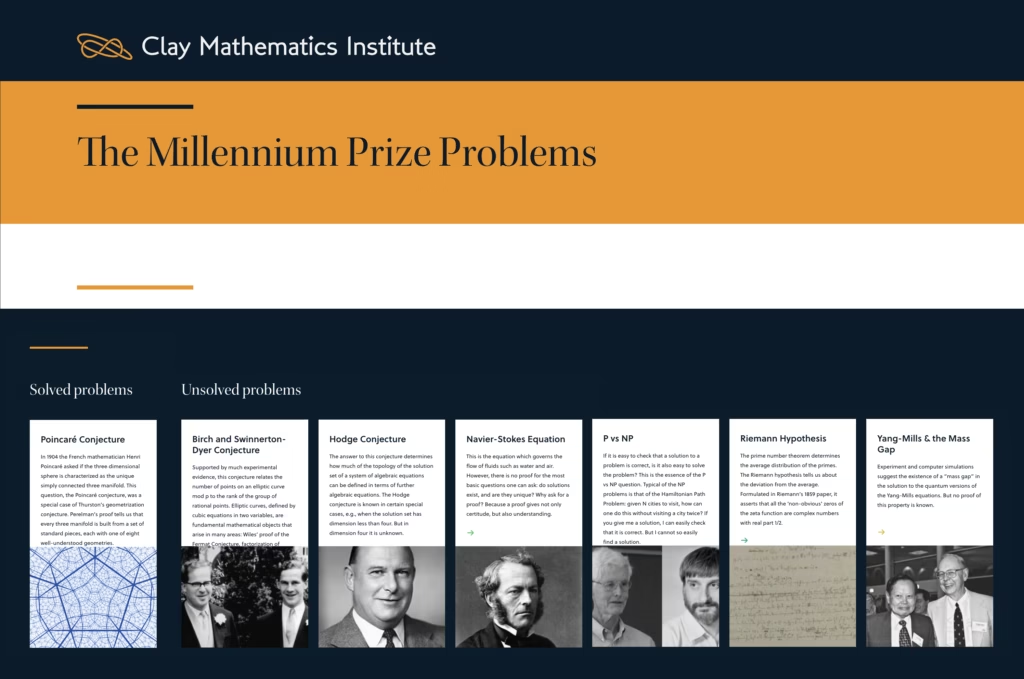
The difficulty in solving these problems is largely because they represent the deepest, most fundamental conceptual bottlenecks in modern mathematics and theoretical physics, requiring conceptual frameworks that do not exist in classical computing, due to challenges like extreme structural depth and profound complexity across fields.
The six remaining Millennium Problems sit exactly where our existing mathematical abstractions stop being powerful enough to bridge local knowledge and global truth.
We know enormous amounts around each problem. In several cases the conjecture is so strongly supported that most specialists expect it to be true. What has been missing is the mathematical mechanism that makes the result inevitable rather than observed.
What was missing for more than a century was not necessarily another mathematical idea. In each case, mathematics had already identified where the answer lived. What was missing was a computational instrument capable of reaching it.
Quantum Compute as the Missing Mathematical Instrument
Today, AIX Global has published a new paper, titled, “Demonstrating Quantum Value by Solving the Six Remaining Clay Millennium Problems,” presenting formal resolutions of all six remaining Clay Millennium Prize Problems:
P versus NP — (1971) a 55 year old problem
The Riemann Hypothesis — (1859) a 167 year old problem
The Yang-Mills Mass Gap — (1954) a 72 year old problem
The Hodge Conjecture — (1950) a 76 year old problem
The Birch and Swinnerton-Dyer Conjecture — (early 1960’s) a 62–64 year old problem
Navier-Stokes Existence and Smoothness — (1822) roughly a 180+ year old problem
These six problems span computational complexity, analytic number theory, quantum field theory, algebraic geometry, arithmetic geometry, and nonlinear partial differential equations.
They have almost nothing in common mathematically.
But they share one critical feature:
Each contains a decisive mathematical structure that can be defined, but has remained inaccessible to computation in the regime where the problem is actually decided.
That is where Seed IQ changes the equation.
Using Governed Fault-Tolerant Quantum Computing, AIX has been able to compute these decisive structures directly, then connect the computed result to the surrounding mathematical argument required for the theorem.
The key discovery was recognizing that, despite their radically different subject matter, the decisive structure in each problem could be represented spectrally.
In everyday terms, a spectrum is simply the collection of fundamental values associated with a mathematical system. It is the same basic idea behind the spectrum of light, the energy levels of an atom, or the notes produced by a musical instrument. In mathematics and physics, the spectrum of the right operator can reveal the hidden structure of an entire system.
For these six problems, the relevant operators are different because the problems themselves are different. But the computational question is remarkably similar:
What is the decisive spectral quantity, and can we compute it exactly?
- For the Riemann Hypothesis, the spectrum encodes the structure of the non-trivial zeros of the zeta function.
- For Yang-Mills, it is the spectral gap between the vacuum and the first excitation.
- For Hodge, it is the structure of the relevant zero-energy kernel.
- For Birch and Swinnerton-Dyer, it is the relationship between an analytic spectral quantity and the arithmetic rank of an elliptic curve.
- For P versus NP, it is a persistent spectral separation associated with computational complexity.
- Navier-Stokes uses spectral control of the structure governing the behavior of vorticity.
“What was striking was not simply that these were six different problems. They come from six very different areas of mathematics. What they shared was that each contained a decisive structure that could be defined mathematically but had remained inaccessible in the regime where the problem is actually decided. Quantum computation gave us a way to reach those structures.” – Denis Ovseyenko, Co-Founder and Chief Innovation Officer, AIX Global
The important point is that the quantum computer is not doing the mathematics for us.
The mathematics tells us what quantity matters. Seed IQ then makes the previously inaccessible computational part of that mathematics accessible through governed quantum computation. The resulting value becomes a computed certificate, which is then carried through the remaining mathematical argument.
In simplified form:
mathematical problem → decisive structure → quantum computation → computed result → mathematical proof
Quantum computation is not replacing mathematical reasoning. It is providing a computational instrument for the part of the reasoning that could not previously be evaluated directly.
Quantum computation makes the previously inaccessible part computable.
But How Do We Know the Instrument Works?
There is an important additional element in the new paper that we believe is essential to understanding the work.
Before relying on the same computational approach for six unresolved problems, we applied it to a problem for which the answer is already known: the Poincaré Conjecture, the seventh Millennium Prize Problem, solved by Grigori Perelman in 2003.
We did not use Perelman’s proof as our computational input and simply reproduce his conclusion. Instead, we approached the problem independently using the same fundamental question applied to the six unresolved problems:
What mathematical invariant, if computed exactly, decides the core of the problem?
For Poincaré, that route leads to a spectral formulation associated with Ricci flow. The governed quantum computation reaches the known fixed point corresponding to the three-sphere, producing the same topological conclusion that Perelman’s work established by a completely different route.
This is why we describe Poincaré as a positive control.
A positive control is a problem where the correct answer is already independently established. If an experimental or computational method is supposed to work, applying it to something whose answer is already known provides a way to test whether the method produces the expected result.
In other words, before asking the instrument to tell us something new, we asked it to recover something we already knew to be true.
It did.
The Poincaré result is not being presented as a seventh Millennium Prize resolution. Perelman’s theorem stands on its own, and his proof remains the established proof. Our Poincaré computation only serves to demonstrate that the same spectral computational pathway used for the six remaining problems can recover an independently established mathematical truth. The result is also included in the same Lean 4 verification package as a kernel-checked control theorem.
That gives us a very different kind of confidence in the computational architecture.
Before attempting to produce answers to the remaining six unsolved Millennium Problems, we first demonstrated that the same computational approach could recover a known extraordinary answer.
Six Problems. Six Different Mathematical Worlds. One Computational Question.
Although the mathematics is completely different in each case, the computational question was the same: identify the decisive structure, represent it in a form quantum computation can evaluate, and determine the invariant that controls the unresolved core.
- For P versus NP, Seed IQ computes the structural boundary-expansion invariant used in the resolution and follows its persistence through increasingly powerful proof systems, leading to the formal conclusion P ≠ NP.
- For the Riemann Hypothesis, the computation realizes and evaluates the self-adjoint spectral structure associated with the non-trivial zeta-zero ordinates, with the paper deriving the critical-line condition from the resulting real spectrum.
- For the Yang-Mills Mass Gap, governed FTQC evaluates the nonperturbative low-energy spectral structure and the continuum argument carries a strictly positive gap through removal of the lattice regulator.
- For the Hodge Conjecture, the computation evaluates the rational relationship between the (p,p) cohomological structure and algebraic-cycle classes, with the paper concluding that the rational Hodge classes are generated by algebraic cycles.
- For the Birch and Swinnerton-Dyer Conjecture, Seed IQ computes and composes the relevant arithmetic information into the global L-function and evaluates its central behavior alongside the Mordell-Weil rank, producing the equality at the heart of BSD.
- And for Navier-Stokes Existence and Smoothness, the computation evaluates the turbulent attractor and, critically, the geometric structure controlling vortex stretching in the high-vorticity regime, with the resulting argument excluding finite-time blow-up.
Computed within roughly one week.