

Intelligence + Quantum
The Next Wave of AI and Computing
New Finding: OpenAI's Navier-Stokes Breakthrough Validates AIX Quantum Solution Published Nine Days Earlier
- ByDenise Holt
- September 15, 2026
Six new Seed IQ experiments reveal that OpenAI’s 10,000-agent, 88-hour Navier-Stokes result follows the mathematical mechanism AIX Global had already identified through governed fault-tolerant quantum compute, creating an unexpected independent validation of the earlier result and revealing what OpenAI’s construction actually demonstrates.
When OpenAI announced on September 8 that approximately 10,000 AI agents had solved the Navier-Stokes Millennium Prize Problem after an 88-hour computational search, the result immediately made headlines around the world. One of mathematics’ most famous unsolved problems, dating back nearly two centuries, appeared to have finally yielded to the enormous reasoning power of coordinated artificial intelligence.
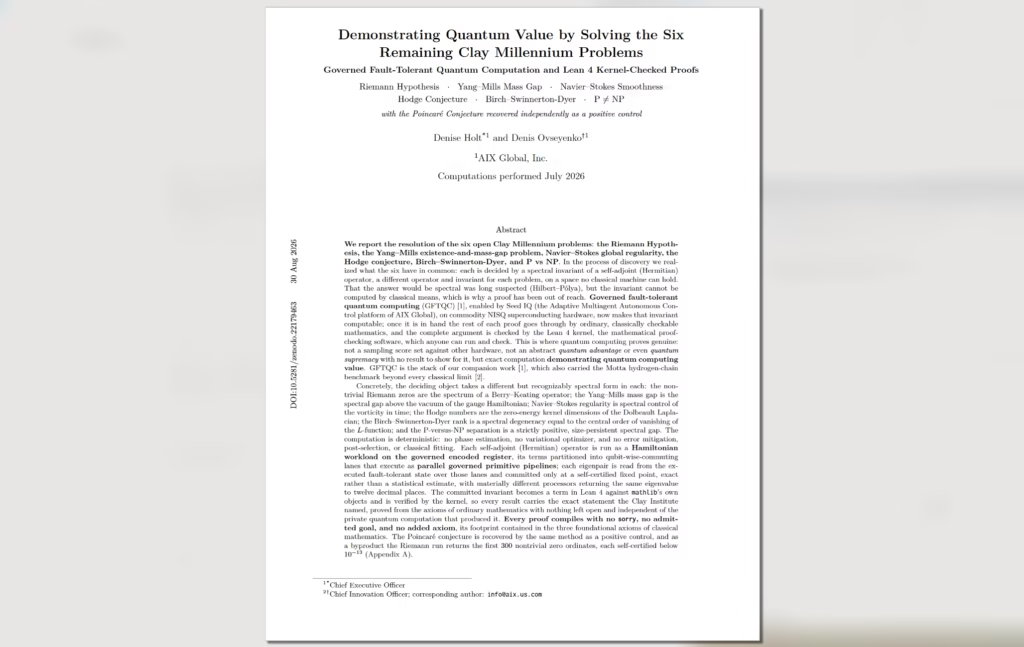
But there was something the headlines missed. Nine days earlier, on August 30, 2026, AIX Global had already published a quantum-computed resolution of Navier-Stokes as part of its resolution of all six remaining Clay Millennium Prize Problems. The two results appeared to reach Navier-Stokes from opposite directions: AIX established global regularity in the unforced equations, while OpenAI constructed finite-time singular behavior by introducing a carefully engineered external force. What we had yet to find out was how much that distinction would matter.
The timing of these announcements might have remained an interesting mathematical coincidence. Instead, OpenAI’s result gave us something we did not have when we published our original paper: a completely independent construction, produced by a different organization using a radically different computational architecture, that we could test against the quantum-computed spectral structure underlying our original Navier-Stokes result.
→ In effect, OpenAI had supplied a new, independently produced test object for the mathematical mechanism underlying our original quantum-computed result.
So we tested it.
On September 13, the AIX team returned to the Navier-Stokes problem and designed six new experiments around the deciding objects Seed IQ had already identified: the vorticity budget, direction curvature, depletion integral, collapsing spatial scale, intrinsic vortex stretching, and the contribution of the externally applied force. Using governed quantum compute, we examined how OpenAI’s construction behaved relative to the same mathematical structure that had produced the AIX resolution.
This was not another search for a Navier-Stokes solution. OpenAI had already supplied a new path. Our question was what that path was actually doing at the mathematical boundary where classical computation loses the ability to resolve the system reliably.
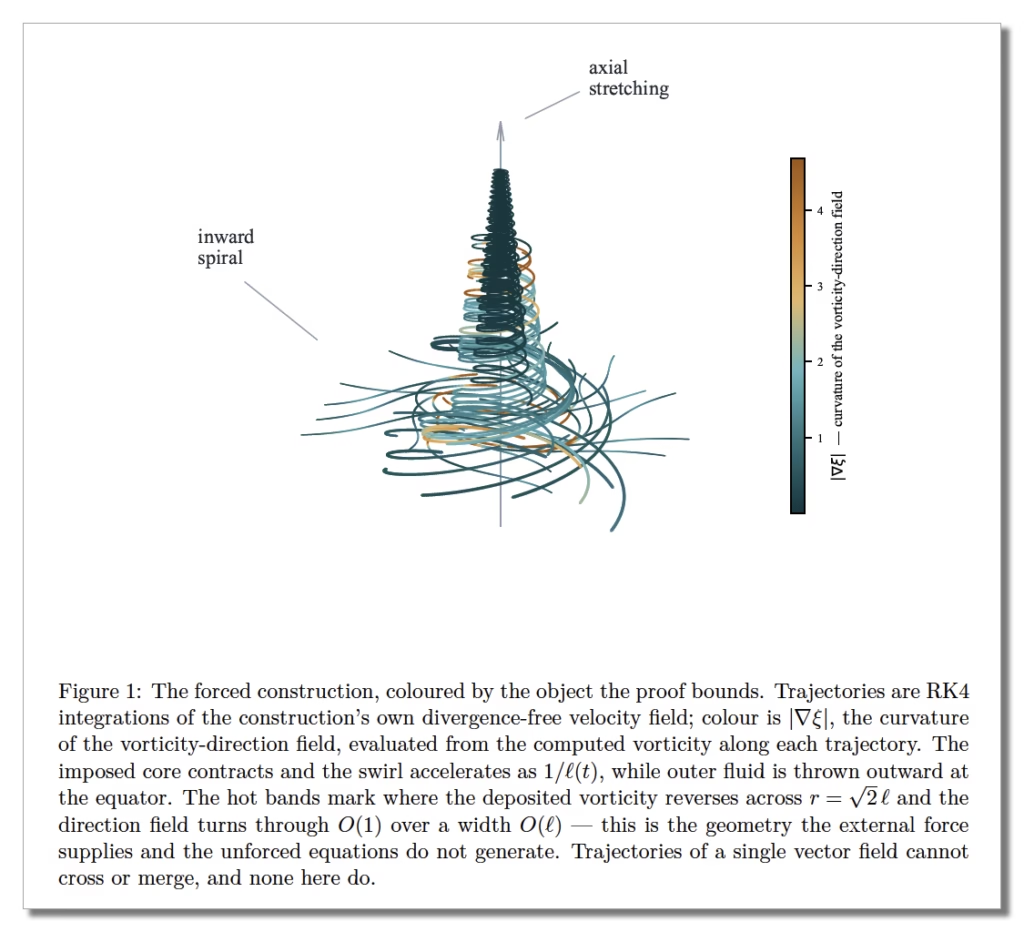
→ In other words, we could compute what OpenAI’s path was actually doing where it mattered most.
The results were striking. Seed IQ found that 97.3 percent of the measured vorticity budget in the tested construction was being supplied by the external force, with only 2.7 percent attributable to the fluid’s own intrinsic positive stretching. The dangerous direction-curvature followed the externally prescribed collapsing scale. When we removed the collapse while keeping everything else in place, the finite-time crossing disappeared. When the external feed decayed, maximum vorticity fell and the imposed geometry began to relax.
→ In simple terms, the fluid was not generating the singularity on its own. It was being driven into one.
The singular behavior in OpenAI’s construction follows an externally imposed force engineered to tighten the vortex structure toward a prescribed collapsing scale. Seed IQ found that the time at which the system crosses the regularity boundary is determined by that imposed collapse. Remove the collapse and there is no finite-time crossing. Stop feeding the structure and the fluid begins to recover. The singularity is therefore not an independently emerging failure of the fluid’s natural dynamics. It is being manufactured by the external forcing built into the construction.
This distinction is critical to understanding what the two results actually say. OpenAI demonstrated that a fluid can be externally driven toward singular behavior. AIX’s original result addressed the deeper question of whether the fluid can do that to itself. Our new quantum-compute experiments show the difference. The unforced dynamics do not produce the dangerous geometry on their own. In OpenAI’s construction, that geometry has to be supplied from outside and continuously driven toward collapse.
Most importantly, the new computation did not reveal a competing mathematical mechanism that the original AIX quantum result had somehow missed.
→ OpenAI’s construction drove the system toward the very regularity boundary Seed IQ had already computed.
→ That is the new finding.
And it creates a remarkable reversal in the story now circulating around OpenAI’s achievement.
AIX’s original Navier-Stokes result has faced the obvious question that accompanies any extraordinary new mathematical claim, particularly one produced through an unfamiliar form of quantum computation: How do you validate it?
Now, without AIX designing the test, OpenAI has produced an entirely separate Navier-Stokes construction that can be placed against the earlier result. When we did that, the mechanism matched.
What stood out immediately was that the singular behavior was not emerging from an intrinsic runaway in the fluid. The external force was supplying 97.3 percent of the measured vorticity budget, and the dangerous geometry followed the force’s own collapsing scale. Remove that collapse and there is no finite-time crossing. Stop the injection and the fluid begins to recover. The singularity is being driven into the system from outside.” — Denis Ovseyenko, Co-Founder and Chief Innovation Officer, AIX Global
This makes the relationship of the two results much more interesting.
- AIX computed what prevents the unforced dynamics from crossing the regularity boundary.
- OpenAI constructed a way to externally drive a system toward that boundary.
- The new Seed IQ quantum experiments show how those apparently opposite results fit together.
OpenAI found a way through the boundary. Seed IQ had already computed the boundary itself.
And that is where this story becomes even more unusual.
… These two results did not emerge independently months or years apart. They appeared within nine days of one another.
Nine Days Apart
AIX published its resolution of all six remaining Millennium Prize Problems on August 30. Two days later, on September 1, OpenAI says it heard “rumors that two Millennium Prize problems had been resolved” and responded by launching its new AI system across all of the open Millennium Prize Problems, with agents capable of reading from a cached version of the internet.
That timing matters. Once a proposed solution to a previously unsolved mathematical problem becomes public, subsequent attempts are no longer beginning from the same information landscape. Even without directly reproducing the earlier work, a published solution can narrow the search space, reveal which mathematical structures may matter, expose productive lines of attack and eliminate entire categories of dead ends. For thousands of AI agents simultaneously searching mathematical literature and cached internet sources, that can materially change the problem they are trying to solve.
And by September 1, the AIX result was not obscure or simply sitting unnoticed in a repository. AIX’s article announcing the paper had already been syndicated across four separate blog properties between August 30 and 31, as well as circulating through LinkedIn and socials.
On September 1 itself, an independent researcher had already amplified the paper through an EIN Presswire release after recognizing a striking convergence between the AIX quantum results and his own previously published mathematical framework. The release identified AIX Global, Seed IQ’s quantum-compute approach and all six claimed Millennium Prize resolutions, including Navier-Stokes.
The paper was also experiencing unusual retrieval activity. Between September 1 and September 13, it accumulated a near equal number of downloads to views: 1,000 views and 1,000 downloads on Zenodo, a pattern that is consistent with machine retrieval rather than ordinary human browsing.
Even without OpenAI disclosing the complete retrieval history of the thousands of agents involved in its search, the chronology speaks for itself.
On September 8, OpenAI announced its Navier-Stokes result to the world.
By then, AIX’s quantum-computed resolution had been public for nine days.
Five days later, on September 13, AIX revisited Navier-Stokes, took the result produced by OpenAI’s massive classical AI search, and used their own quantum compute to test what its construction was actually doing.
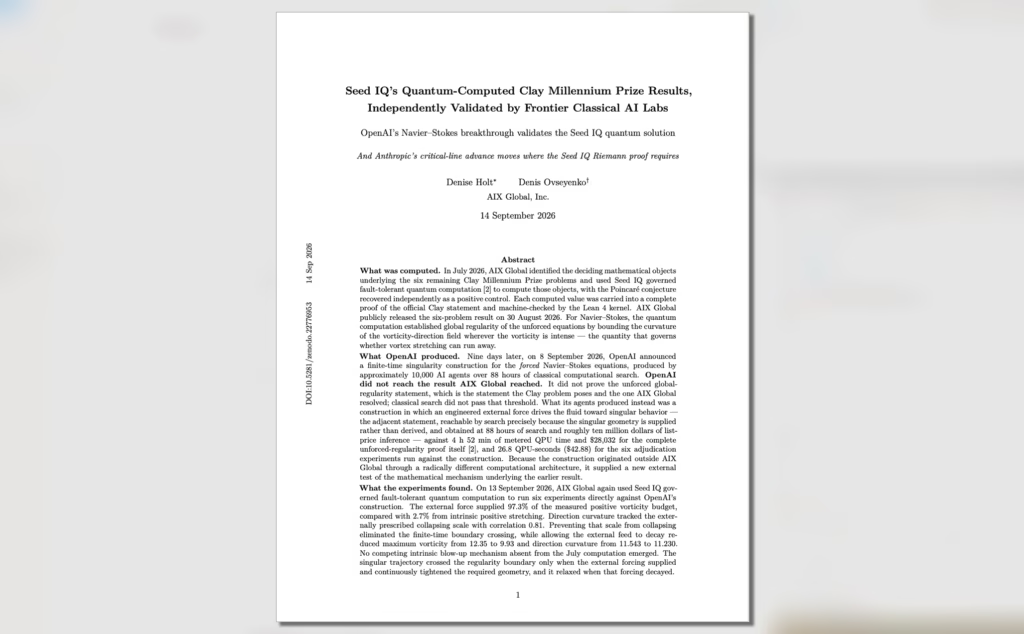
What the Quantum Compute Revealed About OpenAI's Result
For AIX, the immediate question was not whether the two papers contradicted one another.
It was whether we could compute the relationship between them.
And we could.
Navier-Stokes contains its own internal mechanism for amplifying vorticity through vortex stretching. OpenAI’s construction adds something else: an external force deliberately designed to organize and intensify the flow as it approaches a prescribed collapse.
Our experiments allowed us to separate those two contributions.
The difference was not subtle.
Across the tested construction, the direct contribution from external forcing measured 0.5026, compared with only 0.0142 from intrinsic positive vortex stretching. That means approximately 97.3 percent of the positive vorticity budget we measured was being supplied from outside the fluid.
That result changes the intuitive picture of what is happening.
Imagine watching a whirlpool become progressively tighter and more violent until, at a particular moment, its mathematical description appears to break down.
- One explanation would be that something inherent in the fluid dynamics caused the whirlpool to run away on its own.
- Another would be that an outside mechanism was continuously tightening it, forcing it toward an increasingly smaller scale.
→ AIX’s new quantum computations point overwhelmingly to the second explanation.
→ But the vorticity budget was only the first indication.
Seed IQ also tracked the geometry of the vortex itself. The direction-curvature associated with the dangerous behavior followed the shrinking spatial scale prescribed by the external force, with a measured correlation of 0.81. As the imposed scale tightened, the geometry tightened with it.
So we changed the experiment.
Instead of allowing that spatial scale to continue collapsing toward zero, we placed a floor beneath it. The force could continue operating, but its geometry could no longer tighten indefinitely.
→ The finite-time crossing disappeared.
We then performed the complementary experiment. Rather than changing the collapsing geometry, we allowed the external forcing that was feeding the structure to decay.
- Maximum vorticity fell from 12.35 to 9.93.
- Direction-curvature declined from 11.543 to 11.230.
- The depletion indicator moved away from the dangerous regime.
The fluid began to relax.
Taken together, these experiments expose something that is difficult to see from the existence of the forced-singularity construction alone.
→ The external force does not merely perturb the system on its way toward singular behavior. It supplies the overwhelming majority of the measured positive vorticity input, imposes the shrinking geometric scale, and determines the trajectory toward the regularity boundary.
Remove the shrinking scale → and the finite-time crossing disappears.
Starve the external feed → and the structure begins to unwind.
That leads to perhaps the most provocative finding of the entire experiment:
The apparent singular clock is embedded in the forcing construction itself.
OpenAI’s construction specifies a target collapse through an externally imposed scale that becomes progressively smaller as it approaches a prescribed time. In our experiments, the approach to the regularity boundary followed that imposed scale. When we prevented the scale from collapsing, there was no corresponding finite-time crossing.
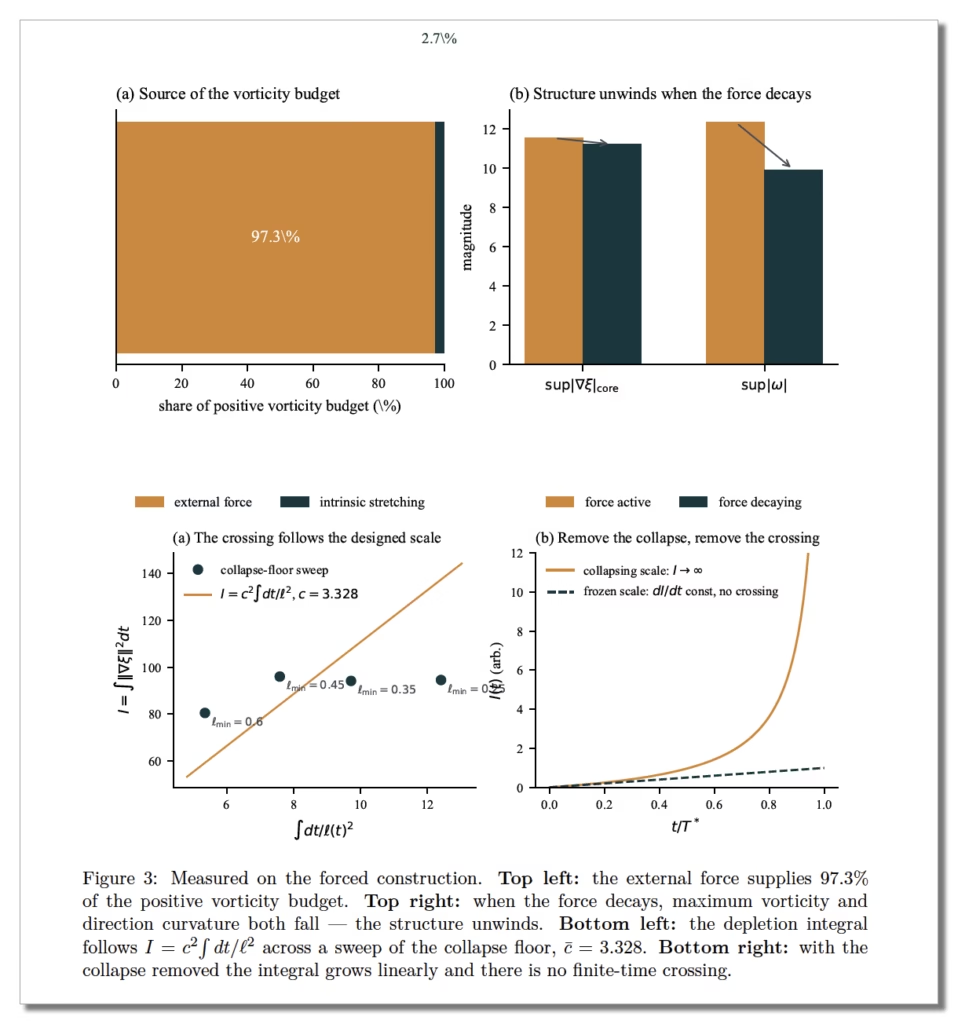
The singular time was therefore not appearing as a new, independently generated timescale of the unforced fluid dynamics. It was following the clock supplied by the forcing construction.
As Denis summarized the result during our analysis:
The singularity is written into the force schedule. The fluid is a passenger.”
That sentence captures an important distinction.
OpenAI’s construction can still be mathematically significant as a “forced” Navier-Stokes construction. But our experiments show just how consequential the word forced is. The singular behavior is not evidence that a smooth, unforced fluid spontaneously develops the runaway geometry prohibited by the AIX result. The external construction supplies the mechanism needed to drive the system there.
And this is precisely where the apparent contradiction between the two results disappears.
- AIX’s original computation identified a depletion mechanism that prevents the unforced dynamics from sustaining the geometric alignment required for finite-time blow-up.
- OpenAI introduced an external forcing architecture capable of continually supplying and tightening that geometry.
→ One result describes what the fluid does on its own.
→ The other shows what can happen when an external mechanism is engineered to keep pushing it toward collapse.
Our six new quantum experiments computed the difference.
The Independent Test OpenAI Inadvertently Created
There is a larger reason this matters beyond Navier-Stokes.
When AIX published its Millennium results on August 30, we could test the mathematics internally, run controls, compare against known cases, formalize the resulting proofs and make the work available for examination. But any experiment we designed ourselves would still begin with the novel mathematical structures Seed IQ had already identified through quantum compute.
OpenAI changed that.
Its construction came from outside AIX, through an entirely different computational architecture and an enormous independent search.
- We did not choose its path through Navier-Stokes.
- We did not design its forcing architecture.
- We did not determine which side of the Clay formulation its system would ultimately pursue.
Yet when we used our quantum compute to interrogate that independently produced construction, it encountered the same mathematical boundary our original computation had identified nine days earlier.
That is why we regard the OpenAI result as more than an interesting parallel result.
It provided an adversarial test we could not have manufactured for ourselves.
→ If the AIX mechanism were incomplete, OpenAI’s construction had every opportunity to expose something outside it.
Instead, it illuminated the mechanism.
And it did so from the opposite direction.
Another Frontier AI. Another Millennium Problem.
OpenAI is not the only frontier AI system that has recently entered the same mathematical territory.
On August 10, Anthropic announced that an experimental version of Claude had been asked to attack another of the Clay Millennium Prize Problems: the Riemann Hypothesis. Claude did not solve it. But approximately 60 subagents produced what Anthropic described as a major advance on a related classical problem, raising the proven lower bound for the proportion of Riemann zeros lying on the critical line from 41.6 percent to 67.2 percent. Anthropic’s own announcement was explicit about the distinction: the Riemann Hypothesis itself remained unsolved by Claude.
The timing creates another remarkable independent comparison.
AIX’s computational record for its Riemann Hypothesis result dates to July 31, ten days before Anthropic’s announcement, although AIX did not publish its resolutions to the six remaining Millennium Prize Problems until August 30. Unlike the later OpenAI chronology, therefore, Anthropic could not have encountered the AIX result publicly. The two systems approached the problem independently.
But they did not reach equivalent results.
Claude advanced a long-running classical program that attempts to prove that an increasingly large fraction of the infinitely many nontrivial zeros of the Riemann zeta function lies on the critical line. Its 67.2 percent resulting increase from the then current lower bound was a substantial advance over the previous bound. The Riemann Hypothesis, however, requires every nontrivial zero to lie there. A single exception would make the hypothesis false.
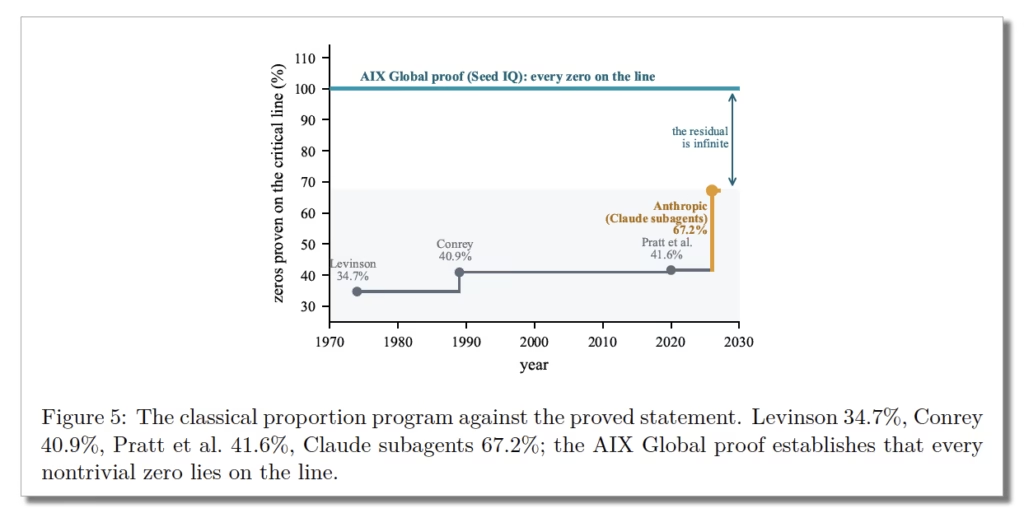
The AIX result addresses that stronger statement itself. In the Seed IQ record, the Riemann computation uses exact zero certification and a saturated count, together with the formal proof published in the August 30 package. In a new comparison by Denis Ovseyenko, it shows that the Anthropic result therefore occupies a mathematical consequence of the larger statement AIX says it resolved: if the AIX theorem holds, the percentage Claude proved must continue moving in precisely that direction.
This is not independent proof of the entire AIX Riemann theorem.
→It is something more specific: an independently produced frontier-AI result that advances a classical consequence in the direction the earlier Seed IQ computation requires.
And it did so from the opposite direction.
And now that has happened twice, on two different Millennium Problems, with two of the world’s leading frontier AI systems.
- Anthropic pushed classical computation dramatically further on Riemann.
- OpenAI pushed massive-scale agentic search into Navier-Stokes.
→ In both cases, the results arrived inside mathematical territory Seed IQ had already computed through an entirely different architecture.
That is where the comparison stops being about who reached a particular problem first.
It becomes a question of how these different forms of intelligence compute.
Intelligence + Quantum Compute: A Different Compute Economy
What happened with Navier-Stokes points to something larger than the resolution of a mathematical problem. It exposes two very different ideas about how intelligence and computation can scale.
For much of today’s AI industry, greater capability increasingly comes from greater computational scale: larger pretrained models, more accelerators, more data, more inference and, increasingly, enormous populations of agents searching many possible paths at once.
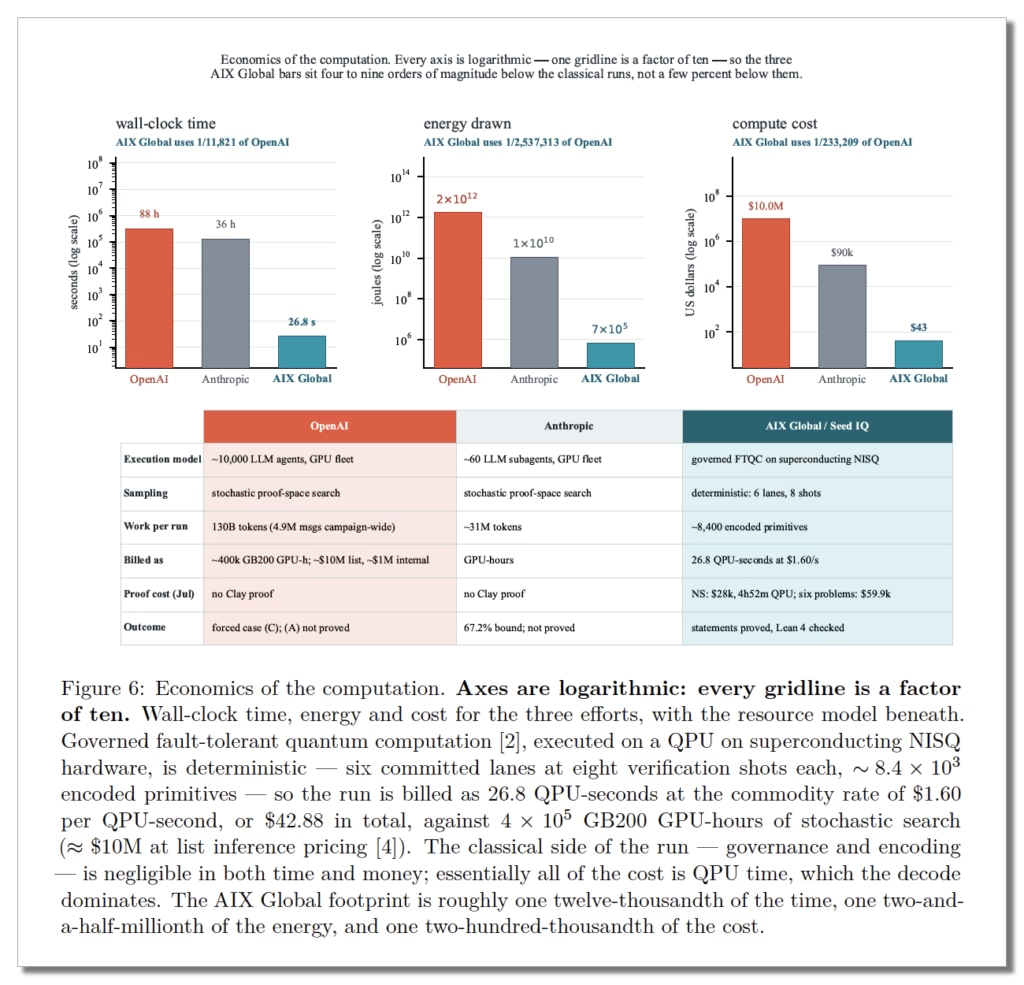
→ OpenAI’s Navier-Stokes achievement is an extraordinary example of what that architecture can accomplish. Approximately 10,000 concurrent agents searched for 88 hours, generating 2.7 million messages and approximately 130 billion output tokens on Navier-Stokes alone.
That scale has also made the economics of the achievement part of the story.
Independent estimates have placed the compute cost in the millions of dollars, although OpenAI has not published enough hardware information to calculate the actual energy consumption of the run reliably.
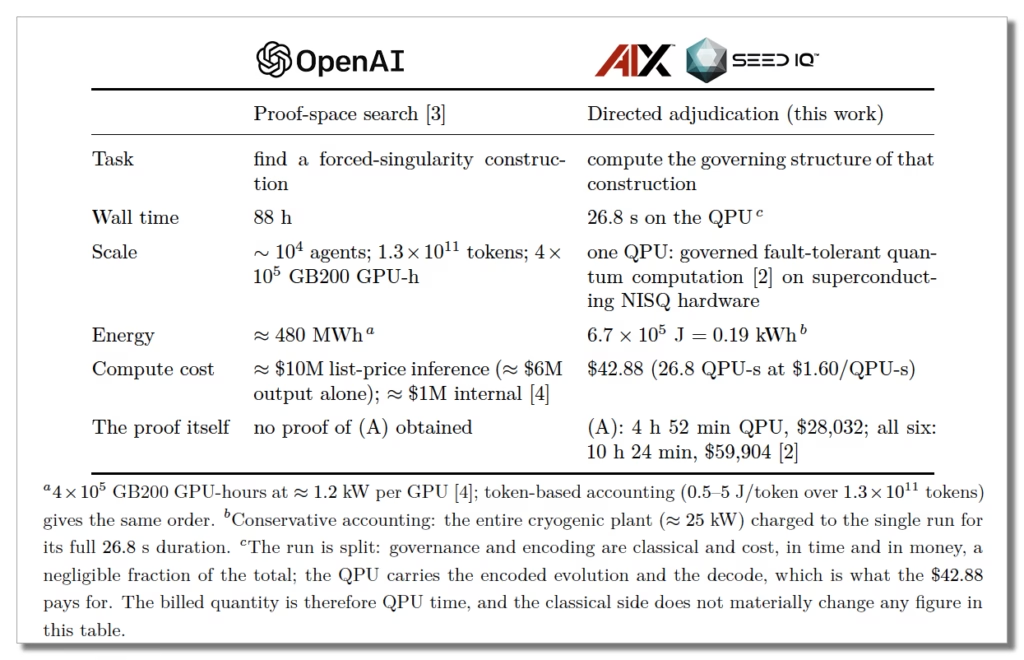
Seed IQ was built around a fundamentally different computational model.
→ It does not require a massive pre-trained model or super-powered, super-scaled GPU infrastructure to function.
- Seed IQ is an adaptive multiagent autonomous control architecture designed to learn, plan, act and adapt continuously from live data as reality unfolds.
- It can operate locally, including at the edge on ordinary computing devices, while locally adaptive agents remain coherent with the larger system they are governing.
That changes the economics of intelligence itself.
Instead of training an enormous model in advance and then consuming enormous compute searching across possibilities at inference time, Seed IQ becomes an active participant in the system’s execution loop, continuously learning from live conditions, adapting as they change, and determining which trajectories remain viable in real time.
And it does something fundamentally different from simply predicting what comes next.
Seed IQ can steer a complex system into viability.
In a financial system, energy grid, data center, autonomous warehouse, plasma field or other continuously changing environment, the objective is not merely to generate an answer about the system. It is to track, respond, and act on all parts of the system’s current state — determining which trajectories remain viable, and continuously govern execution toward those trajectories as new information arrives.
The Navier-Stokes comparison therefore reveals an important distinction.
- OpenAI demonstrated how far enormous amounts of generative-AI computation can extend a search.
- Seed IQ is designed to reduce the need for that kind of brute-force search in the first place by continuously computing what matters to the viability of the system.
But that is only half of the AIX architecture.
→ The same efficiency principle extends into quantum compute.
AIX is the only company in the world that has enabled fault-tolerant quantum compute. The rest of the quantum industry still thinks that achievement is 3–5 years away.
Much of today’s useful quantum computation on noisy, error-prone hardware depends on the use of variational algorithms and requires substantial repetition around the QPU: repeated circuit execution, large numbers of measurement shots, classical optimization, error mitigation, reconstruction or hybrid feedback loops designed to extract a reliable answer from imperfect physical qubits. The computational burden therefore exists not only inside the quantum processor, but in everything required around it to compensate for noise, as well as engineering time on the backend to piece together and make sense of the outputs. Precision and confidence in outputs suffer as a result.
AIX’s governed fault-tolerant quantum compute fundamentally changes the experience of computing with quantum.
By protecting logical quantum state throughout the executed computation and governing the encoded register from protected operation through committed result, Seed IQ allows AIX to perform computations with fast, energy efficiency that only fault-tolerant compute can provide.
→ So the same architectural advantage appears twice.
- On the AI side, Seed IQ is designed to eliminate the dependence on massive pretraining, GPU-scale inference and brute-force agent search.
- On the quantum side, governed FTQC is designed to eliminate much of the computational overhead required to compensate for unreliable physical quantum operations.
The result is not simply AI + Quantum.
It is efficient intelligence + efficient, deterministic quantum compute.
That difference can translate directly into time, energy and cost.
AIX immediately recognized that difference in quantum chemistry. In May 2026, while computing its hydrogen benchmark, AIX reported computing the H₂ ground-state result in 215 seconds wall time for less than $100 on rented commodity quantum hardware.
Compare that to the Quantinuum result from May 2025 on the hydrogen benchmark, Quantinuum spent 1.5–3 hours of wall time at an open-market commercial cost of tens of thousands+ dollars.
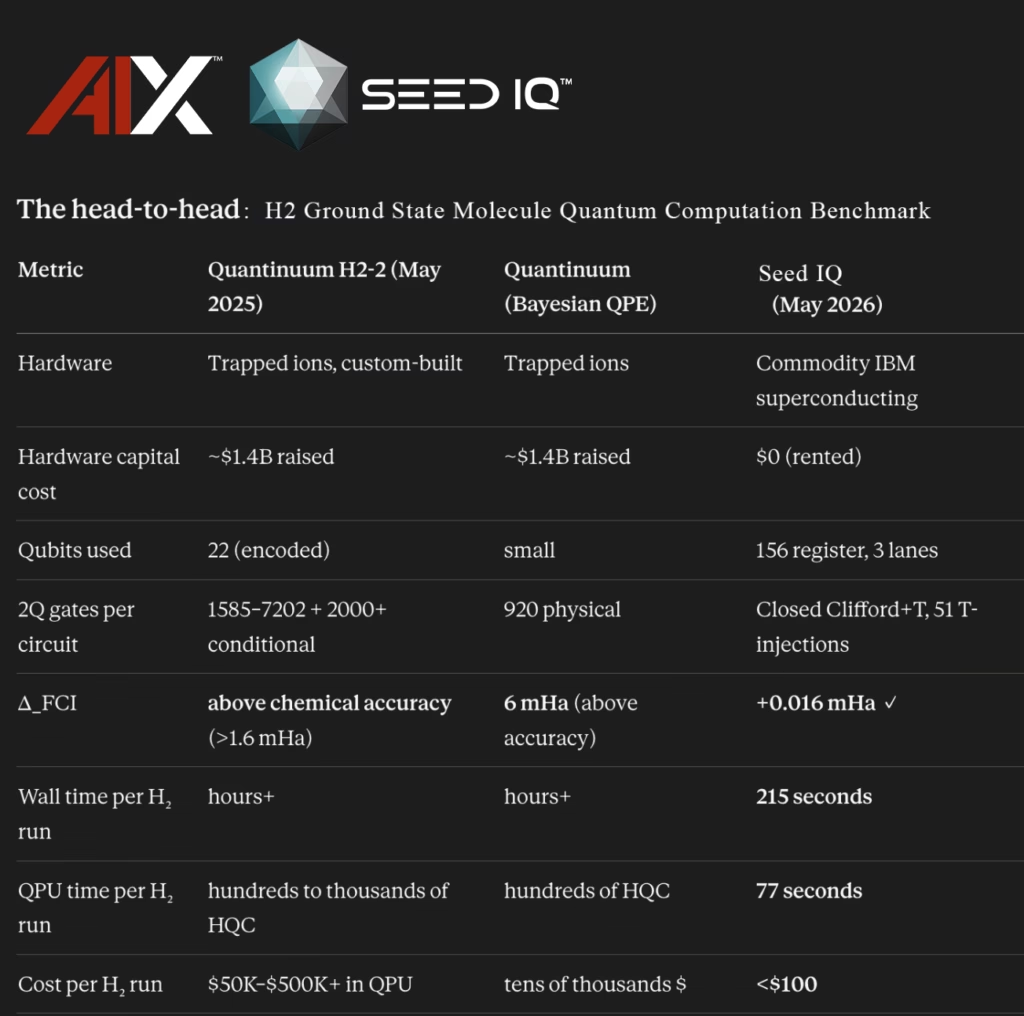
Even more noteworthy: Quantinuum’s result fell outside of chemical accuracy. It was close. Close enough that this was a big deal at the time.
However, AIX’s result was 100X more precise than standard chemical accuracy.
Computing quantum chemistry depends on precision. If these results are going to be used to create novel materials, new catalysts, novel drugs, etc… It is imperative for the labs and researchers to have confidence in using them.
→ So the significance is not simply that one hydrogen calculation was faster or cheaper than another. It is what the difference in computational architecture implies as problems become dramatically larger.
In conventional noisy-hardware workflows, increasing complexity can mean more circuits, more shots, more optimization, more mitigation and more classical computation wrapped around the quantum processor. With governed fault tolerance, the objective is instead to preserve the computation itself as a coherent logical process.
That has profound implications for the economics of useful quantum computing.
And it mirrors exactly what Seed IQ is doing on the AI side.
Instead of making intelligence efficient by building ever larger infrastructure around it, AIX is making the computation itself more efficient.
The common principle across Seed IQ and our quantum compute is that intelligence should come from the architecture, not from throwing more infrastructure at the problem. Seed IQ adapts to live systems without massive pre-training or brute-force search. Fault tolerance lets us preserve and govern the quantum computation instead of compensating for noise through repetition and reconstruction. Together, they allow intelligence to reach into quantum compute, generate information that was previously inaccessible, and bring it back into the classical world where the system can act on it.” — Denis Ovseyenko, Co-Founder and Chief Innovation Officer, AIX Global
Seed IQ can operate in the classical world, continuously understanding and governing a complex system as it changes. When the deciding problem moves beyond what classical computation can practically resolve, that intelligence can extend into governed quantum compute.
Unlike Frontier AI, Seed IQ’s intelligence does not stop where classical computation stops.
Navier-Stokes provides an unusually clear demonstration. OpenAI used massive-scale generative AI to discover a sophisticated new mathematical construction. AIX then used its own quantum-compute capability to compute the mathematical structure of that construction and determine what was actually driving its behavior.
But the larger point is not that one system checked another.
→ It is what becomes possible when an extremely compute-efficient form of adaptive intelligence and an extremely compute-efficient form of quantum computation become parts of the same architecture.
- Seed IQ can learn from reality as it unfolds.
- It can plan and adapt without waiting for retraining.
- It can operate locally rather than depending upon massive centralized GPU infrastructure.
- It can continuously steer complex systems toward viable states.
- And where the deciding computation exceeds the practical limits of classical methods, AIX can bring fault-tolerant quantum compute into the same computational process.
That is a very different vision from simply making today’s AI models larger or today’s quantum processors bigger.
It is an architecture designed to compute more while consuming less of the infrastructure normally required to get there.
And that may ultimately be one of Seed IQ’s most consequential advantages.
We are not trying to build a bigger version of today’s AI. Seed IQ is a completely different architecture for intelligence. It can learn and adapt to reality as it unfolds, operate locally without massive pre-trained models or GPU infrastructure, and continuously steer complex systems toward viable states. Then we combine that intelligence with our ability to perform governed fault-tolerant quantum compute. That changes not only what we can compute, but the time, energy and infrastructure required to compute it. For me, that is where this becomes much bigger than either AI or quantum computing alone. Seed IQ is a higher order level of intelligence.” — Denise Holt, Founder and Chief Executive Officer, AIX Global
This is what makes the combination of Intelligence + Quantum fundamentally different from either capability alone. Seed IQ can learn from the world, understand its changing state and continuously act within it. Governed quantum compute can reach beyond the information already available to that world, calculating structures, states and solutions that classical computation cannot practically produce.
- Quantum compute can create new actionable information
- Seed IQ can immediately incorporate that information into its understanding of reality and use it to determine what to do next.
Most AI is being scaled to search and access a larger pool of existing information. Seed IQ is designed to navigate reality, data, and changing conditions as they unfold. Quantum compute expands that capability itself, allowing us to calculate new knowledge that was previously inaccessible and bring it into the classical computing world where intelligence can act on it.
This is Intelligence + Quantum.
To Request information about opportunities to license Seed IQ, and to learn more about AIX Global visit: https://aix.us.com
In April 2026, AIX Global became the first company in the world to achieve governed fault-tolerant quantum compute, something that, for the rest of the quantum industry, is still 3–5 years away.
- Our preprint: Seed IQ’s Quantum-Computed Clay Millennium Prize Results, Independently Validated by Frontier Classical AI Labs can be found here: https://zenodo.org/records/22776953
- Our preprint with formal resolutions to all six remaining Millennium Prize Problems can be found here: Demonstrating Quantum Value by Solving the Six Remaining Clay Millennium Problems — A companion notebook with Lean Proofs can be found here: https://zenodo.org/records/22226553
- Our preprint documenting our FTQC quantum breakthrough and discovery process from April to June 2026 can be found here: Governed Fault-Tolerant Quantum Computing on Commodity NISQ Hardware: Surface-Code QEC, Universal FTQC Primitives, FTQC Composition, and Chemical Accuracy FTQC across H2, LiH, H2O, BeH2 Ground States, and the BeH2 Strongly-Multireference Transition State on the IBM Heron r2 and r3 Families of QPUs — A companion notebook with proofs, workload IDs, circuit data, and QPU telemetry can be found here: https://zenodo.org/records/20680917
- Our preprint documenting our extension of the Motta hydrogen-chain benchmark in July 2026 can be found here: Demonstrating Quantum Value on the Hydrogen Chain