

Intelligence + Quantum
The Next Wave of AI and Computing
Seed IQ Beats NVIDIA's Audited Financial Risk Benchmark with Exact Quantum Computation
- ByDenise Holt
- September 3, 2026
Quantum Financial Risk Without Sampling: Seed IQ Reports 35× the Throughput of NVIDIA’s Audited STAC-A2 Record
AIX Global applies Seed IQ Governed Fault-Tolerant Quantum Computing to financial risk, reporting deterministic, machine-precision calculations across derivatives pricing, Value-at-Risk, Expected Shortfall, XVA, Greeks and portfolio optimization, while sustaining 35× the option-valuation throughput of NVIDIA’s audited 8×H100 STAC-A2 benchmark.
Over the past several days, AIX Global has begun revealing pieces of what we have been quietly computing since publishing our governed fault-tolerant quantum computing breakthrough in June.
The significance of these announcements is not simply that Seed IQ can execute fault-tolerant quantum computation. That was the threshold we crossed first. The more consequential question has always been what value becomes computable once that capability exists.
- Our hydrogen-chain work demonstrated exact computation beyond the practical reach of classical computing.
- Our Millennium Prize work demonstrated a much broader proposition: quantum computation can become an instrument for accessing previously inaccessible mathematical structures whose value exists independently of the machine that produced them.
- Our collaboration with GODOT begins moving that capability into physical industrial systems where the economic value of a computed answer can ultimately be measured.
Today, we are revealing another area where Seed IQ has already been computing, and this one goes directly to the heart of the global financial system.
Financial Risk
In July 2026, AIX applied Seed IQ Governed Fault-Tolerant Quantum Computing to the workload calculations financial institutions perform every day to price derivatives, measure risk, calculate exposure, construct hedges, allocate capital and optimize portfolios.
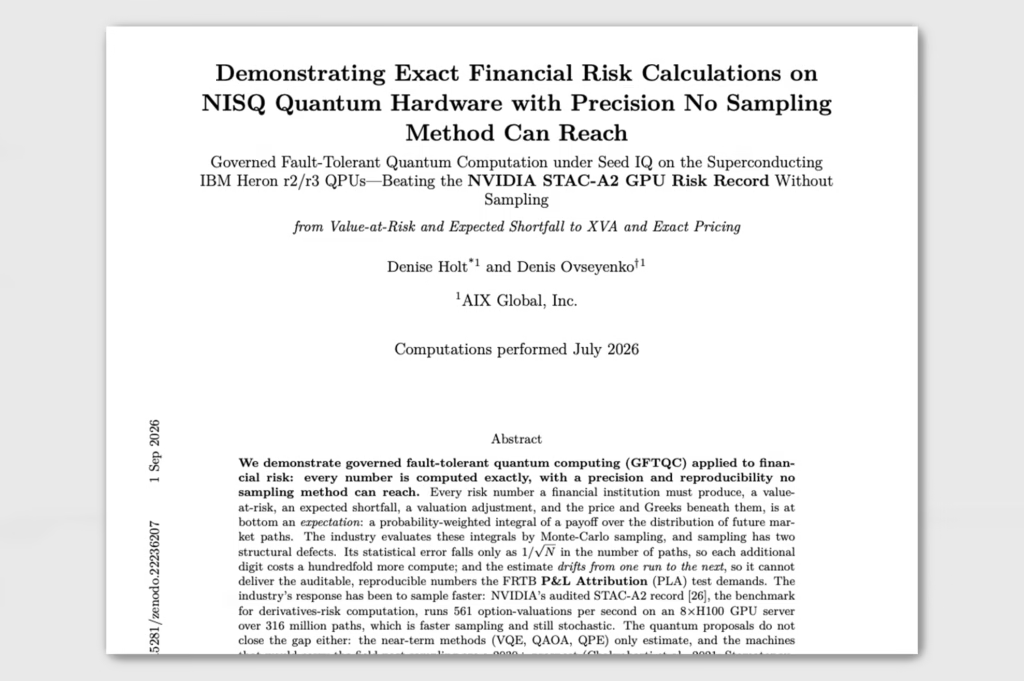
The resulting preprint, Demonstrating Exact Financial Risk Calculations on NISQ Quantum Hardware with Precision No Sampling Method Can Reach, reports something that initially sounds like a performance story: on the derivatives-risk workload represented by NVIDIA’s audited STAC-A2 benchmark,
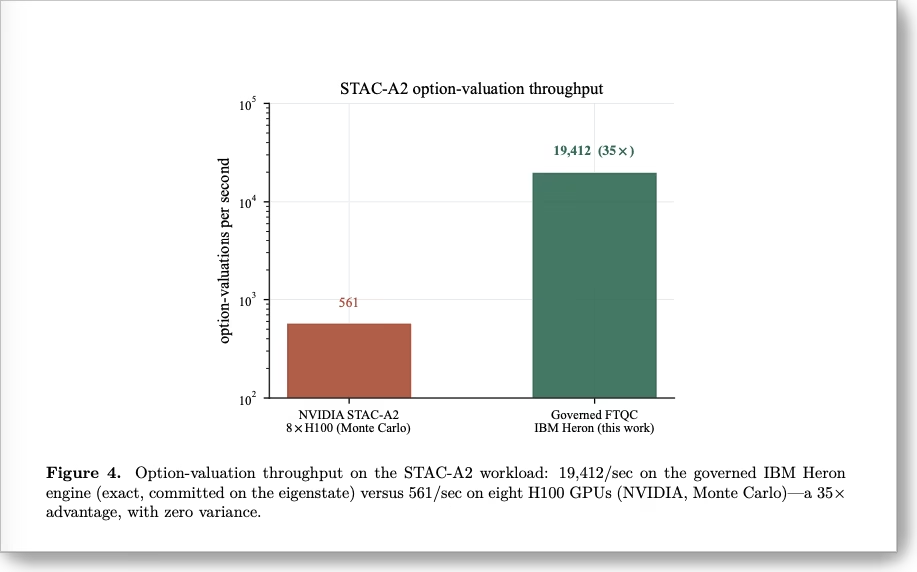
- Seed IQ sustained 19,412 option valuations per second
compared with
- 561 option valuations per second for NVIDIA’s record-setting Dell XE9680 system equipped with eight H100 GPUs.
That is approximately 35 times the option-valuation throughput.
That number will understandably attract attention.
But it is not the most important part of the result.
NVIDIA’s extraordinary computing infrastructure is being used to perform Monte Carlo sampling faster.
Seed IQ is not sampling at all.
And that distinction may be much more important for financial computing than the 35× performance comparison itself.
The Problem With Sampling
Financial risk is fundamentally a problem of calculating expectations. A bank may need to determine the expected loss of a portfolio, the probability-weighted value of a derivative across future market conditions, the likely exposure to a counterparty, or the effect of changes in volatility, interest rates and correlations.
Mathematically, many of these questions ultimately reduce to probability-weighted integrals over possible future market states.
For decades, the dominant way to calculate many of these quantities has been Monte Carlo simulation. The basic method is simple: generate a very large number of possible future market paths, calculate what happens in each one, and use the collection of outcomes to estimate the answer.
The problem is that the result remains an estimate.
Finance Runs on Estimates
The difficulty is that real financial systems quickly become too complex for those integrals to be evaluated directly by conventional methods. There may be hundreds of assets, thousands of market factors, path-dependent products, changing correlations, early-exercise conditions and multiple layers of contingent exposure.
So the industry samples.
Monte Carlo simulation generates large numbers of possible future market paths, evaluates what happens under each one, and averages the results to estimate the answer. It is universal, flexible and extraordinarily useful. Much of quantitative finance as we know it depends on it.
But Monte Carlo carries an unavoidable mathematical property: its statistical error falls only in proportion to 1/√N, where N is the number of paths.
This means precision becomes progressively more expensive. To reduce error by a factor of ten, approximately one hundred times as many samples are required. Another decimal place means another hundredfold increase. Then another.
And because the calculation is based on random sampling, running exactly the same calculation again can return a slightly different answer.
The industry has responded exactly as one would expect: sample faster.
GPUs have transformed computational finance by making it possible to process enormous numbers of paths simultaneously. Quasi-Monte Carlo methods use more structured sequences to improve convergence under certain conditions. Financial institutions deploy sophisticated distributed risk engines and large compute clusters specifically to push more scenarios through the system in less time.
NVIDIA’s STAC-A2 achievement represents the extraordinary engineering progress made along this path.
But there is a more fundamental question underneath it:
What if we stop sampling?
The NVIDIA STAC-A2 Benchmark
STAC-A2 is an independently audited industry benchmark designed around derivatives-risk computation, making it especially useful as a reference point because it is not a quantum benchmark created to showcase quantum hardware.
NVIDIA’s published record runs on a Dell PowerEdge XE9680 with eight H100 GPUs. On the benchmark workload, that system processes 316 million Monte Carlo paths and achieves 561 option valuations per second across a 440-asset universe.
That is an enormous amount of classical computational power applied to one of the industry’s hardest problems.
Seed IQ approached the same workload differently.
Rather than attempting to process those paths faster, AIX’s governed quantum engine represented the relevant financial structure as a governed quantum computation and directly computed the expectation associated with the workload.
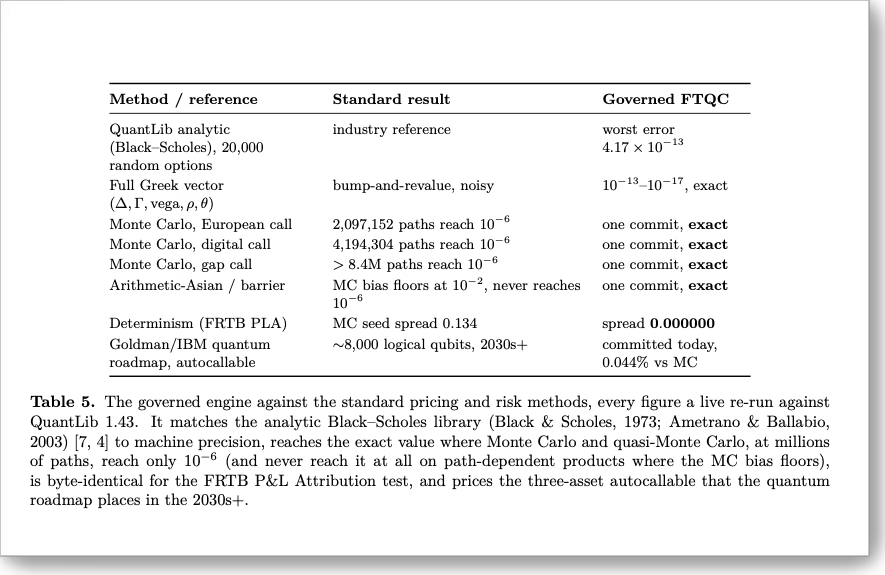
The paper reports 19,412 option valuations per second, approximately 35× NVIDIA’s published STAC-A2 rate. But more importantly, the paper reports each committed price at machine precision, with zero statistical variance and byte-identical output on rerun.
That performance difference is significant, but it is not the most important result.
Seed IQ is not claiming to be a faster Monte Carlo engine.
It is not out-sampling the H100.
It eliminates the need for the 316 million sampled paths in the first place.
The NVIDIA system is producing a stochastic estimate. The governed quantum computation is producing a deterministic committed value.
“Sampling is what you do when calculating the complete answer directly is computationally impractical. Once that constraint changes, the problem changes with it. The 35× throughput comparison is significant, but the more fundamental result is that we are no longer introducing computational uncertainty through sampling in the first place.” – Denis Ovseyenko, Co-Founder and Chief Innovation Officer, AIX Global
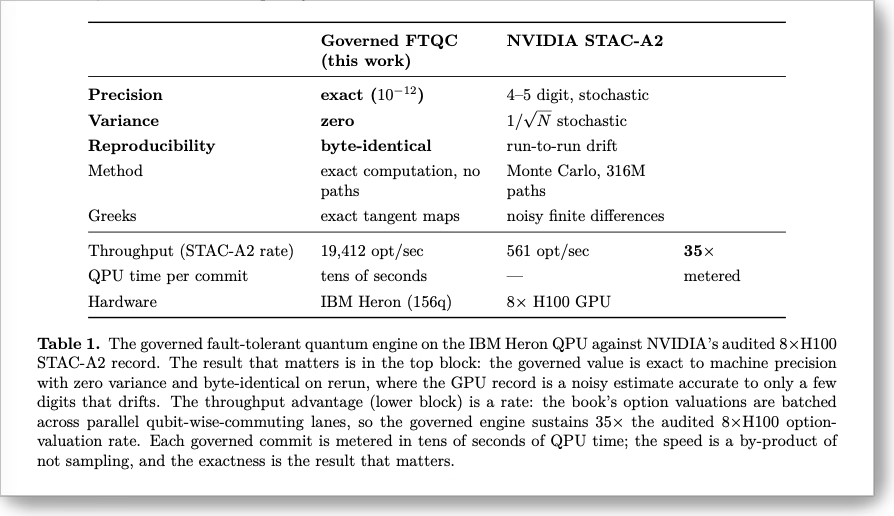
The 35× throughput advantage emerges from that computational difference.
Computing the Answer Instead of Estimating It
Under Seed IQ, the paper describes the financial calculation as a governed fault-tolerant quantum workload. The risk-neutral density is encoded into a governed quantum register, and the system evolves toward a self-certified eigenstate corresponding to the target computation.
Once the governed commit criteria are satisfied, the required expectation is evaluated directly.
There is no Monte Carlo path count that must grow with desired precision. There is no statistical confidence interval that must be squeezed through additional samples.
The paper reports values committed at machine precision, zero variance and identical output across reruns.
For a general audience, the difference can be understood very simply.
Imagine trying to determine the exact average depth of an enormous lake.
One approach is to take more and more measurements at different locations. A thousand measurements may produce a useful estimate. A million may produce a better one. A billion may produce an extraordinarily precise one.
But you are still estimating the whole from samples.
The approach described in this paper is fundamentally different. Instead of asking how many measurements are required to narrow the uncertainty around the answer, the computation is structured so that the quantity itself becomes the committed result.
That is why the paper describes the result as exact rather than estimated.
The Precision Wall
The distinction becomes dramatic as the required precision increases.
The paper calculates that a Monte Carlo method targeting 10⁻³ error would require approximately 2.1 × 1⁰⁸ paths. Reaching 10⁻⁶ grows that requirement to approximately 2.1 × 1⁰¹⁴ paths. At 10⁻⁹, it becomes approximately 2.1 × 1⁰²⁰ paths.
- To match the 10⁻¹² precision of the governed quantum commit, the estimated requirement becomes approximately: 2.1 × 1⁰²⁶ Monte Carlo paths.
At that point, this is no longer a question of whether NVIDIA releases a faster GPU.
It is not a hardware-generation problem.
It is a scaling-law problem.
Every sampling architecture has to pay for greater accuracy through more computation. A newer GPU can move along that curve faster, but it does not remove the curve.
Seed IQ’s governed computation, as reported in the paper, does not sit on that sampling curve at all.
The precision is determined by the committed computational state rather than by the number of random paths used to approximate it.
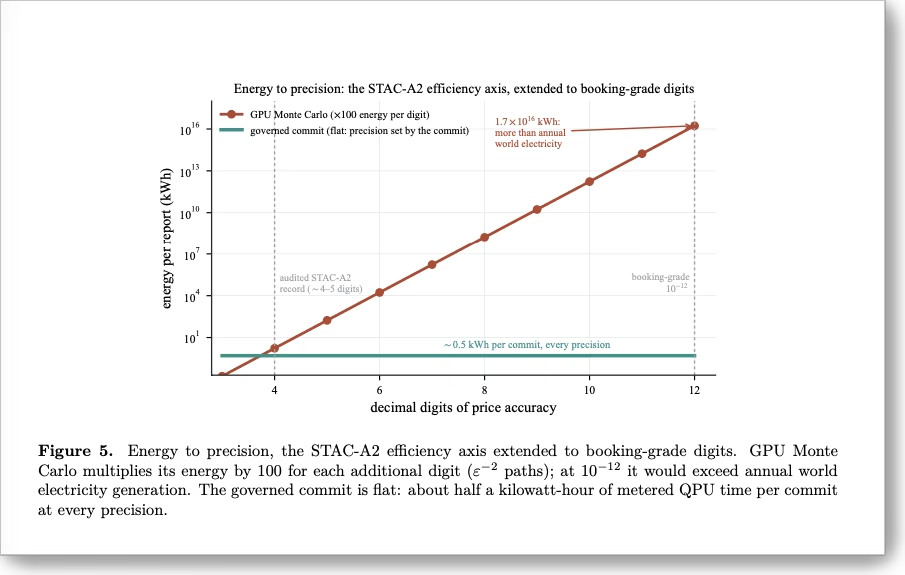
That distinction also changes the energy equation. The paper notes that the audited STAC-A2 workload uses roughly 1.7 kWh to produce its approximately four to five stochastic digits. Extending the same Monte Carlo scaling to 10⁻¹² would make the required energy physically unrealistic, because each additional decimal digit multiplies the sampling requirement approximately one hundredfold.
The governed computation, by contrast, reports approximately half a kilowatt-hour of metered QPU time per commit with precision effectively fixed at the machine floor.
Again, the point is not that a quantum processor simply uses less electricity than a GPU.
The point is that precision itself no longer has to be purchased through exponentially larger sampling budgets.
- The most important advantage is not simply computational speed.
- It is the removal of the accuracy-versus-compute tradeoff.
Why Reproducibility Matters in Finance
There is another consequence that may be even more important to financial institutions than raw performance.
Financial risk calculations are not simply used internally to help a trader make a decision. They feed regulatory reporting, capital allocation, counterparty reserves, hedging, backtesting and reconciliation.
Those numbers need to be reproducible.
Under the Basel Fundamental Review of the Trading Book framework, for example, the P&L Attribution test compares a desk’s risk-theoretical and hypothetical profit-and-loss behavior. A risk engine that introduces its own run-to-run estimator noise creates an additional reconciliation problem.
Monte Carlo’s stochastic character does not disappear simply because more hardware is added. The variance can become smaller, but two calculations with the same underlying inputs can still produce different sampled results.
The AIX paper reports a different behavior: the governed values are byte-identical on rerun.
The paper’s validation work reports a governed seed spread of 0.000000, while the comparison Monte Carlo calculation drifts. Across the wider validation set, the governed commits reproduce the industry’s analytic references to machine precision.
For financial institutions, that distinction translates into something much more tangible than a benchmark score.
It means the uncertainty comes from the market and the financial model itself, not from randomness introduced by the computation used to calculate the result.
From VaR and Expected Shortfall to XVA
The work extends across a broad range of financial calculations.
The paper reports the full FRTB Internal Models Approach Expected Shortfall matrix, including the 63 separate 97.5% Expected Shortfall calculations a trading desk must produce each day. It also reports Value-at-Risk calculations, including a regime-aware model that remained calibrated through a correlation-regime shift.
The same architecture was applied to XVA, the collection of valuation adjustments financial institutions use to account for counterparty credit risk, funding, margin and capital.
XVA is particularly computationally demanding because it often creates a simulation inside a simulation. An outer Monte Carlo process models future exposure over many dates, while inner simulations repeatedly reprice the underlying portfolio at those future states. The computational workload can grow into billions of valuations.
The paper reports governed calculations of wrong-way CVA, where market exposure becomes adversely correlated with the probability of counterparty default, with the computed values tracking reference results to approximately 10⁻⁶ basis points while remaining deterministic.
This is where replacing sampling becomes economically interesting.
The value is not simply in calculating today’s risk number faster. It is potentially in making deeper, more complex, more frequently updated calculations practical without multiplying nested simulation workloads.
Exact Greeks and Better Hedging
A derivative price is only the beginning of a trading desk’s computational problem.
Institutions also need to know how that price changes when markets move.
Those sensitivities are known as the Greeks: Delta, Gamma, Vega, Rho, Theta and others.
In a sampled system, Greeks can introduce yet another layer of noise because they are frequently obtained by changing an input, rerunning the pricing calculation, and measuring the difference between two already noisy estimates.
Seed IQ’s paper reports the Greeks differently: as exact tangent maps of the committed price.
Against QuantLib analytic references, the reported errors across Delta, Gamma, Vega, Rho and Theta fall between approximately 10⁻¹³ and 10⁻¹⁷ on the named edge cases.
That matters because hedging decisions depend directly on those sensitivities.
Estimator noise is not merely an academic inconvenience if it flows into how billions of dollars of positions are hedged.
If the underlying computational result becomes deterministic, the downstream economic consequences begin to compound.
And Then There Are Problems Classical Computers Cannot Calculate Exactly at All
The paper also explores another boundary.
There are financial problems for which exact classical computation does not simply become expensive. The state space becomes so large that enumeration becomes physically meaningless.
For a 50-asset basket, the paper estimates an exact classical state space of approximately 1⁰¹¹⁵ cells. For 128 assets it rises to approximately 1⁰²⁹⁴, and for 256 assets to approximately 1⁰⁵⁸⁹.
At an assumed 10 PFLOP/s, the corresponding exact classical computations would take approximately 1⁰⁹¹ to 1⁰⁵⁶⁶ years.
Seed IQ reports the corresponding governed commits in approximately 45 seconds to two minutes of metered QPU time, depending on the workload.
Monte Carlo provides an approximation around that classical impossibility.
The governed quantum calculation is aimed at the exact quantity.
That distinction mirrors what we have already demonstrated elsewhere.
With the Motta hydrogen-chain benchmark, the exact classical configuration space eventually became too large to store or solve.
In financial risk, the exponential wall appears again, but this time the object behind the wall is not a molecular ground-state energy.
- It may be the price of a complex structured product
- the risk of a large basket
- a counterparty exposure
- or an optimal portfolio.
The computational principle is the same.
The economic consequence is entirely different.
Portfolio Optimization
The paper also extends beyond risk measurement into portfolio construction.
Using real index data, Seed IQ was applied to efficient-frontier optimization for the Hang Seng and DAX, matching exact quadratic-programming references to approximately 10⁻¹¹.
It was then tested on a constrained portfolio problem requiring the selection of 10 assets from 20 possible assets, a space of 184,756 candidate subsets. The governed computation identified the same global optimum as exhaustive enumeration, with a reported gap of 3.5 × 10⁻¹⁸, without enumerating all of the candidate portfolios.
At 20 assets, exhaustive enumeration is still possible.
But combinatorial spaces grow extremely quickly.
That makes this example important because it demonstrates the computational structure before the same problem is scaled into regimes where enumerating every possible portfolio is no longer realistic.
A Quantum Finance Roadmap That Was Supposed to Be Years Away
Quantum finance has been discussed for years as one of the most commercially promising future applications of fault-tolerant quantum computing.
The word future has always been important.
Conventional approaches to fault-tolerant derivatives pricing generally assume very large error-corrected machines with sophisticated magic-state distillation infrastructure. The roadmap cited in the paper anticipates approximately 1⁰⁶ to 1⁰⁹ physical qubits for those approaches and places the practical systems well into the 2030s.
The calculations reported in this paper were performed on IBM Heron r2/r3 superconducting processors, with the financial workload running within a physical resource envelope of up to 156 qubits.
The reason is architectural.
Seed IQ does not attempt to build one enormous fault-tolerant circuit and protect the entire depth through a conventional distillation-heavy architecture. It governs the composition of shorter fault-tolerant primitives, restoring admissibility as the computation progresses.
That is the same governed computational principle behind the work AIX has been revealing since June.
The subject matter changes.
The computational capability does not.
From Quantum Capability to Economic Value
This brings us back to the broader question behind this entire series of announcements.
The quantum industry has spent years debating when quantum advantage will occur.
- Can a quantum processor execute something a classical computer cannot reproduce?
- Can it sample from a distribution faster?
- Can it sustain a larger logical circuit?
- Can it beat a benchmark?
Those remain important measures of engineering progress.
But the ultimate economic question is different.
What becomes possible when quantum computation changes the economics of an activity people already spend enormous amounts of money performing?
- Financial institutions already spend heavily on risk computation.
- They already buy enormous amounts of GPU infrastructure.
- They already run hundreds of millions or billions of simulations.
- They already make business, trading and regulatory decisions based on the resulting estimates.
There is no hypothetical market that needs to be invented here.
The computation already has economic value.
So if Seed IQ can replace enormous sampling workloads with deterministic quantum calculations, increase throughput, remove statistical estimator noise, reach precision that sampling cannot economically achieve, and open exact computational access to high-dimensional problems that classical systems cannot enumerate, the economic implication is very different from another quantum demonstration.
The value is not created because the computation ran on a quantum processor.
The value comes from what changes because the answer can now be computed.
That is why the NVIDIA comparison matters.
It gives us an established, independently audited classical benchmark against which the scale of the result can be understood.
And it is why the no-sampling result matters even more.
AIX is not simply reporting a quantum computer that runs the existing financial-computing paradigm faster.
“The benchmark gives us a way to compare the systems on a workload the financial industry already understands. But the larger result is not simply that we can perform that workload faster. We have changed the way the answer is obtained.” – Denis Ovseyenko, Co-Founder and Chief Innovation Officer, AIX Global
The NVIDIA STAC-A2 record demonstrates how extraordinarily fast modern computing has become at sampling financial risk.
Seed IQ asks a different question:
What happens when you no longer need to sample the answer at all?
The answer is exact computation at machine precision, deterministic reproducibility, and approximately 35× the option-valuation throughput of NVIDIA’s audited eight-H100 record on the benchmark workload.
This is another piece of what we have been quietly computing since June.
And perhaps more importantly, it is another example of the transition we believe is now underway.
- From quantum experiments to quantum compute.
- From quantum compute to previously inaccessible answers.
- And from those answers to measurable economic value.
The full preprint, Demonstrating Exact Financial Risk Calculations on NISQ Quantum Hardware with Precision No Sampling Method Can Reach: Governed Fault-Tolerant Quantum Computation under Seed IQ on the Superconducting IBM Heron r2/r3 QPUs, Beating the NVIDIA STAC-A2 GPU Risk Record Without Sampling, from Value-at-Risk and Expected Shortfall to XVA and Exact Pricing, presents the complete financial workloads, benchmark comparisons, validation sweeps and computational methodology.
Seed IQ is not simply demonstrating another way to perform financial computation. It is showing what happens when the underlying computational constraint changes:
- when hundreds of millions of sampled paths can be replaced by a deterministic calculation
- when precision no longer has to be purchased with exponentially more compute
- and when a quantum system can outperform an audited 8×H100 benchmark while producing the exact result instead of an estimate.
That is a very different definition of quantum advantage.
This is no longer about quantum computing proving that it can compute.
The era of asking whether quantum computing can outperform classical computing is giving way to a much bigger question:
What happens to entire industries when quantum computation can produce answers that were previously too expensive, too approximate, or simply impossible to compute?
We are beginning to answer it.
This new work takes that progression directly into one of the most consequential computational environments in the global economy: financial risk.
At AIX, we are changing the economics of the systems that depend on computation everyday.
TO REQUEST INFORMATION ABOUT OPPORTUNITIES TO LICENSE SEED IQ FOR QUANTITATIVE FINANCE, and to learn more about AIX Global visit: https://aix.us.com
In April 2026, AIX Global became the first company to achieve governed fault-tolerant quantum compute.
- Our preprint documenting our FTQC breakthrough and discovery process from April to June 2026 can be found here: Governed Fault-Tolerant Quantum Computing on Commodity NISQ Hardware: Surface-Code QEC, Universal FTQC Primitives, FTQC Composition, and Chemical Accuracy FTQC across H2, LiH, H2O, BeH2 Ground States, and the BeH2 Strongly-Multireference Transition State on the IBM Heron r2 and r3 Families of QPUs — A companion notebook with proofs, workload IDs, circuit data, and QPU telemetry can be found here: https://zenodo.org/records/20680917
- Our preprint documenting our extension of the Motta hydrogen-chain benchmark in July 2026 can be found here: Demonstrating Quantum Value on the Hydrogen Chain
- Our preprint with formal resolutions to the Millennium Prize Problems can be found here: Demonstrating Quantum Value by Solving the Six Remaining Clay Millennium Problems. — A companion notebook with Lean Proofs can be found here: https://zenodo.org/records/22226553
- Information on our new strategic quantum chemistry collaboration between AIX Global and GODOT to apply Seed IQ Governed Fault-Tolerant Quantum Computing to real-world waste streams, hydrogen production, fertilizer recovery and industrial chemistry, moving quantum computation from breakthrough results toward measurable economic value.