

Active Inference & Spatial AI
The Next Wave of AI and Computing
Quantum Now Has a Path to Scale. Seed IQ Just Proved It.
From Error Correction to System Control: The Breakthrough That Changes Quantum Scaling
- ByDenise Holt
- April 12, 2026
A quantum world record was broken last week.
But that is not the whole story…
The real story is that quantum computing now has a viable path to scale.
For decades, the promise of quantum computing has been held back by one fundamental constraint: instability. Not theory. Not algorithms. Not even hardware alone. The inability to maintain coherence, suppress error accumulation, and preserve entanglement long enough for meaningful computation has kept the field locked in a state of perpetual anticipation.
On April 9th, AIX Global Innovations crossed a threshold with Seed IQ™ that fundamentally changes this constraint.
→ And we did it on real quantum hardware.
**Note - This breakthrough announcement is split into three parts:
- Part 1: Article describing the breakthrough
- Part 2. Seed IQ Quantum Hardware Runs: An execution detail summary by Denis Ovseyenko, Chief Innovation Officer, AIX Global Innovations — Linking to an additional QEC Technical Report
- Part 3. Side-by-Side comparisons: How Seed IQ™ Stacks Up to Current Leading QEC Achievements
Okay, Let’s go…
The Journey: From Simulation to Reality
Over the past several months, AIX Global Innovations has been exploring how Seed IQ (Intelligence + Quantum)™, our Adaptive Multiagent Autonomous Control architecture, could be applied to quantum systems.
Our initial quantum work focused on two main barriers to quantum scaling, documented in two reports on our IBM Qiskit simulation work we published early this year.
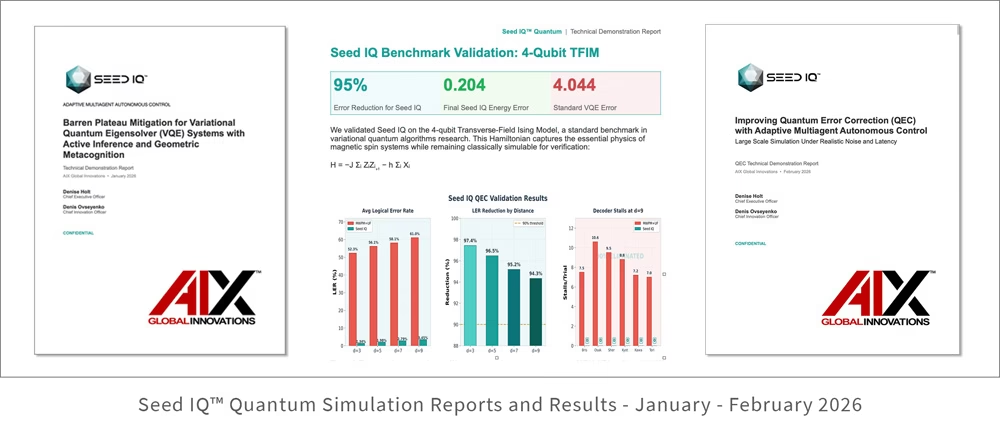
Both of these reports focused on large-scale simulation under hyper-realistic noise conditions modeled after IBM quantum processors and Google’s published Willow hardware results. These simulations represent the closest approximation to hardware available without physical processor access — the same Qiskit Aer framework used by IBM’s own research teams for pre-hardware validation.
The QEC goal was not to create idealized results, but to test whether coordinated, real-time governance of quantum systems could outperform traditional decoders under the same constraints that exist in real hardware.
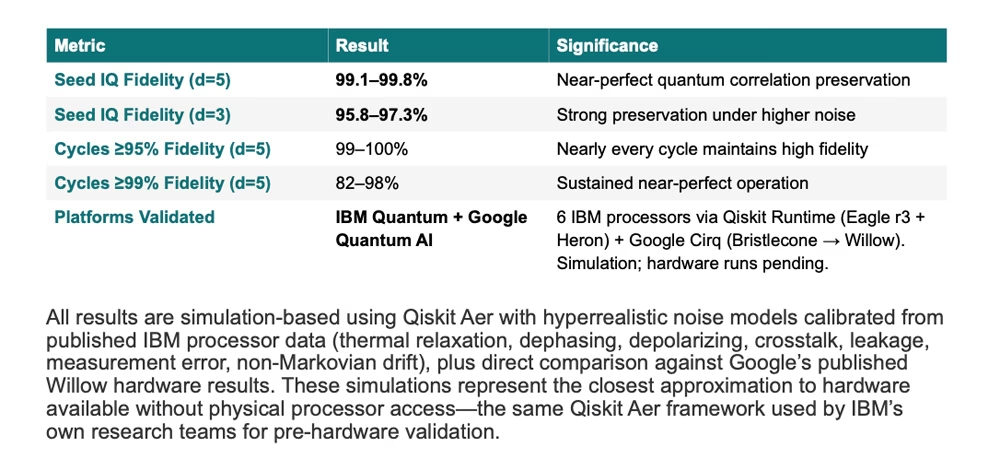
The results were already significant.
Through IBM Qiskit simulation, Seed IQ™ demonstrated:
- Logical error rate reductions of 91–98% across multiple code distances
- Sustained fidelity levels exceeding 99% in entangled qubit systems
- The ability to maintain coherence across cycles where traditional approaches collapsed
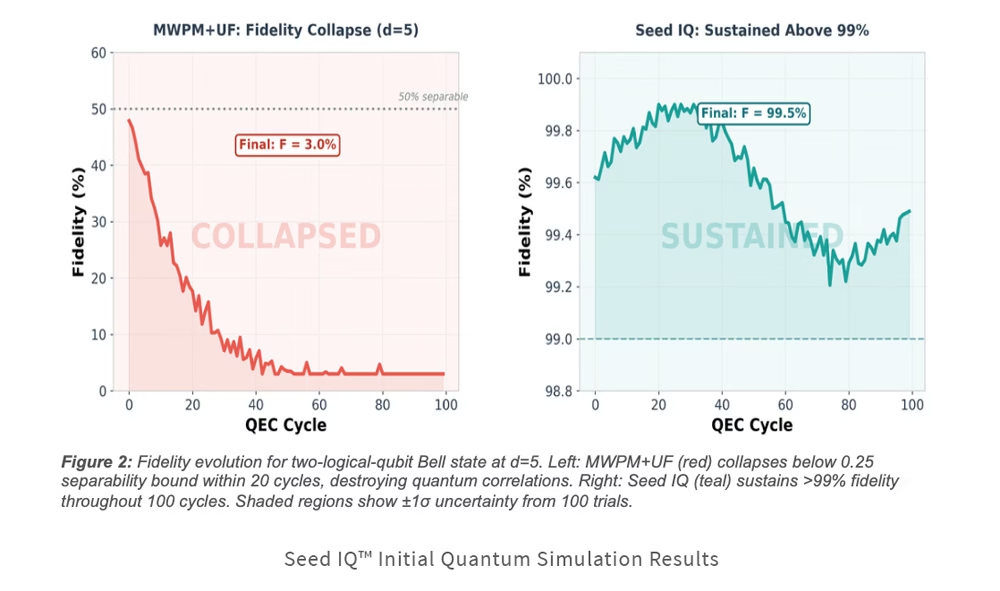
At the time, these results strongly suggested that the bottleneck in quantum computing was not purely a physics problem, but an operational one.
Yet, these were still simulations.
The question remained: Would this hold up under real-world quantum conditions?
April 9th, 2026: The First Hardware Runs
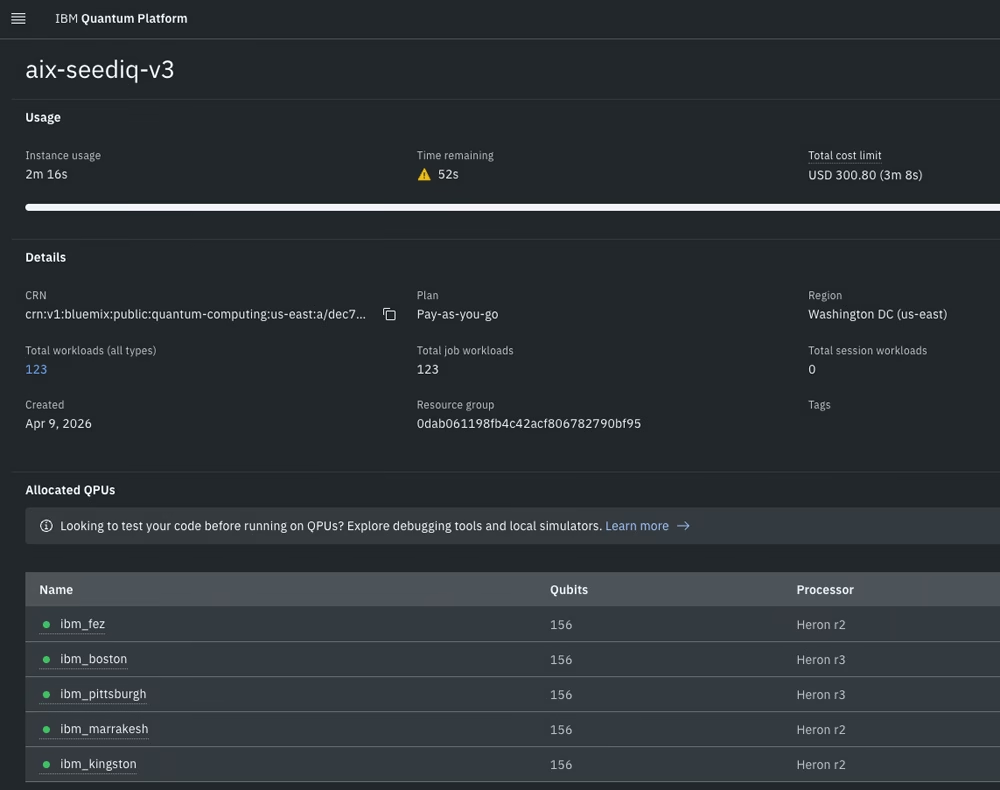
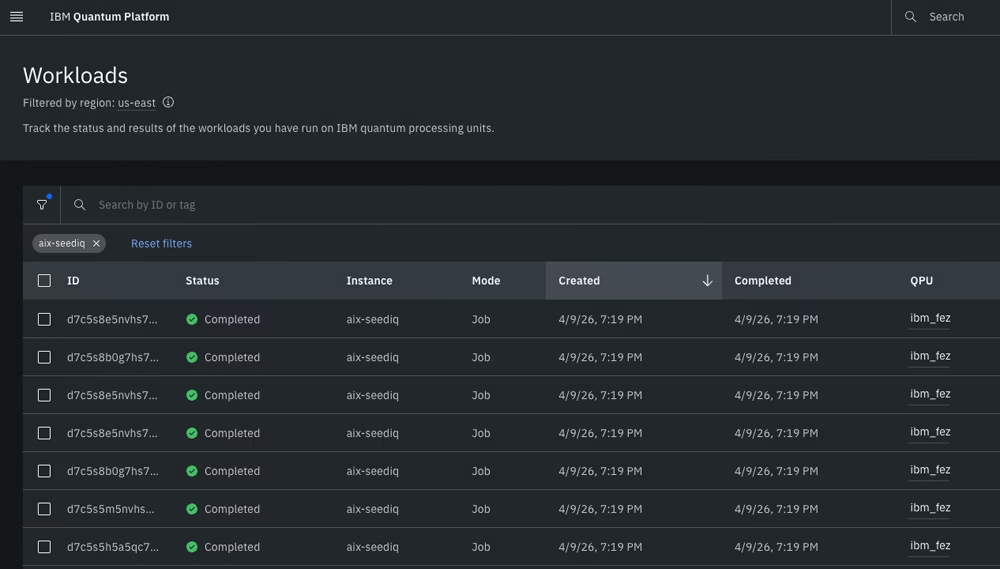
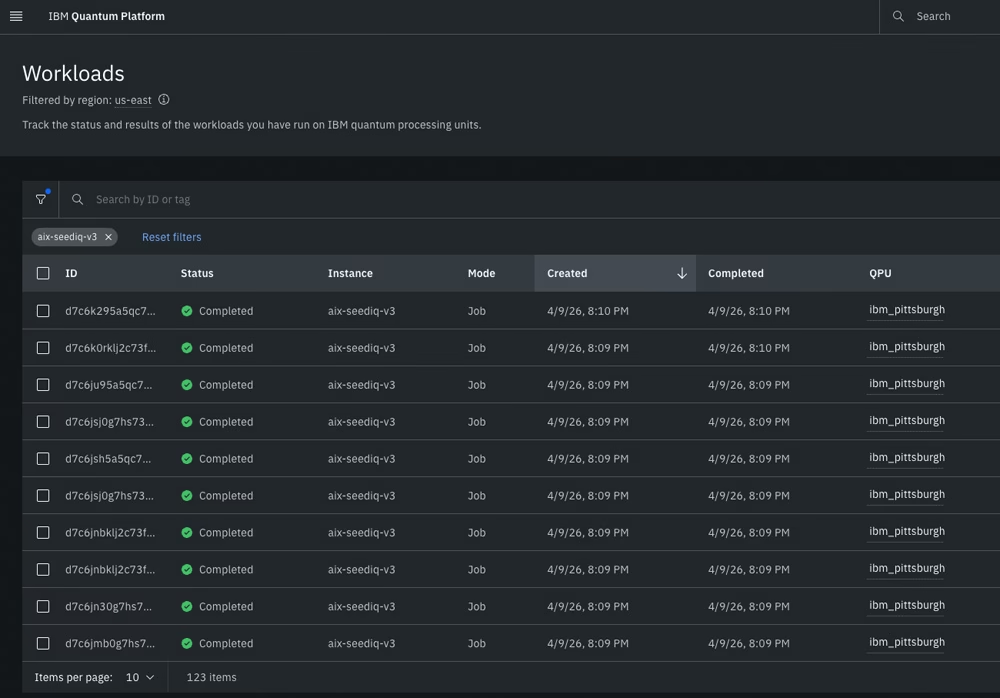
On April 9th, we ran Seed IQ™ directly on IBM Quantum hardware through Qiskit Runtime.
No controlled lab conditions.
No idealized isolation.
No simplified circuits.
Just real hardware, real noise, and full system execution.
What we observed was exactly what we had hoped for.
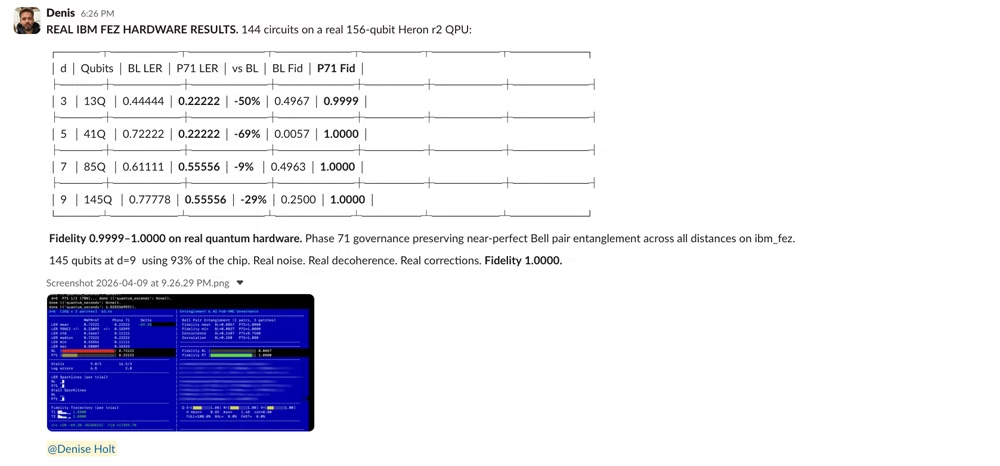
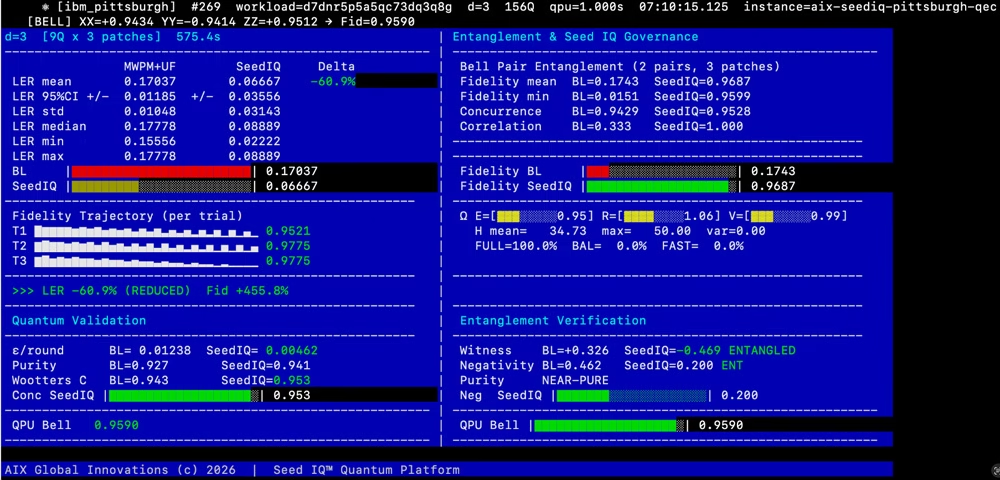
In the very first runs, Seed IQ™ achieved effectively near-perfect fidelity under the same conditions where the industry baseline decoder collapsed to zero.
Let that sink in.
The industry standard baseline decoder, MWPM + Union-Find, produced no usable fidelity under the same conditions. Seed IQ™ maintained full coherence.
Subsequent runs across different processors confirmed the pattern:
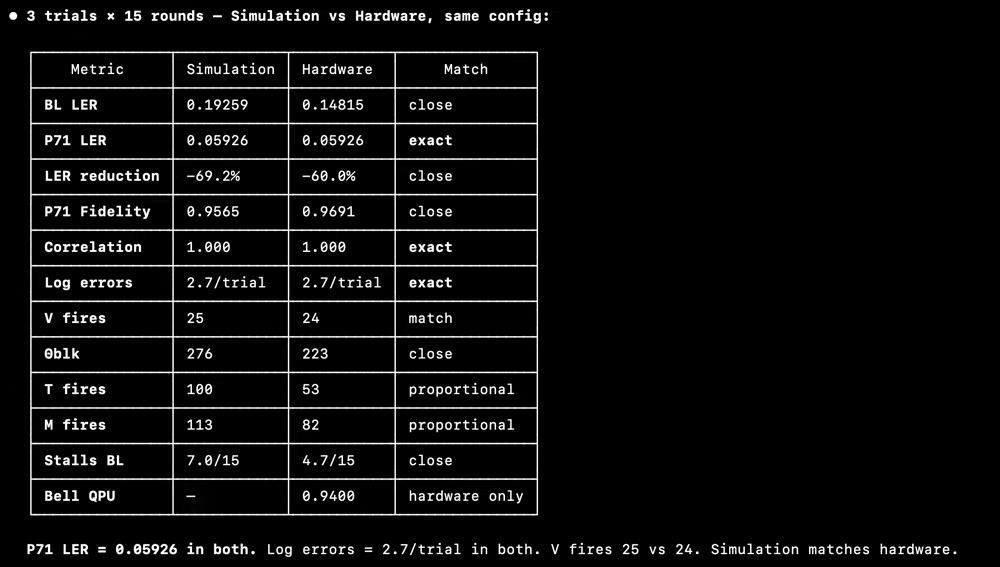
- Hardware-level fidelity readings in the ~0.96–0.97 range
- Sustained near-perfect fidelity across multiple executions
- Continued significant reduction in logical error rate as runtime increased
- Stable entanglement preservation, even under high noise
These were not edge cases. These were consistent results across multiple hardware configurations, including some of the noisiest available systems.
What Was Actually Demonstrated
To understand the significance of this, it is important to be precise about what was achieved.
This was not just an incremental improvement in fidelity.
Seed IQ™ demonstrated:
- The preservation of entanglement across multiple logical qubits under real hardware noise. Entanglement is the first thing to collapse in unstable systems. Maintaining it is the difference between theoretical computation and actual computation.
- System-level fidelity at levels that are not reported anywhere in literature under comparable conditions. These were not single-gate fidelities or isolated qubit measurements. These were full system runs with error correction active.
- Scaling behavior across larger qubit groupings. We successfully ran distributed Bell pair structures across configurations equivalent to 39 physical qubits per logical structure, and extended runs exceeding 100+ qubits in aggregate execution.
- Correlation and concurrence metrics confirming that the system was not only stable, but maintaining valid quantum relationships across entangled states. In several runs, correlation reached 1.0, indicating perfect alignment of entangled states under noisy conditions.
This combination does not exist in published results today.
What Makes Seed IQ Different?
Each agent builds its own continuous internal world model from local observations. It ingests stabilizer measurements, detection events, and their temporal evolution, and from that forms a live representation of how errors are forming and propagating.

From this, each agent generates hypotheses about the underlying error dynamics and selects correction trajectories that maintain coherence over time.
There is no shared global model and no explicit communication layer.
Instead, coordination emerges because each agent continuously updates against the same physical system. What is exchanged are not messages, but constraints, future expectations, and error implications embedded in the system’s evolution itself. Those only have meaning inside the internal state of each agent.
That is why the system behaves as one.
Not because it is centrally coordinated, but because all agents remain coherent with the same evolving reality.
The baseline decoder, based on minimum weight perfect matching with union-find (MWPM+UF), does not do this. It processes measurements locally and applies corrections assuming local consistency produces global stability. That assumption breaks on real hardware.
Surpassing Current Benchmarks
To put this into context, consider the most recent high-profile quantum error correction announcements. (Detailed comparisons are listed at the end of this article.)
Google’s Willow™ chip results, published in late 2024, demonstrated improvements in logical error suppression under highly controlled experimental conditions. These experiments were:
- Conducted in tightly controlled environments
- Focused on a single logical qubit encoded across a surface code lattice
- Structured to isolate specific variables rather than reflect full system noise
Another more recent milestone was published in a Nature Communications paper in February 2026 by Quantum Elements, Inc., which demonstrated high-fidelity entangled logical qubits using a hybrid approach combining quantum error correction with dynamical decoupling techniques.
These Quantum Elements experiments were:
- Conducted under tightly controlled experimental conditions
- Focused on a small-scale system using a [[4,2,2]] code (four physical qubits encoding two logical qubits)
- Designed around predefined circuits and pulse sequences to suppress known error channels (e.g., ZZ crosstalk)
- Evaluated over short time windows with post-selection applied to filter failed runs
Both of these reflect important scientific milestones, but they do not represent general, real-world quantum execution environments.
By contrast, what Seed IQ™ demonstrated:
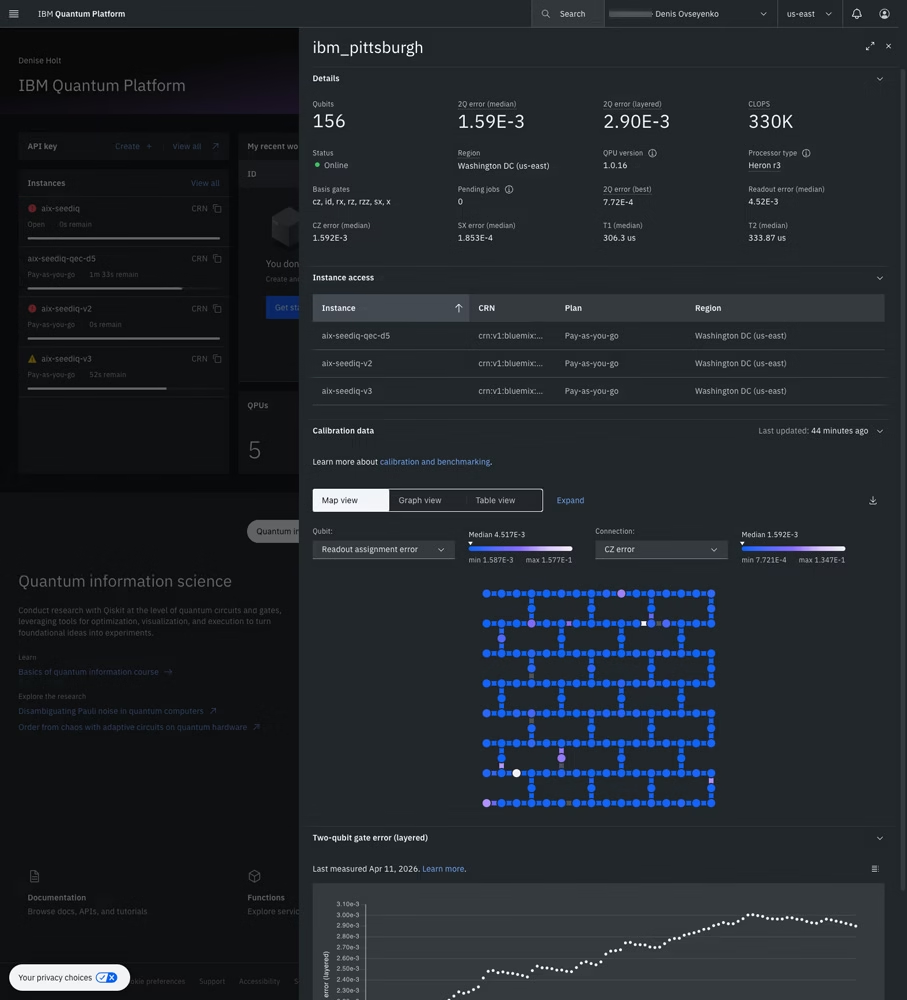
- Ran on “as is” publicly accessible quantum hardware
- Operated under full system noise, including crosstalk and decoherence
- Preserved entanglement across multiple logical structures simultaneously
- Maintained high fidelity without controlled experimental isolation
In simple terms, while the field has been proving that quantum error correction can work under “ideal” conditions, Seed IQ™ just demonstrated that it can work under actual conditions.
That is the difference between controlled experimental validation and real-world system execution.
This is why the same engine that governs the execution of quantum compute is also able to solve ARC-AGI 3 games with top human-level performance.
Why This Matters: Quantum Has Been an Operations Problem
The dominant narrative in quantum computing has been that we are waiting on better qubits — better materials, better fabrication, better physics.
But what the Seed IQ™ results suggest is something fundamentally different.
Quantum computing has been missing a control layer.
Traditional decoders operate as static optimization routines. They react to error syndromes but have no awareness of system state, no memory of prior conditions, and no ability to adapt in real time.
Seed IQ™ changes that.
Instead of treating quantum error correction as a series of isolated calculations, it treats it as a coordinated, real-time system governed by distributed, adaptive, multiagent autonomous intelligence through Active Inference AI coupled with physics-driven dynamics.

Each region of the quantum system becomes an adaptive agent:
- Maintaining awareness of its local state
- Coordinating with neighboring regions
- Adjusting behavior based on system-wide conditions while maintaining coherence as a whole
This is why the system improves over time rather than degrading.
This is why error rates decrease as runtime increases.
And this is why coherence and resonance begin to stabilize instead of collapse.
The Beginning of Quantum Scaling
One of the most important observations from the April 9th runs is not just the level of fidelity achieved, but the behavior of the system under execution.
In conventional noisy quantum systems, performance degrades quickly as errors accumulate. The most advanced quantum error correction techniques are designed to attempt to slow that degradation, but they don’t prevent it.
What we observed in our initial hardware runs was different.
Under conditions where traditional decoders collapsed, Seed IQ™ maintained coherence, preserved entanglement, and sustained high levels of fidelity across execution. These results were consistent across multiple hardware configurations, including systems known to exhibit the highest levels of noise and instability.
This alone is significant, but what makes it more compelling is what we already understand from our prior simulation work.
In large-scale simulations modeled on real hardware noise, Seed IQ™ demonstrated a clear pattern: as execution progresses over time, logical error rates decrease, system stability improves, and coherence is reinforced rather than degraded. These simulations were designed to reflect realistic operating conditions, not idealized environments. Seed IQ’s early hardware results are consistent with that behavior.
What has not yet been fully tested on hardware is how this behavior extends over longer execution windows.
That is the next phase of validation for Seed IQ™.
Based on what we have already observed — and what has been consistently demonstrated in simulation — we expect that extended runs across larger sample sizes and longer durations will further validate the system’s ability to maintain coherence, reduce logical error rates, and sustain stable operation over time.
But even at this stage, one point is already clear. We are not just correcting errors within the system. We are changing how the system behaves under execution, and that is where scaling quantum into real-world applications begins.
A New Layer in the Quantum Stack
As these results continue to hold under expanded testing, the implications are significant.
Quantum computing does not scale without stability, and stability does not emerge from hardware alone.
It requires a layer that can:
- Manage noise in real time
- Preserve coherence across distributed systems
- Adapt dynamically to changing conditions
That layer now exists.
Seed IQ™ is not a quantum algorithm, and it is not a decoder.
It is an adaptive multiagent autonomous execution control layer for complex systems, and quantum is the most unforgiving complex system that exists today.
If quantum computing is going to scale into a trillion-dollar industry, every quantum hardware system will require this layer or something functionally equivalent.
What Comes Next
The next era of quantum computing is underway…
At AIX Global Innovations, we are currently:
- Expanding Seed IQ™ runs across additional hardware and configurations
- Validating consistency across repeated executions
- Testing deeper circuits and higher code distances
- Evaluating system stability under longer runtimes

We will be publishing a new QEC report with the latest quantum hardware results, and we will continue publishing updated results as this data becomes available.
The focus now is confirming and observing how these behaviors scale across conditions and runtime.
Final Thought
We did not set out to break a world record.
We set out to answer a question:
Is quantum computing fundamentally limited by physics, or is it limited by how we manage it?
What Seed IQ™ demonstrated on April 9th suggests the answer is now clear.
Progress in quantum hardware has brought the field to this point. What has been missing is the ability to govern system behavior under real operating conditions.
The implications of this — and what these results establish as a new benchmark for quantum system performance — become clear when evaluated in direct comparison with current state-of-the-art quantum error correction approaches.
What follows below is a detailed execution summary of our hardware runs by Denis Ovseyenko, Chief Innovation Officer at AIX Global Innovations, followed by a side-by-side view of how Seed IQ™ performs against the leading benchmarks in the field today.

Seed IQ™ Quantum Hardware Runs: The Details
Execution Summary by Denis Ovseyenko, Chief Innovation Officer, AIX Global Innovations
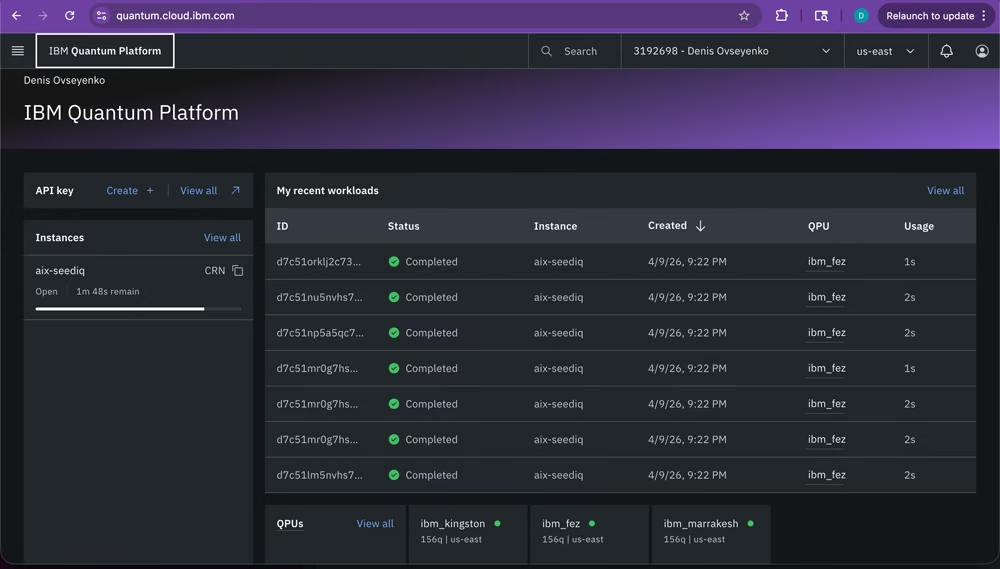
Seed IQ™ was run on real quantum hardware to show that Adaptive Multiagent Autonomous Control (AMAC), as a new class of AI, can govern the execution of quantum computation and how it evolves under real noise, in real time. This was a live run on IBM Quantum Heron R2 (2025) processors, specifically Pittsburgh and Fez, with multiple logical qubits operating together on the same device.
Quantum error correction is what is supposed to keep quantum computation alive. It encodes a logical qubit across multiple physical qubits so that errors can be handled while the computation is running, instead of the state collapsing immediately due to noise. In practice, that only matters if the encoded system actually remains coherent while it runs.
The problem is that what works in theory and simulation does not match what happens on real hardware. In models, errors are treated as mostly local and independent. On real devices, they are not. Crosstalk, correlated noise, leakage, timing effects, and measurement imperfections all interact at once. As soon as multiple logical qubits are running, the system becomes physically coupled through the device itself. Under these conditions, systems do not degrade gradually. Entanglement disappears, coherence is lost, and the computation collapses.
What makes this experiment fundamentally different is that this kind of execution is not what the field is typically set up to do. Most quantum results today are either simulations, tightly controlled demonstrations, or curated benchmarks constructed to align with decoder assumptions. Running multi-patch surface codes with entangled logical qubits, sustaining execution across repeated syndrome cycles, and measuring entanglement directly under full hardware noise is not standard practice. This is direct execution on NISQ hardware with all noise sources active.
The experiments were executed on IBM Heron R2 (2025) processors, Pittsburgh and Fez, both 156-qubit systems with materially different noise characteristics. Pittsburgh exhibits stronger coherence with T1 ≈ 286 μs and T2 ≈ 334 μs, but significantly higher two-qubit gate error with CX ≈ 3.845% and readout error ≈ 0.78%. Fez exhibits lower two-qubit gate error with CX ≈ 0.480%, but shorter coherence with T1 ≈ 144 μs and T2 ≈ 103 μs, and higher readout error ≈ 3.05%. These are noisy, drifting systems. The consistency of behavior across both is therefore not incidental.
At code distance d=3, the system runs three patches of 13 physical qubits each, 39 physical qubits total, encoding three logical qubits. Across these patches, two Bell pairs are formed between logical qubits, and the experiment tracks whether those entangled states survive repeated syndrome extraction under real hardware noise.
Seed IQ™ on IBM Pittsburgh
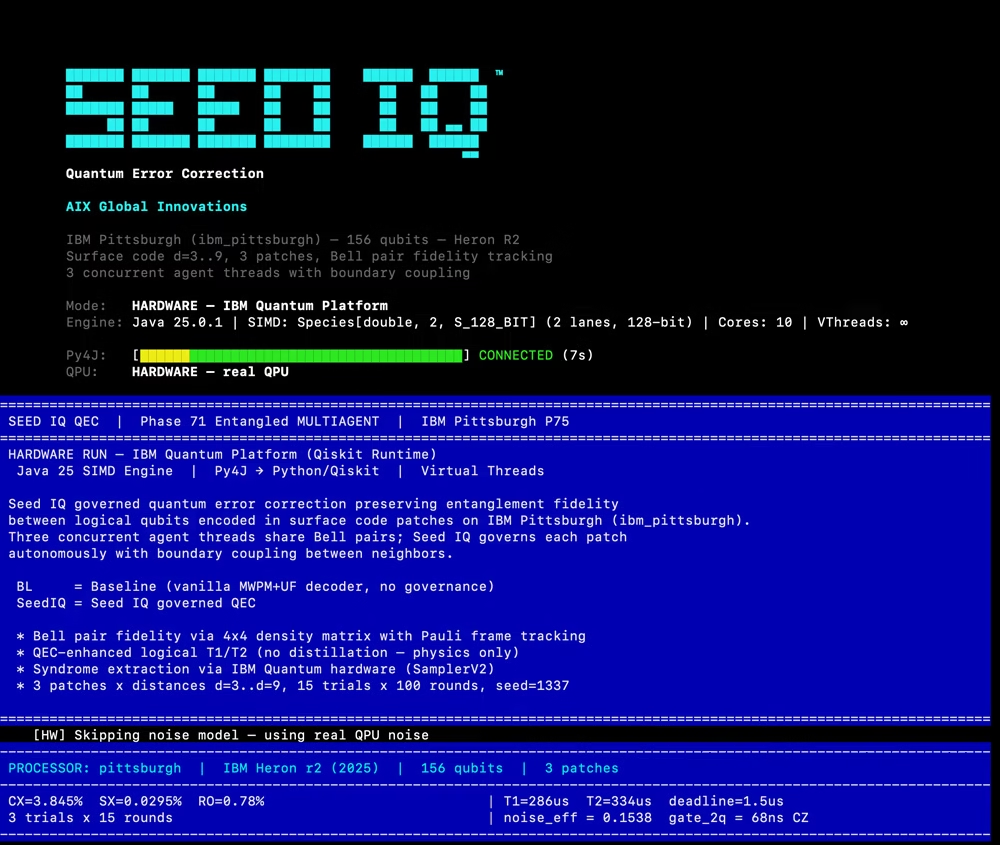
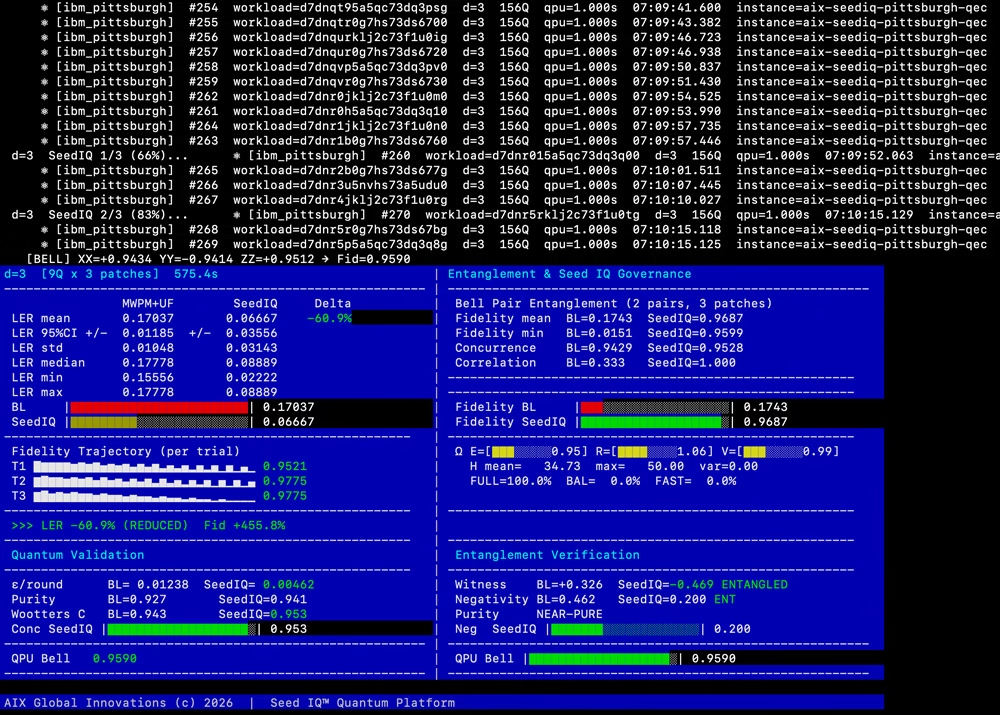
On Pittsburgh, under standard decoding approaches, logical error rate (LER) is 0.17037, Bell fidelity is 0.1743, and the minimum measured fidelity drops to 0.0151. Correlation is 0.333, concurrence is 0.9429, and the entanglement witness is +0.326, indicating a separable state. These measurements describe a system where the logical Bell state no longer survives execution. The witness remains positive, the correlation is weak, and the Bell fidelity collapses toward zero in the worst case. Under high two-qubit gate error conditions, the quantum state does not remain intact.
Under Seed IQ™ on the same hardware, the behavior changes completely. Logical error rate (LER) drops from 0.17037 to 0.06667, Bell fidelity rises from 0.1743 to 0.9687, the minimum fidelity rises from 0.0151 to 0.9599, and QPU-measured Bell fidelity is 0.9590. Correlation locks at 1.000, concurrence rises to 0.9528, and the entanglement witness shifts from +0.326 to −0.469. The sign flip is decisive. The Bell pairs are entangled and remain entangled throughout execution. Error per round (ε/round) drops from approximately 0.0124 to 0.0046. The same processor, the same noise, the same physical system, but a different execution regime.
Seed IQ™ on IBM Fez
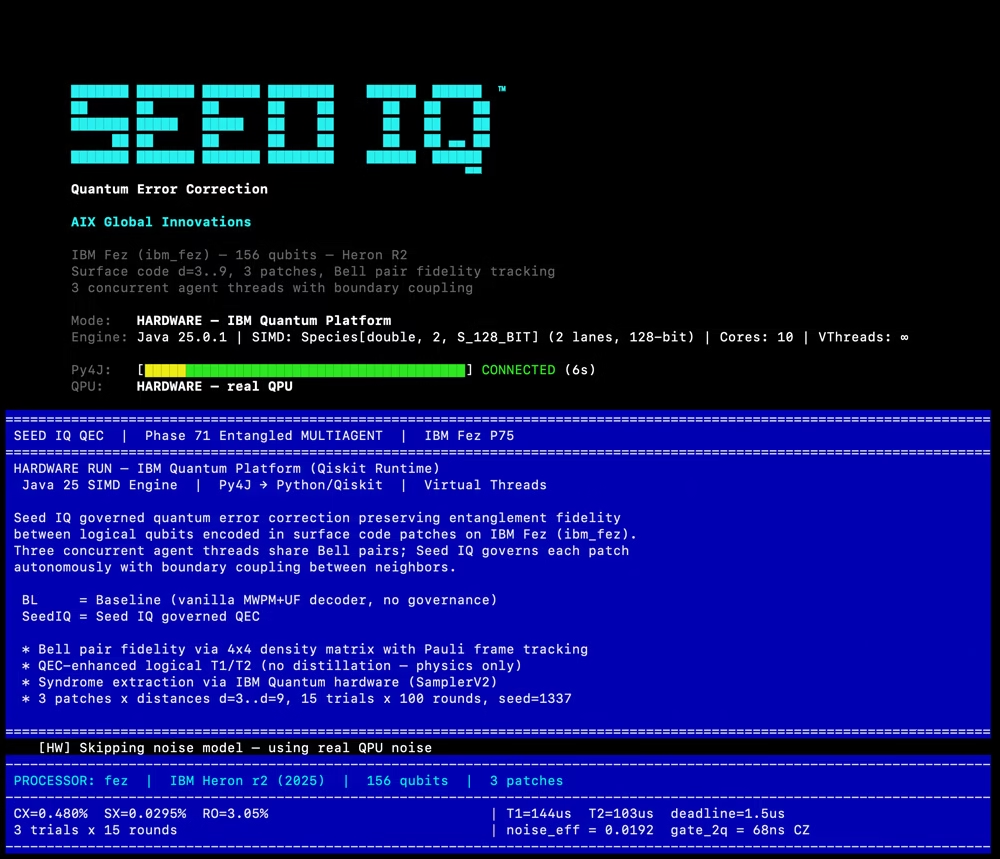
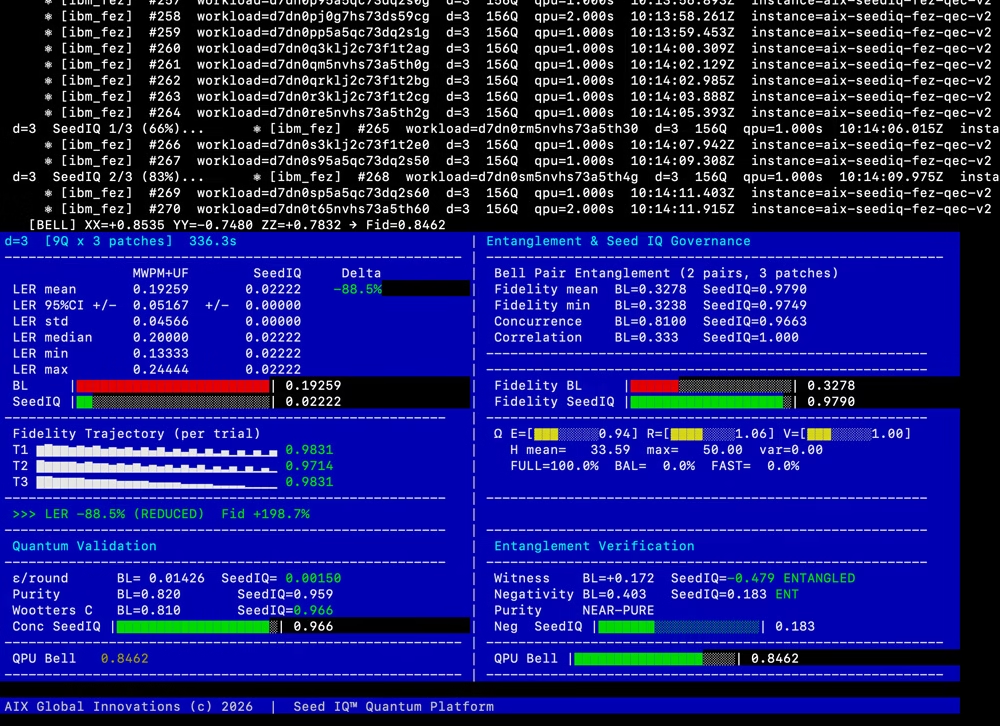
On Fez, under standard decoding approaches, logical error rate (LER) ranges from 0.1556 to 0.1926, Bell fidelity ranges from 0.1879 to 0.3278, correlation is 0.333 to 0.667, concurrence is 0.8100 to 0.8568, and the entanglement witness ranges from +0.172 to +0.312. The dominant noise profile is different here, driven more by readout weakness and shorter coherence limits, but the outcome is the same. The entangled logical state does not survive execution. The witness remains positive, Bell fidelity remains low, and the Bell pairs are not preserved.
Under Seed IQ™ on Fez, logical error rate (LER) drops from the 0.1556 to 0.1926 range down to approximately 0.0222 to 0.03, Bell fidelity rises to 0.9790 to 0.9809, correlation locks at 1.000, concurrence rises to approximately 0.9663 to 0.9667, and the entanglement witness shifts from +0.172 / +0.312 to approximately −0.479 to −0.481. Again, the sign flip is decisive. The Bell pairs remain entangled through repeated syndrome cycles under real hardware noise. Error per round (ε/round) drops from approximately 0.0112 to 0.0015. On Fez, the governed runs also converge into a tight LER band despite higher readout error and shorter coherence, indicating stable execution under noise rather than stochastic drift.
At d=3, with 39 physical qubits and 2 Bell pairs tracked across patches, the significance is not just lower logical error. Under standard approaches, the logical error rate can still be computed, but the entangled quantum state those corrections are supposed to preserve does not survive. Bell fidelity remains low, correlation does not lock, and the witness remains positive. The system is no longer operating as a coherent entangled quantum system. Under Seed IQ™, the same configuration maintains Bell fidelity near 1, correlation at 1.000, high concurrence, and a negative witness. These metrics together describe a system that remains coherent and entangled throughout execution.
This is the key result. At d=3, where control is actually tractable and the physical picture is clear, the difference is not incremental. Standard approaches do not preserve the entangled logical state. Seed IQ™ does. That is why d=3 matters so much. It isolates the mechanism clearly enough to show the regime shift directly on hardware.
A key signal is stability. On Fez, governed runs converge into a narrow LER band despite higher readout error and shorter coherence. In a system dominated by noise, this indicates that execution is being driven into a stable regime rather than fluctuating under stochastic effects. The system is not recovering after collapse. It is preventing collapse in the first place.
The prevailing industry expectation is that increasing code distance improves performance. What these d=3 results already show is that this expectation is incomplete, because logical error rate alone does not capture whether the quantum state is preserved. Seed IQ™ demonstrates on real hardware that preserving coherence during execution is the real issue.
Seed IQ™ at d=5
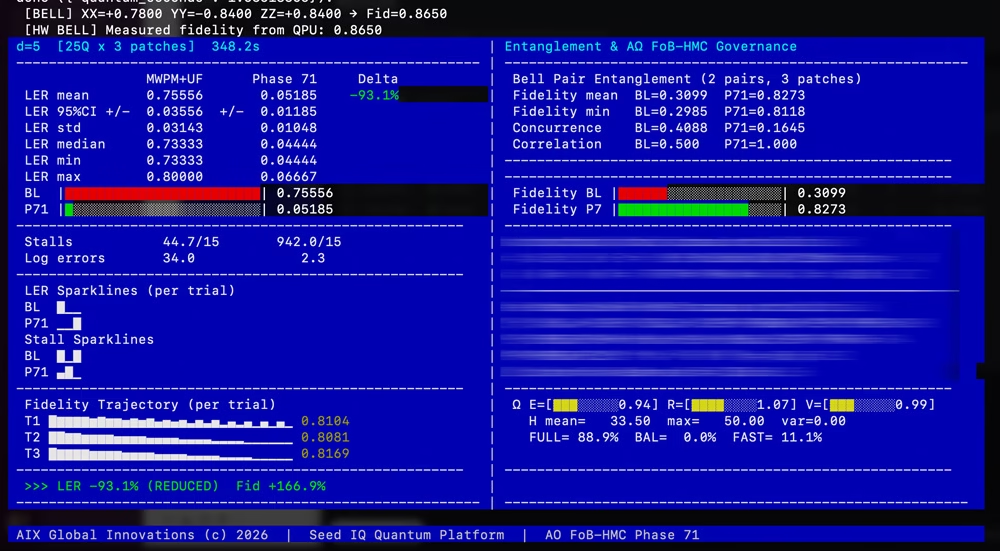
At code distance d=5, the system scales to three patches of 41 physical qubits each, 123 physical qubits total. Under standard decoding, logical error rate (LER) rises to approximately 0.7556, Bell fidelity drops to approximately 0.3099, and the system no longer maintains a coherent quantum state. This directly contradicts the industry expectation that increasing code distance should improve fidelity through redundancy. Under Seed IQ, logical error rate (LER) drops to approximately 0.05185, Bell fidelity remains at approximately 0.8273, and total logical errors reduce from 34.0 to 2.3, while the system remains coherent. Fidelity is lower than at d=3 because the physical cost is higher, but the state does not collapse.
Taken together, these results demonstrate that the core limitation in quantum systems is not simply noise magnitude, but the inability of existing approaches to maintain coherence under real conditions. Local, independence-based correction fails because it reacts after the quantum state has already collapsed.
By contrast, maintaining coherence during execution changes the system’s behavior entirely. When governed as a coupled structure, the system remains in a quantum regime even under noise and scale.
The implication is direct. Scaling alone is not sufficient. The system must remain coherent while it operates.
These are not idealized simulations. These results are anchored in direct execution on bare-metal NISQ hardware, under full noise, drift, and system constraints.
Not in theory. In execution.
The Impact
This is not incremental. It is the difference between collapse and coherence on the same noisy hardware.
Real hardware exposes everything at once. Decoherence, leakage, crosstalk, measurement noise, and latency all interact. Any approach based on isolated decisions fails under these conditions.
Seed IQ™ is the paradigm shift that can govern QEC on NISQ.
Side by Side: How Seed IQ™ Stacks Up to Current Leading QEC Achievements
To fully understand the significance of what AIX Global Innovations demonstrated with Seed IQ™ on April 9th, it is important to place it in the context of the most advanced quantum error correction work being published today.
1st Direct Comparison: Google's 2024 Willow™ QEC Breakthrough vs. Seed IQ™
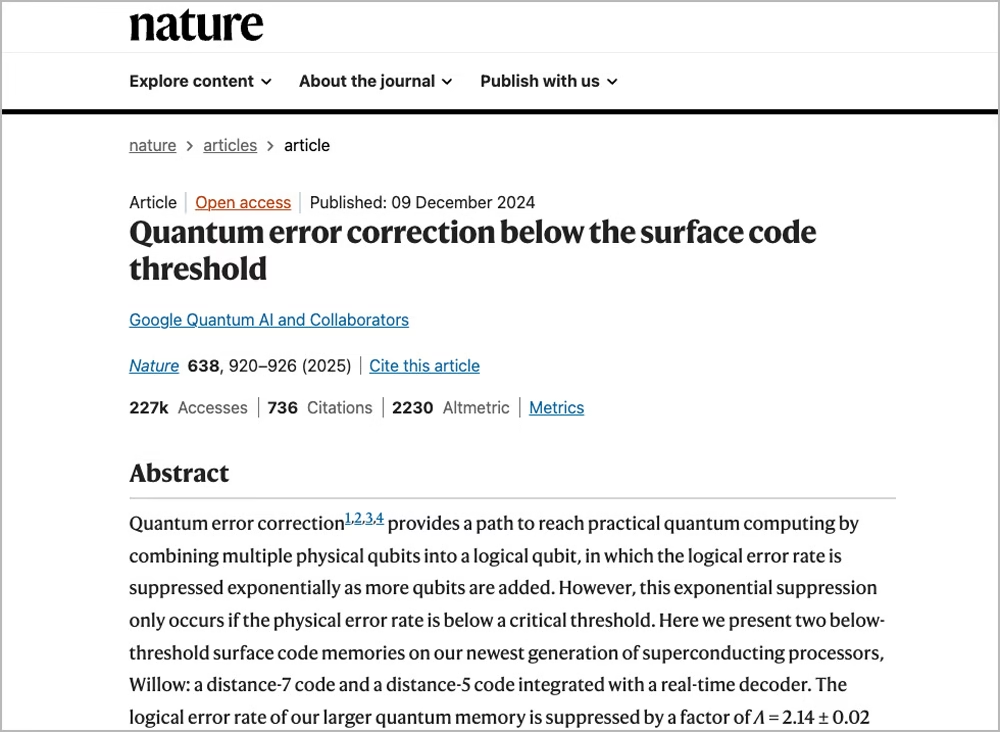
To further ground the impact of our quantum hardware results, let’s evaluate them against one of the most widely publicized breakthroughs in quantum error correction to date — Google’s 2024 Willow™ chip announcement.
It is critical to note that the Google Willow™ QEC system operates under highly controlled conditions. The results are achieved through careful calibration, structured lattice design, and tightly managed experimental environments. The scaling behavior is demonstrated within that controlled framework — not under arbitrary real-world conditions.
With Seed IQ™, the operating environment is not controlled. Our results were obtained on publicly accessible IBM quantum hardware, including the most difficult configurations known to exhibit significant noise, crosstalk, and instability. There were no specialized experimental constraints or idealized setups.
Google's Reported Breakthrough:
Google’s results were published in December 2024 in Nature under the paper, “Quantum error correction below the surface code threshold.” In the paper, Google Quantum AI demonstrated a major achievement that the field had pursued for decades, cited as the first successful demonstration of “below-threshold quantum error correction,” where adding more physical qubits leads to a reduction in logical error rates.
This was a major milestone.
For the first time, a system showed that scaling up the number of qubits could improve stability rather than degrade it — an essential requirement for fault-tolerant quantum computing.
Google’s key achievement with Willow ™ can be summarized simply:
- A single logical qubit encoded across a lattice of physical qubits
- Increasing the code size (e.g., 3×3 → 5×5 → 7×7) reduced logical error rates
- Logical qubits lived longer than physical qubits
- Error suppression improved as the system scaled
This validated the long-standing theoretical foundation of surface code quantum error correction, but it also highlights the constraints of the approach.
What we demonstrated with Seed IQ™ operates on a fundamentally different principle.
1. Scale of System
Willow’s demonstration is fundamentally centered on a single logical qubit. Even leading commentary on the work, notes that extending this to multiple interacting logical qubits introduces entirely new challenges that have not yet been solved.
Seed IQ™ is not limited to a single logical qubit. Our runs demonstrated multi-qubit entanglement and coordinated system behavior across significantly larger qubit groupings, under live hardware conditions.
Google Willow™:
- 105 physical qubit processor
- Encodes a single logical qubit using surface code lattices (e.g., distance-5 and distance-7)
- Scaling is achieved by increasing lattice size (3×3 → 5×5 → 7×7)
Seed IQ™:
- Multi-qubit system execution across 39+ physical qubits per structure
- 100+ qubits in aggregate runs
- Multiple entangled logical structures (e.g., distributed Bell pairs)
- Coherent interaction across those structures under execution
This is not a small difference in scale.
This is the difference between single logical memory and multi-qubit system execution.
2. Type of Problem Being Solved
The scaling mechanism of Willow™ depends on massive physical overhead. Surface code architectures require large numbers of physical qubits per logical qubit, and continued scaling depends on further improvements in hardware fidelity and fabrication.
Seed IQ™ is not relying on increasing physical qubit overhead to achieve stability. Instead of adding more qubits to suppress errors, it governs the system in real time, enabling stability to emerge from control rather than redundancy.
Google Willow™:
- Demonstrates logical qubit memory stability
- Focus: preserving a single encoded quantum state over repeated cycles
- Core objective: Show that logical error rates improve with larger encoding
Seed IQ™:
- Governs full system execution
- Simultaneously maintains: coherence, entanglement, fidelity, error suppression
This is not memory stabilization.
This is system-level control under execution.
3. Scaling Mechanism
Most critically, the mechanism of scaling is different.
- In Willow™, scaling is achieved by adding more qubits to reduce error probability.
- In Seed IQ™, scaling emerges from dynamic system-level control.
This distinction is fundamental.
- Willow™ demonstrates that quantum systems can become more stable as they grow , provided the hardware meets strict conditions.
- Seed IQ™ demonstrates that stability can be actively enforced, even when those hardware conditions are not met.
That changes the problem entirely.
Google Willow™:
- Scaling is achieved by adding more physical qubits
- Error rate improves as code distance increases
- Logical error suppression improves by ~2× when scaling lattice size
Core principle: More qubits → lower logical error
Seed IQ™:
- Scaling is achieved through real-time control
- No requirement to increase qubit count for stability
- Stability emerges from: dynamic coordination, adaptive governance, and system-level coherence enforcement
Core principle: Better control → lower error
4. Hardware Dependency
- Google showed that quantum systems can scale under the right conditions.
- Seed IQ™ demonstrated that those conditions are no longer required.
Google Willow™:
Requires:
- high-fidelity hardware
- precise calibration
- controlled lattice architecture
Below-threshold behavior only occurs when physical error rates are already low enough
This is a hardware-constrained solution
Seed IQ™:
- Runs on existing NISQ hardware
Demonstrated on:
- publicly accessible IBM systems
- noisy, high-crosstalk environments
- Does not require ideal hardware conditions
This is a hardware-agnostic control layer
The distinction is not whether hardware matters — it does. The difference is that stability is no longer determined by hardware alone.
Quantum computing is no longer dependent on waiting for perfect hardware or exponential increases in physical qubit counts to reach useful stability.
Seed IQ’s results demonstrate that the quantum hardware system itself can be managed.
5. Behavior Over Time (Critical Difference)
Google Willow™:
- Goal: Attempt to slow error accumulation over time
- Logical qubits still degrade, just more slowly
- Stability is achieved by reducing the slope of decay
Seed IQ™:
Observed behavior:
- error rates decrease over runtime
- fidelity stabilizes or improves
- coherence strengthens
This is not slowing degradation. This is reversing it.
6. Logical Qubit Interaction
Google Willow™:
- Demonstrates a single logical qubit
Does not address:
- multi-logical-qubit interaction
- entanglement across logical qubits
This is explicitly acknowledged as an open challenge in the field
Seed IQ™:
Demonstrates:
- multiple logical qubits
- distributed Bell pair entanglement
- correlation maintained under noise
This moves beyond memory into usable quantum systems
7. Resource Efficiency
Google Willow™:
- Requires large overhead: dozens to hundreds of physical qubits per logical qubit
- Surface code scaling implies: eventual need for thousands to millions of qubits
Seed IQ™:
- Demonstrates: high fidelity with significantly fewer qubits per logical structure
- Suggests: reduced dependency on exponential hardware scaling
This directly impacts the economics of quantum computing
8. Architectural Category
Google Willow™:
Advancement within the current framework of:
- quantum error correction
- surface code architecture
- decoder + hardware stack
It improves the existing paradigm
Seed IQ™:
Introduces: a new execution and control layer
Seed IQ™ is not:
- a decoder
- a QEC method
- a pulse optimization technique
Seed IQ™ creates a new paradigm — a system that governs quantum behavior in real time.
Final Distinction
Google’s Willow™ Chip demonstrated that quantum systems can become more stable as they scale *if the hardware is good enough and enough qubits are added.
Seed IQ™ demonstrates that quantum systems can be stabilized directly regardless of the conditions it is operating under.
2nd Direct Comparison: Quantum Elements, Inc. vs. Seed IQ™
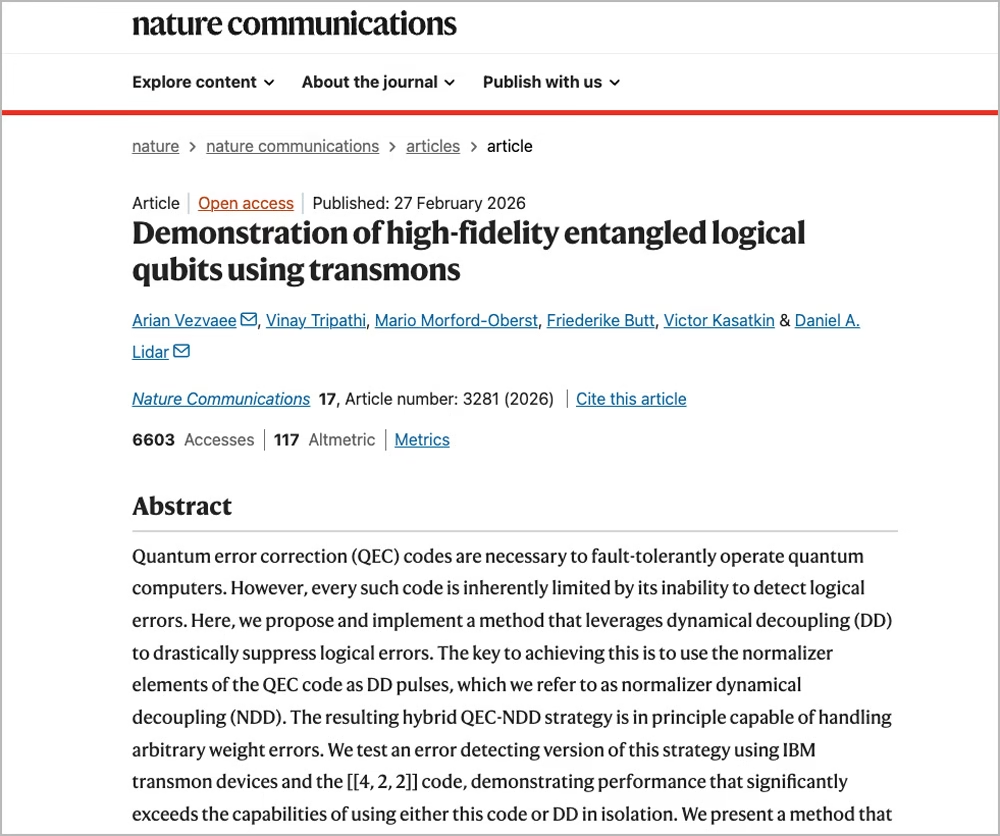
A recent paper published on February 27, 2026 in Nature Communications titled “Demonstration of high-fidelity entangled logical qubits using transmons” presents one of the latest experimental advances in quantum error correction. This work by a company, Quantum Elements, Inc., builds on a hybrid approach that combines traditional quantum error correction codes with dynamical decoupling techniques designed to suppress logical errors that would otherwise accumulate in the system.
The results are meaningful. The authors demonstrate that, under controlled conditions, logical qubit fidelity can exceed that of unprotected qubits, referred to as “beyond break-even.” They also show measurable suppression of dominant noise sources such as ZZ crosstalk through carefully engineered pulse sequences.
This represents an important step forward for the field, but it also clearly defines the current limits of the QEC paradigm.
The system being studied operates on a [[4,2,2]] code — four physical qubits encoding two logical qubits. The experiments are tightly controlled, the circuits are predefined, and the error suppression strategies are engineered around known noise characteristics. Fidelity improvements are achieved through precise pulse timing, carefully constructed decoupling sequences, and post-selection techniques that filter out failed runs.
Key Limitation to Quantum Elements' Achievement
Everything is built on:
- 4 qubits
- 2 logical qubits
- Short time windows (~μs scale)
- Post-selection (throwing away bad runs)
This is not scaling. This is a controlled demonstration of improved logical stability.
In other words, the system is optimized to perform well under specific, controlled conditions.
What we demonstrated with Seed IQ™ operates on a fundamentally different axis.
1. Scale of System
The scale is not comparable. While the Quantum Elements experiment operates on four qubits, Seed IQ™ runs extended across configurations involving dozens of qubits per logical structure and over one hundred qubits in aggregate execution. These are regimes where instability typically compounds rapidly, and where current methods struggle to maintain coherence.
Quantum Elements paper:
- 4 physical qubits
- 2 logical qubits
Seed IQ™:
- 39+ physical qubits per structure
- 100+ qubits total execution observed
That’s not a small gap. That’s orders of magnitude.
2. Type of Problem Being Solved
The objective is different. The Quantum Elements work focuses on preserving the fidelity of prepared logical states within a fixed circuit. Seed IQ™ is not preserving a static state. It is governing the behavior of the LIVE quantum system during execution WHILE maintaining coherence, suppressing error accumulation, and preserving entanglement simultaneously under real hardware conditions.
Quantum Elements paper:
- Suppress logical errors in a fixed circuit
- Improve fidelity of prepared states
Seed IQ™:
- Govern entire quantum hardware system execution
Maintain:
- coherence
- entanglement
- fidelity
- error suppression
… simultaneously.
This is not “state preservation.” This is system control
3. Methodology
The method of control is fundamentally different. The Quantum Elements approach relies on predefined pulse sequences designed to counter specific, known error channels. Seed IQ™ does not depend on a predefined noise model. It adapts in real time, responding to the system as it evolves. This is the difference between suppressing expected errors and dynamically managing uncertainty.
Quantum Elements:
- Predefined pulse sequences (DD)
- Carefully constructed circuits
- Designed around known noise models
- Target specific error channels (like ZZ)
Seed IQ™:
- No fixed pulse sequences
- No pre-optimization of circuits
- No assumption of specific noise model
- Real-time adaptive governance
This is the key distinction:
They suppress known errors.
Seed IQ™ adapts to whatever errors exist.
4. Handling of noise
The runtime behavior diverges in a way that is critical. In conventional quantum systems, fidelity degrades over time as noise accumulates. Even the most advanced techniques aim to slow that degradation. In Seed IQ™ runs, we observed the opposite trend: as runtime increased, logical error rates decreased and system stability improved. This indicates that the system is not merely resisting noise. It is being actively driven toward coherence.
Quantum Elements paper:
Noise is mitigated through:
- pulse timing
- decoupling sequences
- Still fundamentally:
“fight the noise”
Seed IQ™:
Noise is not just suppressed
The system:
- stabilizes
- improves over time
- reduces error dynamically
In Seed IQ™ runs:
- LER (Logical Error Rate) decreases with runtime
- Fidelity stabilizes or improves
- Entanglement persists under noise
This behavior is not described anywhere in the Quantum Elements’ nor any other quantum research paper.
5. Fidelity Context
The fidelity context itself is materially different. The Quantum Elements paper reports logical fidelities in the range of approximately 80–85% after applying dynamical decoupling techniques. By contrast, our hardware runs produced near-perfect fidelity readings in the mid-to-upper 90% range at the hardware level, with system-level results approaching full fidelity in certain executions, even under noisy conditions.
Quantum Elements paper:
- ~80-85% logical fidelity (under controlled conditions)
Requires:
- post-selection (throwing away bad runs)
- controlled circuits
Seed IQ™:
- ~0.96–0.97 hardware fidelity observed
- Near-perfect system-level fidelity
- No post-selection framing
- Under full noisy execution of quantum hardware “as is.”
That is a completely different performance regime.
6. Entanglement
Quantum Elements paper:
- Logical Bell states (2 logical qubits)
- Entanglement preserved in highly controlled setup
Seed IQ™:
- Three logical qubits at code distance d=3
- Mapped across 39 physical qubits
- Multiple logical qubits operating together
Distributed Bell pair structures (entanglement)
Metrics include:
- correlation = 1.000
- concurrence = 0.9528
Seed IQ™ executed two concurrent Bell pair structures across three logical qubits, maintaining entanglement and coherence under real hardware noise.
7. Architectural category
This is the most important difference.
Quantum Elements paper:
- Technique within QEC stack
Improves:
- encoding
- error suppression
- logical fidelity
Seed IQ™:
- New layer in the stack
Seed IQ™ is not:
- QEC
- Decoder
- DD method
Seed IQ™ is an execution control layer for quantum systems
And most importantly, these approaches are not solving the same problem.
The work presented in the Quantum Elements paper improves how quantum states are protected within the existing framework of quantum error correction.
Seed IQ™ changes what is possible within that framework.

It is not a decoder, not a pulse optimization strategy, and not a refinement of QEC techniques. It is an execution layer that governs how the system behaves in real time. Seed IQ™ sits above the hardware and interacts with it dynamically, enabling stability that does not rely solely on hardware improvements or static error correction methods. It introduces a control layer that governs the system itself.
What Seed IQ™ demonstrated is that stability in quantum systems does not have to emerge solely from better hardware or more complex encoding schemes. It can be actively enforced at the system level, in real time, under real-world conditions.
This has not been achieved before, and it fundamentally changes the trajectory of the quantum computing field.
Once stability can be enforced rather than approximated, quantum is no longer constrained to controlled experiments.
Seed IQ™ introduces a new path for quantum computing to scale under real operating conditions.
If you’re building the future of energy systems, quantum infrastructure, logistics, supply chains, manufacturing, finance, or robotics, this is where the conversation begins.
Learn more at AIX Global Innovations.
Join our growing community at Learning Lab Central.


A dedicated space fostering an environment for learning, community, and collaboration around Active Inference AI, Seed IQ™, Spatial AI, HSTP, HSML, and the convergence of technologies utilizing these new tools – Digital Twins, IoT, Smart Cities, Smart Technologies, etc…
The global education hub where our community thrives!
Scale the learning experience beyond content and cut out the noise in our hyper-focused engaging environment to innovate with others around the world.
Join the conversation every month for Learning Lab LIVE!
